Somewhere in most display and architectural programs there is a meeting where someone asks why the case, the barrier, or the panel is not simply glass. It is a fair question — glass is the incumbent, every install trade knows it, and it holds two genuine advantages no acrylic shop should talk around. But the comparison is usually argued at the wrong altitude: as a contest of surface properties, when the real differences show up at the level of the whole project — what the walls have to carry, what happens when something strikes the panel, and what shapes the material can actually be built into. Here is the comparison as we would make it across the table, concessions first.
Where glass genuinely wins
Surface hardness. Glass is a much harder surface than acrylic, and no honest specifier should pretend otherwise. Bare acrylic scratches under abrasion that glass shrugs off — a gritty cloth, a dragged object, a key across a countertop. Hard-coated acrylic grades exist and meaningfully improve abrasion resistance, but they narrow the gap rather than close it; the coated sheet still does not match glass under sustained abrasive contact. For a horizontal surface that the public touches and staff wipe down many times a day — a transaction counter, a tabletop, a working showcase deck — that difference is not cosmetic pedantry. It is the dominant wear mode of the part, and it is a real argument for glass.
Chemical indifference. Glass does not care what you clean it with. Ammonia glass cleaners, solvent wipes, harsh disinfectants — none of them touch it. Acrylic is a thermoplastic, and aggressive solvents can attack the surface, producing hazing or crazing that no amount of subsequent polishing fully undoes. Acrylic has a well-defined care regime, and it is not a difficult one — we cover it below — but glass needs no regime at all, and in a facility where you do not control who cleans what with which bottle, that robustness has value.
Trade familiarity. Every glazier, millworker, and storefront crew in the country has handled glass. Its hardware ecosystem — standoffs, channels, clamps, patch fittings — is mature and universally stocked. Acrylic installs are not exotic, but the muscle memory of the trades runs toward glass, and on a fast-moving site that familiarity reduces friction.
So the short version of the glass case: high-abrasion horizontal surfaces with uncontrolled cleaning, in the hands of crews who know glass — glass earns real consideration there, and we will tell a customer so.
Where acrylic wins, and why the wins compound
Acrylic’s advantages are of a different kind. Glass wins on properties of the surface. Acrylic wins on properties that propagate through the structure, the installation, and the safety analysis — which is why programs that start with a surface-level comparison often reverse their choice once the engineering begins.
Weight, before anything else
Acrylic is substantially lighter than glass at equal thickness. Stated as a material property, that sounds like a minor line item. Stated as a project property, it is often the deciding one, because panel weight cascades through every downstream decision:
- Mounting hardware sizes to the load it carries. Lighter panels mean smaller standoffs, lighter cleats, and simpler brackets — or the same hardware carrying a comfortable margin instead of running near its rating.
- Wall anchoring is where display work meets the building. A heavy glazed assembly can force blocking, backing plates, or structural review of the wall itself; a lighter acrylic assembly frequently hangs on the wall as found.
- Freight classes and handles by weight. Lighter crates move through lighter-rated services, and large-format pieces that would demand mechanical handling in glass can be walked in by hand in acrylic.
- Installer count follows directly. A panel two people can lift, position, and hold against a wall is a different install day — and a different site-safety picture — than one that needs four people or a lift.
None of these is a property of the sheet. All of them are consequences of it, and they arrive together on every panel in the program. For rollouts across many locations, the cascade repeats at each site — which is why weight, not optics, is usually the first thing the fabrication drawings have to resolve on large architectural and multi-site display work.
Impact behavior and how failure happens
Acrylic is far more impact-resistant than glass, and — just as important — it fails differently. Be precise about which glass, because the specifier reading this knows the difference: annealed glass fails into sharp fragments and is rarely what gets specified around the public; tempered glass dices into small granular pieces, but it fails totally — one strike anywhere and the entire panel is gone at once; laminated glass stays in its frame when broken, at the price of still more weight on every square foot of the cascade above. Acrylic takes substantially harder strikes before failing at all, and when it does fail it cracks or breaks into large, comparatively blunt pieces that stay where the part is — a repair, not an evacuation, and never the all-at-once loss of a tempered panel. For guards and barriers in occupied space, for overhead or elevated panels, for anything a crowd stands next to, and for any case whose entire purpose is to protect what sits inside it, failure mode is not a footnote to the spec — it often is the spec.
The one caveat worth carrying forward: where impact is not merely possible but the design condition — machine guarding, deliberate-abuse environments — the comparison stops being acrylic versus glass and becomes acrylic versus polycarbonate. We have written that one honestly too: acrylic vs polycarbonate, and when to specify each.
Optical clarity at thickness
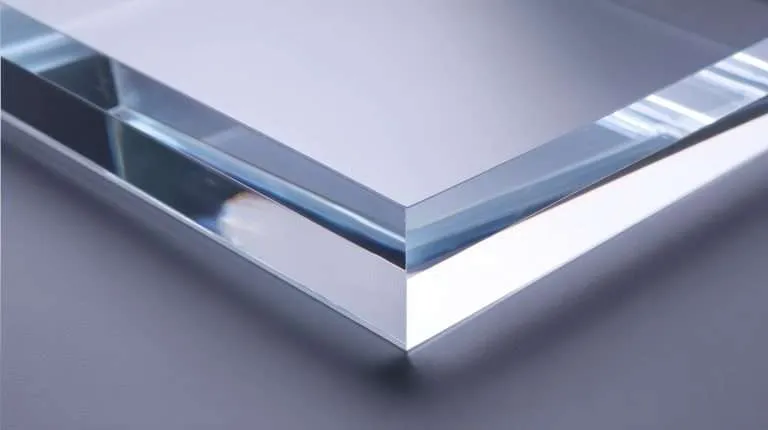
Standard float glass carries iron content that reads as a green tint — faint at window thickness, unmistakable at the edges and increasingly present through the body as the material gets thicker, exactly when display and architectural work needs it thicker. Low-iron glass reduces the cast at additional cost. Clear acrylic simply does not have the problem: what passes through carries essentially no color, at any thickness the work calls for. When the assignment is to present an object or a graphic accurately — true whites, calibrated brand colors, an artifact whose surface tones matter — the material’s job is to disappear, and acrylic disappears more completely than the standard glass it would replace.
Fabricability: forms glass cannot take
This is the least-argued difference and the most decisive one, and it deserves an honest baseline: glass casework can be bonded too — UV-bonded, frameless, low-iron glass vitrines are a real product, and a registrar has stood next to one. What glass cannot do is the rest of the acrylic form vocabulary. It is not thermoformed into compound curves, and it is not carved and polished as a solid transparent mass — a formed dome or wrapped face and a machined solid block detail are parts that simply do not exist in glass. And where both materials can be bonded, the joints differ in kind: a UV-bonded glass seam is an adhesive layer between two panes, visible as a line under close inspection, while a solvent-welded acrylic joint is continuous material — the panels become one part, and the seam can be specified and inspected as optical continuity rather than tidy glue work. Add the edge behavior (glass reads its tint at every polished edge; acrylic’s polished edge reads water-clear), the bonded volume’s weight, and field repairability, and the frameless-transparent-form brief still lands on acrylic — but it lands there on the merits, not because the alternative was pretended away.
The case-work argument, specifically
Nowhere do these differences converge harder than in exhibit and display cases, so it is worth running the comparison on that ground explicitly: a bonded acrylic case against a framed glass vitrine.
The traditional glass vitrine is a frame system — panels held in extrusions or fittings, with joints, gaskets, and sightline interruptions at every corner — and even the frameless bonded-glass alternative carries its adhesive seams, its edge tint, and the full weight of the glass volume down into the deck and the mount. The bonded acrylic case is a single optical volume in a stricter sense: five panels solvent-welded into one continuous form, with the joint itself held to a written spec. Our Acrylic Joint Clarity Standards define what a bonded seam must look like — how clear, how free of bubbles and inclusions — so “seamless” stops being a showroom adjective and becomes an inspectable requirement on the drawing.
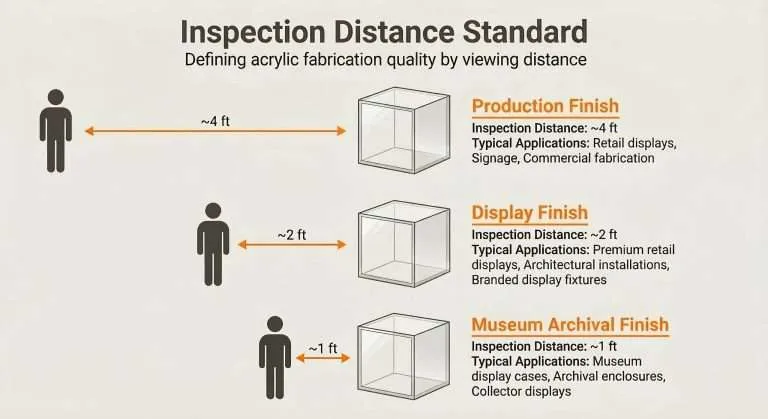
The finished case is then graded under our Acrylic Quality Standards by Inspection Distance — the distance at which the work must show no visible cosmetic defects. Production Finish inspects at approximately 4 feet, Display Finish at approximately 2 feet, and Museum Archival Finish at approximately 1 foot. Case work for registrars and serious retail sits at the top of that scale: a Museum Archival case is built to be examined from approximately one foot away — closer than a visitor leaning in — and show nothing. That is the vocabulary in which a bonded case should be specified, and the standard the glass-versus-acrylic decision should be tested against.
Tally the case-work comparison honestly and it splits the same way as the rest of the article. Sightlines: acrylic, decisively — no frame, no joint hardware, no green edge reading against the artifact. Load on the artifact mount, the deck, and the floor: acrylic, for every reason in the weight cascade above. Seismic and handling safety — the analysis every registrar runs on a case that will be moved, opened, and stood next to by the public: acrylic, on both impact resistance and non-shard failure. Scratch discipline over years of cleaning: glass, and the honest response is not to dispute it but to manage it, which brings us to maintenance.
The maintenance trade, stated plainly
Acrylic asks for a care regime and rewards it. The regime is short: plastic-safe cleaners — mild soap and water, or cleaners formulated for acrylic — never ammonia products or solvent wipes; soft, clean cloths rather than dry abrasive wiping; dust lifted, not ground in. Followed, it keeps display surfaces clear for years. Ignored — one enthusiastic pass with the wrong bottle — it produces the hazing that gives acrylic an undeserved reputation in facilities that never wrote the cleaning spec.
Two honest qualifiers complete the picture. Hard-coated acrylic is available where handling is heavy, and it genuinely narrows the scratch gap — but it narrows it; a specifier who needs glass-hard surfaces under uncontrolled abrasion should weigh glass for that surface. And the trade runs the other way too: a scratched acrylic surface can often be restored by polishing, while a scratched glass surface is generally scratched for good. Neither material is maintenance-proof. One forgives with a procedure; the other forgives by being hard.
Deciding, part by part
The mistake is choosing one material for the program. Choose per part, by what each part has to do. Surfaces whose life is abrasion — horizontal, high-touch, wiped constantly, cleaning uncontrolled — let glass make its case. Everything whose life is structure, safety, sightline, or form — cases, barriers, wall-mounted and overhead work, anything bonded, formed, or polished into a shape a frame system cannot make — acrylic wins on the systems math, and the win compounds with panel size, installation height, site count, and proximity to people.
The way to settle it for a specific program is not another comparison chart; it is a drawing, a mounting condition, and a viewing distance. Send us those — start the conversation here — and we will spec the case in the same measurable terms we publish: named grades, named joint standards, and a build the drawing can hold us to.