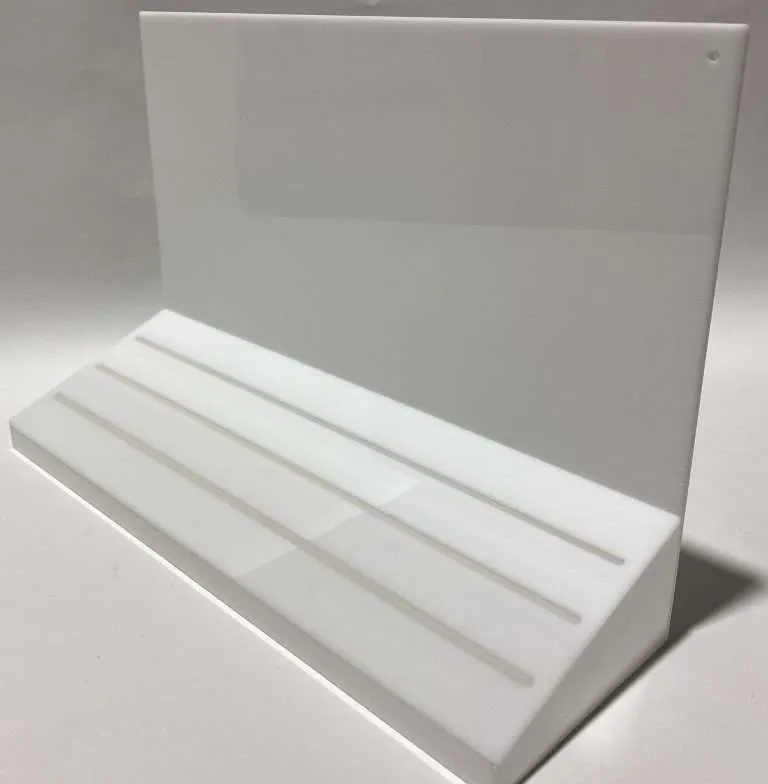
Show season has a rhythm nobody puts in the exhibit plan: the truck comes back from the first show, the crates open, and the booth tells you what the circuit is going to do to it. A cracked literature holder. The counter corner that met a forklift. The demo cover that’s suddenly hazed where ten thousand hands touched it. None of it was in the design review, all of it is now your problem, and the next show’s advance warehouse opens in a handful of weeks.
This is the between-shows playbook — written for the exhibitor mid-circuit, holding a damage list and a show calendar at the same time.
Triage first: repair, polish, or refabricate
Acrylic damage sorts into three bins, and the sort decides everything downstream:
- Surface scratches — shallow marks that catch light but not a fingernail — are often polishable, especially on flat, accessible faces. This is the recoverable bin.
- Crazing — networks of fine fractures, often around fastener holes or where a cleaner attacked the surface — is not polish-out damage. It’s in the material’s structure, it spreads under stress, and a crazed part on a booth that will be built and torn down five more times is a part on borrowed time. The mechanism is in crazing: causes and prevention.
- Cracks and breaks are replacement fabrication, full stop — a cracked structural or load-bearing piece doesn’t go back on the circuit.
The honest rule: polish what’s cosmetic, replace what’s structural, and treat crazing as a scheduled replacement you get to time — which is the whole advantage, if you act while it’s still your choice.
The replacement-part clock runs on the show calendar
Between-show gaps are short and fixed, which makes a must-have replacement time-critical by definition — but “time-critical” has gradations, and the Production Scheduling vocabulary is how to say which one you mean. A nice-to-have part can ride the standard Production Schedule and join whichever show it’s ready for. A part you’d like sooner fits Accelerated Production — the most opportunistic completion date available, no guarantee. But the panel the booth cannot be built without, needed at the advance warehouse by a date printed in the exhibitor manual? That’s a guaranteed-completion-date problem, and Reserved Production is the only tier that is one — dedicated capacity, priced on the quote, and accepted only when the schedule can actually support it, which is itself a reason to make the call the week the crates open rather than the week the manual’s deadline does.
One calendar subtlety that burns people: the date that governs is rarely the show date. It’s the advance-warehouse window — often weeks earlier — plus your freight transit on top of the manufacturing completion date. Work backward from the warehouse date the way the Q1 season prep post lays out, and hand the fabricator the completion date that math produces.
The notes you take now are next cycle’s design brief
Mid-season damage is data, and it’s the best design data an exhibit program ever gets. The shelf everyone leaned on is telling you it needs to be thicker or supported. The literature holder that emptied and cracked at its screw holes is telling you where the stress concentrations live. The demo cover that hazed is nominating itself for a harder-wearing material. Capture it while it’s specific — photos, locations, which show, what the staff saw — and spend it in the post-season lull, when there’s finally room to redesign instead of patch. That’s the discipline behind designing exhibits for repeat shows, applied one season earlier than most programs apply it.
The spare-parts kit nobody buys the first year
Every multi-show program eventually learns the same lesson: the pieces that fail are predictable — the high-touch, high-handling, easily cracked components — and fabricating spares with the original run costs a fraction of fabricating the same parts alone later, because setup is already paid and the material is already on the saw. A kit of the likely casualties, traveling in its own crate, converts a booth emergency into a quick swap on the show floor. It’s the cheapest insurance in the exhibit budget, and almost nobody specifies it on booth one. Specify it on booth one.
The season is a freight-and-repair cycle — plan it as one
Same booth, different city, every few weeks: the damage-inspect-repair loop isn’t an interruption to the season, it is the season. Programs that thrive on the circuit build the replacement decision into the calendar itself — inspection on every return, a standing damage list, and the next fabrication decision made against the full show calendar instead of show by show. (Weight and drayage realities belong in that same planning pass — see exhibit weight and drayage — since every replacement part ships, drays, and returns for the rest of the circuit.) The broader scheduling architecture is in the production planning guide.
If the crates just came back and the list is in your hand, send photos and the next advance-warehouse date — knowing this week whether a part needs Reserved capacity beats finding out during move-in.