
Production
Scheduling
Production Scheduling defines how fabrication and assembly capacity are allocated within the Acrylic Fabrication Standards Framework to deliver projects on predictable timelines.
The Production Scheduling Standard
Most fabrication shops provide vague lead times such as “3–5 weeks” or “approximately one month.”
While these estimates may reflect current workload, they rarely explain how production capacity is actually allocated or how scheduling decisions are made when projects require faster delivery.
The Production Scheduling Standard, part of the Acrylic Fabrication Standards Framework, introduces a structured approach to scheduling fabrication work based on available production capacity.
Instead of relying on ambiguous timelines, projects are assigned to defined service levels that align fabrication resources with project requirements.
This system allows fabrication teams to:
- maintain consistent production flow
- accommodate time-sensitive projects when required
- provide clearer expectations for project timelines
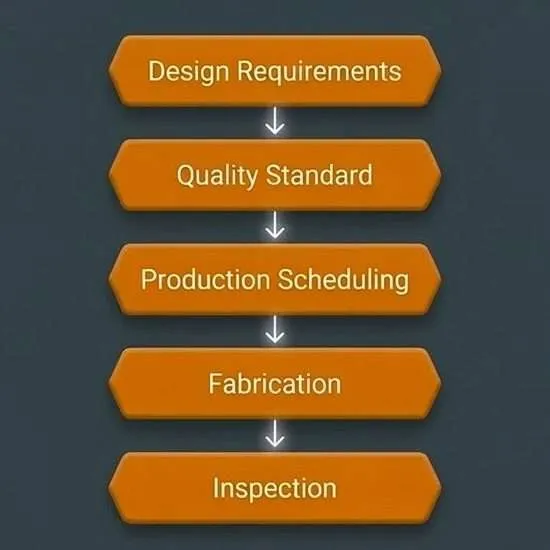
Figure 1 — Acrylic fabrication workflow including quality selection, scheduling, fabrication, and inspection.
Acrylic fabrication projects begin with defined design requirements. Once fabrication quality standards are determined, production scheduling allocates fabrication capacity before the project proceeds to fabrication and final inspection.
Production Service Levels
The Production Scheduling Standard defines three service levels.
Each level corresponds to a different method of allocating fabrication capacity within the production schedule.
Production Schedule
Production Schedule represents the standard production queue.
Projects are scheduled based on available fabrication and assembly capacity and completed in sequence with other scheduled work.
This service level is appropriate for projects that do not require a guaranteed completion date and can align with normal production scheduling.
Typical applications include:
• retail display programs
• architectural components
• fabricated enclosures
• general commercial fabrication
Production Schedule ensures that fabrication resources are used efficiently while maintaining predictable production timelines.
Accelerated Production
Accelerated Production allows a project to move forward in the production schedule when available capacity allows.
Because fabrication workflows vary in complexity, it is sometimes possible to advance smaller or simpler projects without disrupting the broader production schedule.
Accelerated Production brings completion forward while maintaining production stability.
This option is commonly used when:
• a project timeline is flexible but preferred sooner
• available capacity exists within the production schedule
• fabrication complexity allows scheduling flexibility
Accelerated Production brings the scheduled completion date forward; the date is scheduled, not guaranteed — Reserved Production is the service level that guarantees one.
Reserved Production
Reserved Production allocates dedicated fabrication capacity to guarantee a specific manufacturing completion date, counted from payment.
This service level is designed for projects with fixed deadlines such as:
• trade show installations
• retail product launches
• event displays
• architectural installations with scheduled opening dates
To meet a guaranteed completion date, production capacity may be allocated specifically for the project.
Reserved Production ensures that fabrication resources are scheduled to meet the required timeline while maintaining quality standards.
Frequently Asked Questions
Reserved Production guarantees a manufacturing completion date. Is that also the day it ships?
Typically, yes. On most jobs the day the last piece comes off the floor is the day it is packed and handed to the carrier, so you can plan on the completion date as the ship date. The exception is a large project — many pieces, crates built to the piece, a pallet to configure — where packing is its own day or more of work. When that applies we tell you as the date is set, so you know the ship day before you plan around it.
The date is set when the job is paid and the capacity is held, and from there it is a two-way commitment. Most jobs raise a question or two along the way — a dimension to confirm, a proof to approve, a finish call — and on a Reserved job those questions sit between us and the next step. On a time-critical job, answer them right away: a prompt reply is what keeps the date, and an answer that arrives late moves the completion date with it, day for day. We work the same way on our side. If you know you will be hard to reach for a stretch, tell us up front and we plan around it.
Either way, what we guarantee is the day the work is finished in our shop. Transit from there is the carrier’s timing, and we set the schedule so the mode you chose has room to make your date.
Why Structured Production Scheduling Matters
Clear scheduling standards benefit both fabrication teams and project stakeholders.
By defining clear scheduling service levels, the Production Scheduling Standard allows project timelines to be matched to the requirements of each fabrication project.
Structured production scheduling helps:
Production Scheduling defines how fabrication capacity is allocated within the Acrylic Fabrication Standards Framework.
The Production Scheduling Standard establishes three service levels — Production Schedule, Accelerated Production, and Reserved Production — allowing fabrication timelines to align with project requirements.
Production Scheduling
How Production Scheduling Connects to Quality Standards
Production scheduling works in conjunction with the Inspection Distance Quality Standard defined within the Acrylic Fabrication Standards Framework.
Once fabrication quality expectations are determined, production scheduling assigns the project to an appropriate service level.
Together these systems ensure that both fabrication quality and production timelines are aligned with project requirements.
Acrylic fabrication Standards Framework
The Acrylic Fabrication Standards Framework was developed by Akrylix to provide a structured system for defining fabrication quality, production scheduling, and cosmetic expectations using measurable criteria.