Buying a custom part once is a project. Buying it every quarter for three years is a relationship — and the evaluation criteria are completely different. A shop can make one beautiful part through sheer attention; the 50th part matches the first when structure does the remembering. That structure is what a procurement lead or operations buyer is really evaluating in a recurring supplier: whether repeatability is built into tooling, documentation, and standards, or whether it depends on the same people remembering the same things indefinitely.
This guide walks the recurring-production lifecycle the way it actually runs — qualification, first article, documentation lock, repeat releases, change control — and shows where the Acrylic Fabrication Standards Framework turns each stage from a conversation into a specification.
The lifecycle: qualification to repeat releases
Recurring production follows a sequence, and the sequence exists because each stage retires a specific risk before volume money is spent.
Qualification
The evaluation stage: can this shop make this part, at this quality, at this volume rhythm? Qualification is drawings review, DFM feedback, capability questions, and usually sample or pilot work. This is also where a buyer should ask the structural questions — what gets documented, what tooling will exist, how revisions are controlled — because the answers predict year two far better than the pilot parts do.
First-article approval
The first article is the contract made physical: a part (or small set) produced by the intended production process — not a hand-built stand-in — and inspected against the drawing’s dimensions, tolerances, and finish grades. Approving it does two things at once. It confirms the process produces the part, and it freezes the reference that every future release is measured against. A first article approved casually is a dispute deferred; a first article inspected hard is the cheapest quality control the program will ever buy.
Documentation lock
On approval, the package locks: revision-controlled drawings, the CNC programs, forming tooling, assembly fixtures, print art and proofs, finish grades per surface, and edge methods per edge per the Edge Finishing Standards. The locked package is the program’s real asset. It means the part is defined by documents and tooling rather than by anyone’s memory — which is exactly what lets releases repeat across months, staff changes, and gaps between orders.
Repeat releases
From then on, each release runs against the locked package: same programs, same fixtures, same acceptance criteria. The buyer’s side of the rhythm is forecasting and release timing; the shop’s side is capacity planning against the committed schedule. The part itself should be the boring part — that is the whole point.
Repeatability is structural, not aspirational
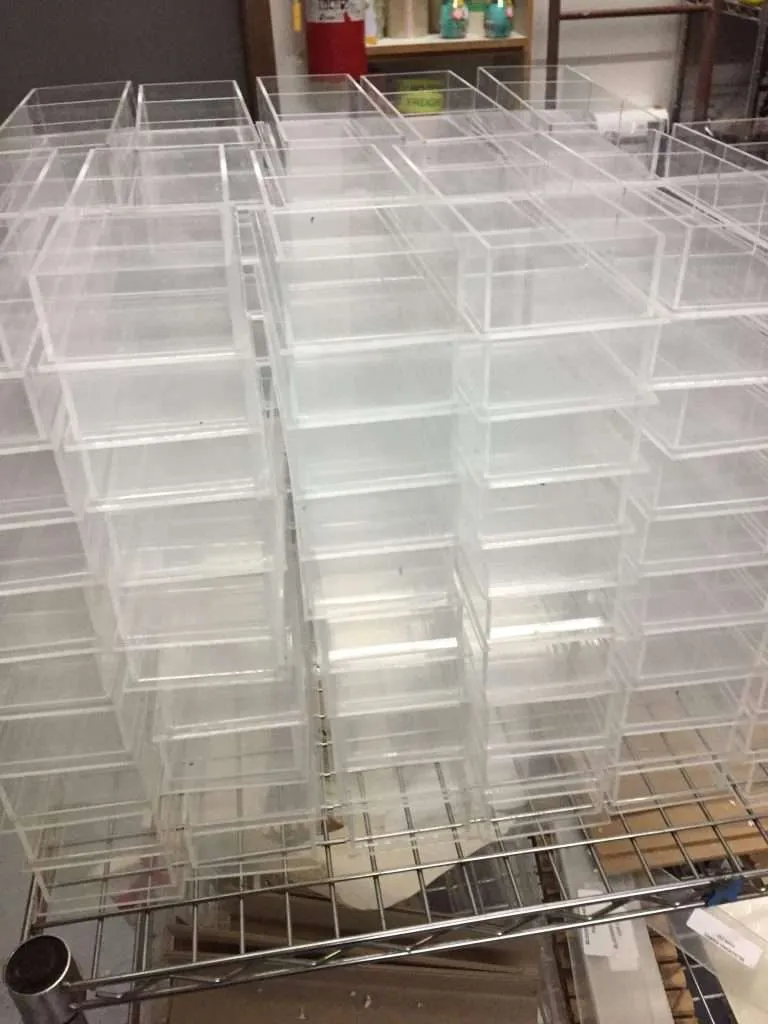
The reason tooling and documentation deserve so much attention is that they are what repeatability physically is. Retained CNC programs mean the geometry is cut from the same code every release. Forming tooling means a thermoformed part takes its shape from the same mold every time — shape locked to the tooling. Assembly fixtures mean bonded parts locate the same way in run 12 as in run 1. The 50th part matches the first because the process that made both is the same process, held to the same per-process ranges published in our Fabrication Tolerances standard.
This is also the honest way to read a supplier’s claims. “We take pride in consistency” is a sentiment. “Your program’s tooling, programs, and fixtures are retained and your parts are held to published per-process tolerance ranges” is a mechanism. Buy mechanisms.
Acceptance criteria up front — so incoming inspection is objective
The most common failure in recurring programs isn’t dimensional — it’s cosmetic, and it happens because cosmetic expectations were never made measurable. One release, a receiving inspector holds a part to the light at arm’s length and rejects what every earlier inspector passed. Nobody changed the part; someone changed the inspection.
The fix is to specify quality the way the Acrylic Quality Standards define it: a finish grade per surface, each grade anchored to a defined Inspection Distance — Production Finish, Display Finish, or Museum Archival Finish. Written into the locked package, that turns incoming inspection from a debate into a measurement: this surface is inspected from this distance, and characteristics invisible at that distance are conforming. Both sides can apply the same test and get the same answer, which is the entire job of an acceptance criterion.
It also lets a program spend quality where it earns something. A customer-facing face at Display Finish and concealed internal parts at Production Finish is a rational program spec; the grade-per-surface vocabulary is what makes it expressible on a drawing at all.
Scheduling recurring releases
Releases ride the same Production Scheduling tiers as any other work, and the tier choice per release is a genuine program tool rather than a formality. Flexible restocks — inventory buffer in place, arrival week matters more than arrival day — belong on the standard Production Schedule tier, scheduled by available capacity and completed in sequence. It is the default, and most releases in a healthy program should qualify.
Some releases don’t: the launch quantity tied to a set date, the seasonal build that must land before a reset, the release feeding a customer commitment. Those go on Reserved Production, which allocates dedicated capacity and guarantees the ship date — the only tier that does. A useful program habit is deciding the tier at forecast time, not release time: the releases that will need reservations are usually visible a quarter out, and reserving at forecast time secures the guarantee before capacity tightens.
Change control: how revisions enter without contaminating releases
Programs live long enough that the part will change — a dimension tuned, a logo updated, a material spec revised. The discipline that keeps change from becoming chaos is small and rigid:
- Rev discipline. Every change is a revision: the drawing moves to a new rev letter; there is no such thing as a verbal tweak to a locked package. If it isn’t in the rev, it doesn’t exist.
- New first article. The change is proven by the production process and inspected against the revised drawing before volume runs — a scaled-down repeat of the original gate, sized to the change.
- Release boundary. In-flight releases finish on their released rev. A revision entering mid-program does not reach into work already released; it takes effect at a named release. That boundary is what prevents the worst program outcome — a shipment containing both versions of a part, distinguishable only by measuring them.
Change control feels bureaucratic exactly once: the first time a “tiny change” quietly breaks a mating part or an install kit, and the rev trail answers in minutes what would otherwise be an archaeology project.
Color and print consistency across reorders
Printed programs add one more repeatability axis: the brand color on release 8 has to match release 1. The mechanism is the same in kind — lock a reference, not a memory. Print work runs as color-managed CMYK matched to the customer’s brand references and approved against a proof; release after release, the approved proofs and print art are retained as the standing reference, so the work is matched to the same brand references rather than re-interpreting the brand each time — so a fixture built two years after the first can sit next to it on the same counter without a visible seam in the program.
What to take into your next supplier conversation
Evaluate a recurring supplier on structure, and ask for evidence of each mechanism: What exists in your documentation package after first-article approval? What tooling and programs are retained for my part? What are your published tolerance ranges per process? How is my acceptance criteria written — can your final inspection and my receiving inspection apply the same measurable test? How does a revision enter, and what happens to in-flight releases? What tier does each release run on, and which of my dates justify a reservation?
A shop with real answers will enjoy the questions — structure is easier to demonstrate than to improvise. Ours are on the table: the standards linked throughout this guide are published precisely so a program can be specified against them, and if you have a part that needs to repeat, send the drawing and we’ll walk the qualification questions against it — including the honest ones about where your spec should be looser than you think.