Every deadline conversation in custom fabrication eventually reduces to one question: is that date a hope or a guarantee? Most of the frustration between buyers and fabricators comes from neither side saying which one they mean. A purchase order that says “need by October 15” and a shop that says “we should be able to do that” have not made an agreement — they have exchanged optimism.
This guide is the long answer to the deadline question. It covers what actually consumes calendar time in acrylic fabrication, how to plan backward from the date that matters, and how the Production Scheduling tiers — part of the Acrylic Fabrication Standards Framework — replace optimism with a specifiable commitment. It is written for the people who own dates professionally: engineers planning a product launch, procurement teams managing a rollout, program managers with a show opening or a retail set date that will not move.
The three scheduling tiers, defined accurately
The Production Scheduling standard defines three service levels. The definitions matter, because two of the three are frequently misunderstood as promises they never make.
Production Schedule
The standard tier. Work is scheduled by available fabrication and assembly capacity and completed in sequence with other scheduled work. A Production Schedule project gets a realistic estimate — but the estimate is a forecast of the queue at quote time, not a commitment against it. There is no guaranteed ship date.
Accelerated Production
Accelerated Production moves a project forward in the schedule when available capacity allows. It is the right mechanism for time-critical work that has some float: the project jumps ahead of Production Schedule work wherever the calendar permits. What it does not do is create capacity that isn’t there. Accelerated Production is also not a guaranteed ship date — it is a priority, not a reservation.
Reserved Production
Reserved Production allocates dedicated fabrication capacity to guarantee a specific ship date. That reservation is what makes the commitment categorical — and it is the only tier that makes one. That exclusivity is the point. A guarantee that everything gets is not a guarantee; a reservation is only meaningful because most work doesn’t hold one.
Read as a system rather than a menu, the three tiers are a way of matching the cost of certainty to the value of the date. Flexible work rides the queue economically. Time-critical work buys priority. Immovable dates buy a reservation. The mistake is paying for certainty a flexible restock doesn’t need — or hoping a priority will behave like a reservation on the one project where the date is the whole job.
What actually drives lead time
Lead time in custom fabrication is not one number — it is the sum of five mostly-independent clocks. Knowing which clock dominates your project tells you where the calendar can be compressed and where it can’t.
1. The capacity queue
The largest and least visible driver. A fabrication shop’s calendar is a queue of committed work, and a new project enters behind it — that is what the Production Schedule tier’s “completed in sequence” means. The queue’s depth changes seasonally (more on that below), which is why the same part can quote different lead times in March and September without anything about the part changing.
2. Material availability
Standard acrylic thicknesses in common colors are stock-and-go. Step outside that envelope and sourcing time enters the calendar: custom sheet sizes are available when a project requires them but add procurement lead, and specialty colors and unusual thicknesses may ship from a distributor or the sheet manufacturer rather than the rack. On a project with any unusual material, the material clock can start before the fabrication clock — one reason early material selection shortens projects more than it seems it should.
3. Finish grade
Fabrication quality is specified by Inspection Distance under the Acrylic Quality Standards — Production, Display, or Museum Archival finish. The grade is also a schedule input: Museum Archival finishing carries more fabrication and inspection time per part than Production finish, because the acceptance criteria are tighter and the finishing labor is real. Specifying the grade each surface actually needs — rather than the highest grade everywhere — is schedule engineering as much as cost engineering.
4. Assembly complexity
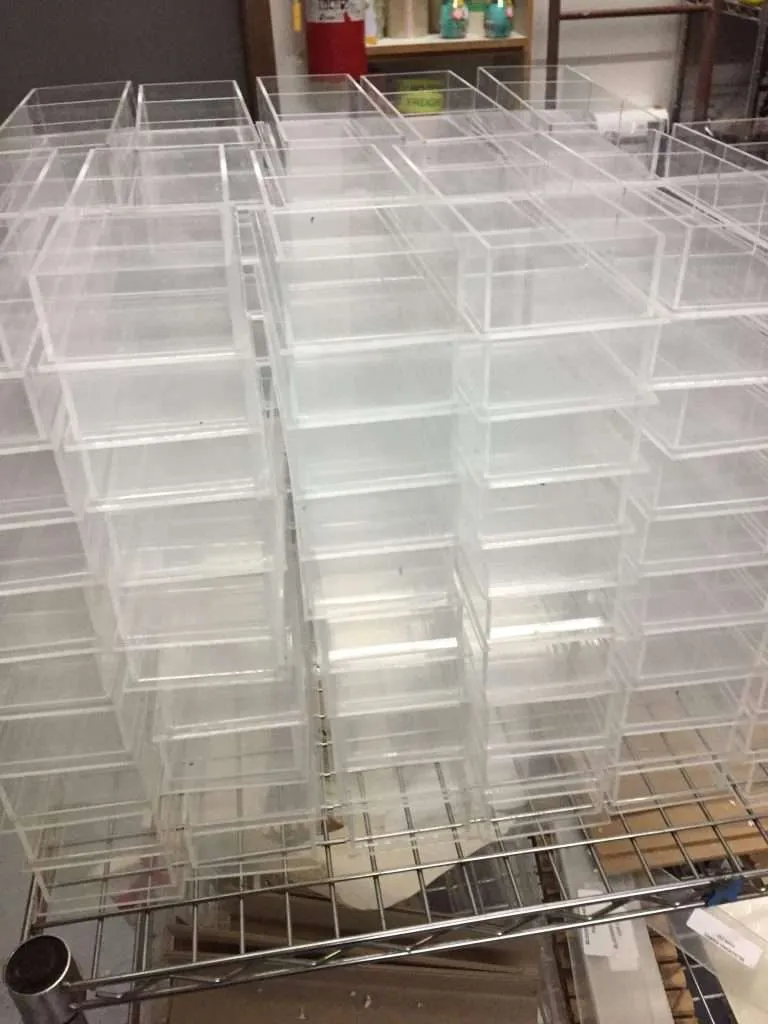
A flat cut part is one operation. A bonded five-sided case is cutting, machining, bonding in fixtures, cure time, and finishing — sequential operations where each waits on the last. Cure and annealing steps in particular are clock time no amount of priority compresses: the chemistry takes what it takes. Complex assemblies also concentrate risk late in the build, which is why experienced planners hold margin behind them.
5. Print and proof cycles
On printed work, the proof loop is a shared clock — the shop produces the proof, but the customer approves it, and production art waits on that approval. A proof approved same-day and a proof that sits in an inbox for a week produce a one-week difference in ship date with identical fabrication effort. Of all the clocks, this is the one the customer controls outright.
Planning backward from the date that matters
The date that matters is almost never the ship date — it is the in-store date, the show opening, the install window, the launch. Backward planning walks from that date to the order date, and the arithmetic is simple enough to do in a meeting:
- Start: the immovable date. The retail set date, the show’s move-in day, the site’s install window.
- Subtract install/setup time. The days between delivery and the thing being done — staging, assembly on site, punch-list slack.
- Subtract freight transit. Dock to dock, at the season’s realistic transit, not the best case. Add margin in Q4, when the freight network runs at its annual worst.
- Subtract crating and packaging time. Finished parts don’t leave the same hour they’re finished; protective packaging for acrylic is its own operation.
- Subtract the production span. The fabrication time quoted for your scope at your finish grade.
- Subtract the proof cycle. On printed or first-article work: proof production plus your own approval turnaround, honestly estimated.
- Land on the order date. What’s left is when the purchase order and complete files must be in the shop’s hands.
Run this template and two things usually surprise first-time planners. The first is how much of the calendar isn’t fabrication — freight, crating, proofs, and install routinely consume as much time as the build. The second is how early the order date lands. If the arithmetic says the order date was last week, that is precisely the situation the scheduling tiers exist for: Accelerated Production compresses what the queue allows, and Reserved Production makes whatever the remaining window can hold a commitment instead of a gamble.
Which tier is the right call
Production Schedule fits work where the arrival week matters more than the arrival day: replenishment runs, internal fixtures, program restocks with inventory buffer, anything a reasonable estimate serves. This should be most work — it is the economical default, and treating it as the default preserves the budget for the dates that are genuinely hard.
Accelerated Production fits time-critical projects that still have float: the launch that wants to be early, the replacement part for a display that’s limping but standing, the project that missed its own planning window but has a few weeks of forgiveness in it. Priority moves it forward wherever capacity allows — a real, usually decisive advantage that still stops short of a promise.
Reserved Production fits the date that cannot move: a show opening, a retail set date agreed with a retailer, a contractual install window, a product launch with media booked. The test is simple — ask what happens if the date slips a week. If the answer is “we lose the slot” rather than “it’s annoying,” the project belongs on Reserved Production, and the earlier the reservation is made, the more schedule there is to reserve.
The seasonal demand curve
Fabrication capacity tightens on a predictable annual rhythm, because the industries that buy displays share calendars. Holiday retail programs load the queue from late summer — displays on the floor by Black Friday are in production well before October. Trade-show season loads it again in late fall, as exhibitors with Q1 shows all order in the same November–December window. Spring retail resets put a third, smaller wave behind that.
The practical consequence: the same project is easier to schedule in the valleys than on the peaks, and a date inside a peak season is exactly where the tier decision carries the most weight. A Production Schedule estimate given in August for October ship is a forecast of the year’s deepest queue. We track these order windows season by season here on the site; the durable rule is that if your date sits inside a peak, plan one season back.
What the customer controls
A fair amount of the calendar, as it turns out. The shop controls the queue and the fabrication span; the customer controls most of what happens before and between.
Complete, quotable files. A dimensioned drawing with material, thickness, finish grade, and edge methods called out can quote in days; a concept that needs three clarification rounds spends weeks in questions. The clarification loop is pure calendar loss — nothing is being fabricated while questions travel back and forth.
Fast proof approvals. The proof loop is the customer’s clock. Naming an approver in advance — one person, empowered to say yes — routinely saves a week against a proof that tours a distribution list.
Early tier selection. Deciding at order time that a date is immovable, and reserving for it, buys certainty at its cheapest. The same decision made three weeks into production buys much less, because the schedule it’s trying to reserve has already been spent.
Honest quantities and honest dates. A padded deadline invites the shop to plan against a fiction, and a “rough quantity” that doubles at order time re-opens process decisions. The planning is only as good as its inputs.
These four habits shorten calendars more reliably than anything a shop can do after the order lands — later in the project, everyone is spending schedule; this is where schedule gets made.
The one-sentence version
Plan backward from the date that matters, know which of the five clocks dominates your project, and match the tier to the truth about your date — because in the end only Reserved Production guarantees a ship date, and the right time to know whether you need that guarantee is the day you order, not the week you’re supposed to ship. If you’re holding a date now and want to know what fits inside it, send us the date and the drawings — the backward plan is the first thing we’ll build.