The most expensive object in a custom fabrication program is usually not a part. It is a word that two people used sincerely and understood differently. Nearly every acrylic order still gets written in those words, and nearly every disagreement about an acrylic order is a disagreement about what one of them meant.
A specification you cannot measure is not a specification
Look at how custom acrylic is actually sold. The surface is “premium quality”, “museum quality”, or a “flawless finish” — none of which names a criterion. The edges are “polished”, which is a family of methods, not a method. The joints are “seamless”, which describes an intention. The schedule is “expedited”, which is a direction of travel with no date attached.
None of this is dishonest. A fabricator writing those words usually means them, and often delivers something the buyer is happy with. The problem is structural: every one of those terms describes an impression, and an impression is produced by a viewer, at a distance, under a light, holding an expectation. Change any of those four and the same physical part becomes acceptable or unacceptable without anyone touching it. There is no instrument you can point at a part to settle the question, because the question was never asked in units.
The dispute that unmeasurable language guarantees
Picture an order for bonded acrylic enclosures written with those words: flawless edges, invisible joints, expedited delivery. The parts arrive. The person receiving them picks one up, turns it close under an overhead light, sees faint lines along one edge and a bond line that catches the light, and rejects the lot. The shop that built it had checked the same enclosure on the bench, under shop light, from a normal working distance, and passed it. Both people looked carefully. Both are describing the same object accurately. Nothing in the order says which of them was looking the way the order intended, so nothing in the order can settle it.
What happens next is not a technical process. It is a negotiation about adjectives, settled by whoever has more leverage, more patience, or a stronger need for the parts. The lot may ship, or get remade, or get discounted. Whatever the outcome, both sides paid for it in weeks. And the schedule failure in that order never even gets argued: “expedited” was not a date, so no one can say whether it was met.
The replacement, one leg at a time
The fix is not better adjectives. It is replacing each adjective with something both sides of an order read the same way. That is what the Acrylic Fabrication Standards Framework does, and each leg governs exactly one thing.
Surface, graded by Inspection Distance
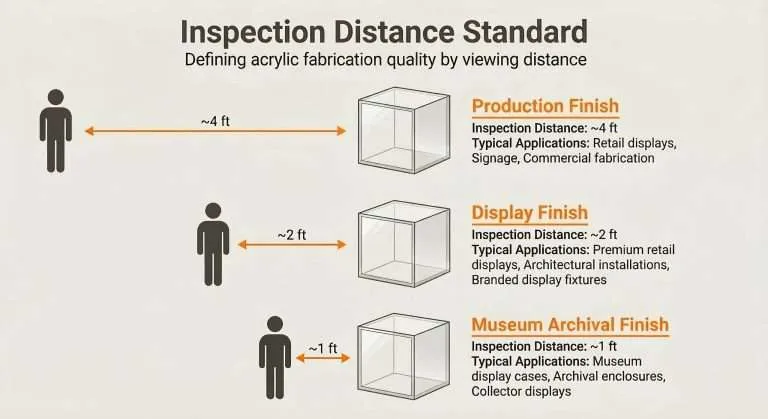
Cosmetic acceptability on acrylic genuinely depends on how close a viewer gets. A panel behind a rail and a piece handed to someone are different problems, and a standard that ignores the difference makes buyers overpay for finish nobody will ever see, or under-buy for a piece that ends up under a spotlight. So the Acrylic Quality Standards grade the surface by the distance it is inspected from: Production Finish is judged at approximately 4 feet, Display Finish at approximately 2 feet, Museum Archival Finish at approximately 1 foot. A distance is a thing a tape measure settles. “Flawless” is not. In the hypothetical above, those numbers are the entire dispute: the buyer inspected at one distance, the shop at another, and a grade with a published distance would have named the test before the parts were made.
Dimensions, held to tolerances defined per process
“Precision” is a compliment, not a band. The Acrylic Fabrication Tolerances publish defined ranges, and publish them separately for sawing, CNC routing, laser cutting, thermoforming, and assembly, because those processes do not hold the same band and never have. A CNC-routed component and a saw-cut panel are published at different ranges; a thermoformed contour is published as a proportion of the formed dimension, because material stretch and thermal shrinkage scale with the part; a multi-part assembly carries its own band, because it stacks the variation of everything inside it. A single headline tolerance covering all of that would read well in a quote and fail at the fit-up. Publishing per process states the difference out loud — including where the honest band is looser than a buyer might have assumed, which is exactly the place a vague quote would have stayed quiet.
Edges, named by method
“Polished” is not an instruction, because there is more than one way to polish an acrylic edge and they do not look alike or cost alike. The Acrylic Edge Finishing Standards define six classifications — raw/saw-cut, sanded, laser-cut, flame-polished, buff-polished, and diamond-polished — so an edge is ordered by its method rather than by an adjective. That also lets a single part carry different edges on purpose: a bonding face wants a sanded surface so the joint seats; a hidden structural edge does not need to be paid for; the display-facing edge is the one that earns a polished method. Naming the method is what makes that mix specifiable, and repeatable on the reorder.
Joints, graded by Joint Clarity
A bond line is a physical feature, and how it reads is set by the method that made it and the edge underneath. Solvent bonding chemically fuses the mating faces into one continuous piece; UV-cure bonding leaves a cured adhesive between them. Either way the joint only reads clean if those faces seat, which is why joint clarity starts at the edge finish rather than at the adhesive. The Acrylic Joint Clarity Standards grade it directly, separately from the surface grade, because a piece can have a beautifully finished face and a bond line that reads, or the reverse. Grading joints on their own axis is how “invisible seam” turns from a sales word into a criterion someone can inspect against.
Dates, assigned by scheduling tier
Production Scheduling names what a delivery commitment actually is. Production Schedule — the standard queue — is scheduled by available fabrication and assembly capacity and completed in sequence with other scheduled work; it is defined for projects that do not require a fixed delivery date, which is to say it carries no guaranteed ship date. Accelerated Production moves a project forward in the schedule when available capacity allows, and does not guarantee a specific ship date. Reserved Production allocates dedicated fabrication capacity to guarantee a specific ship date, and it is the only tier that does.
The honesty in that list is the part that matters. Two of the tiers come without a date guarantee, and the standard is open about it. A scheduling vocabulary in which every option sounds like a commitment is a vocabulary in which no option is one — which is exactly the condition the industry’s expedite language leaves buyers in. Naming the tier that guarantees, and admitting the ones that do not, is what gives a planner something to plan against.
Published standards bind the shop first
Vague language protects the fabricator, not the customer. If nothing was defined, nothing can be shown to be out of spec, and every acceptance argument starts from parity. That protection is real, it is valuable, and publishing standards deliberately gives it away.
Every leg above is now a commitment written in units, and it binds us before a part ever leaves the building. A published tolerance band is the band our own inspection checks against. A published Inspection Distance is where we stand when we grade a surface, before we call it done. Once those pages exist, we can no longer say an edge is fine because it looks fine to us, grade a surface after the fact to match what we happened to produce, or let a date mean whatever the schedule turns out to allow. We wrote down acceptance criteria we can be found to have missed. That is the trade.
We think it is still the right trade, for a reason that has nothing to do with generosity. Being unfalsifiable and being unprovable are the same condition. A shop that cannot be held to a spec also cannot demonstrate that it met one, and that becomes expensive on exactly the work we want: recurring programs, where the reorder gets judged against someone’s memory of the first run unless something was written down. Measurable criteria are how a run and its reorder can be compared at all.
None of which makes our numbers correct. Whether Display Finish should sit at two feet, how tight a saw-cut band should honestly be, what belongs at each joint-clarity grade — those are positions we have taken, and a published position can be argued with. That is also new. An adjective cannot be argued with, only felt. We would rather defend a number we published than win an argument nobody could check.
What to do with this on your next RFQ
The framework is more useful as language than as a badge, so use it as language. On the next custom acrylic RFQ you write:
- Name the grade per surface, and say why — the viewing situation the piece lives in, not just the label.
- Specify edges by method, edge by edge, since bonding faces, hidden structural edges, and display-facing edges have different jobs.
- Ask for tolerance by process, not one band for the whole part, and ask what the assembly tolerance is where components stack.
- State joint clarity separately from surface grade, so a clean face and a clean bond line are both actually specified.
- Ask which scheduling tier a quoted date sits in, and whether that date is guaranteed. If it is not, that is workable information — plan against it.
In practice that turns a drawing note from “polished, flawless, expedited” into something like: front face Display Finish; sight edges diamond-polished; bonding faces sanded; hidden edges raw; assembly to the published assembly tolerance; joints to the stated Joint Clarity grade; Reserved Production against the floor date. Every clause in that sentence is checkable by either party, which is the entire point.
Use it with other vendors too. There is a strategic play in publishing a framework and hoping the industry adopts it, and we would rather say so than pretend otherwise. But we mean the vendor part literally: a quote written in this vocabulary is comparable to another quote written in the same vocabulary, and a buyer who can compare specs is a buyer who can tell shops apart on something other than tone of voice.
This post is the why; the pages are the what
Every definition referenced here lives on its own page, and those pages, not this one, are the source of record: the Acrylic Quality Standards for surface grade and Inspection Distance, the Acrylic Edge Finishing Standards for the six defined edge methods, the Acrylic Fabrication Tolerances for dimensional ranges by process, the Acrylic Joint Clarity Standards for bond lines, and Production Scheduling for what a ship date does and does not commit to.
If you have a program where the acceptance criteria have never quite been written down, that is a conversation worth having before tooling rather than after delivery. Talk to us — describe the piece and where it will be seen, and we will put the grade, edges, tolerances, joints, and scheduling tier in writing so you have something to hold us to.