Every agency that produces physical work has a version of this story: the concept survived every internal review, the client loved the pitch, design development polished it for weeks — and the first fabricator to see it said “this can’t be built the way it’s drawn” within minutes. Nothing in that story went wrong except the calendar. The fabricator would have said the same sentence at concept stage, for free, while changing course cost nothing. This post is the timing map: where fabrication input belongs on the agency arc, what each touchpoint prevents, and what late arrival costs — in calendar, which is the currency that actually runs projects.
The four touchpoints
Concept stage: the feasibility glance
Before the client sees anything, the loose concepts get a fabricator’s eye for one question only: is anything here impossible or secretly enormous? This is a sketch-level read — no drawings, no commitment, often literally a phone photo of a whiteboard. What it catches: the floating form that needs invisible structure nobody budgeted, the seamless monolith bigger than any sheet of material on earth, the finish that photography promised but physics won’t sell. What it prevents: pitching the impossible. A concept killed at this stage cost a conversation; the same concept killed after client approval costs a relationship.
Pitch stage: rough sizing and buildability
The shortlisted concepts firm up, and the fabrication question sharpens to: can we promise this? Rough dimensions, plausible construction, realistic timeline shape — enough to know the pitched promise is a keepable one. This is where scale gets honest (the rendering’s heroic proportions meet sheet sizes and doorways) and where the timeline gets its first reality check against what production actually takes. What it prevents: the specific agency nightmare of winning the pitch and then discovering the win can’t be delivered on the date the deck promised.
Design development: the parallel translation
The approved concept becomes buildable specification — and the timing trick is that this runs parallel with design refinement, not after it. While the designers finish surfaces and graphics, the fabrication side is already resolving construction, materials, tolerances, and finish grades, feeding constraints back while the design can still absorb them cheaply. Run sequentially — design finishes, then fabrication translates — the same work happens, plus a re-drawing cycle for everything the translation discovers, on a calendar that already spent its slack. Parallel is simply free schedule.
Pre-production: the formal gates
Prototype approval, proof approval, design lock. By this point, if the earlier touches happened, the gates are confirmations rather than discoveries — the prototype validates decisions everyone already made together, the proofs match references already exchanged, and production begins on schedule because nothing at the gate was a surprise. The gates only become dramatic when they are the project’s first fabrication contact — which is the whole thesis of this map, read backward.
The asymmetry, stated concretely
Why does early involvement pay so reliably? Because the cost of the same finding grows with everything built on top of it. A feasibility flag at concept costs an email and a call. At pitch, it costs reworking a deck. After client approval, it costs re-pitching work the client already loves — explaining that the thing they said yes to is not quite the thing they’ll get, which is the most expensive sentence in agency life. At production, it costs the date. The finding never changes; only its price does. The cheapest fabrication input on any project is the earliest one, and it is not close.
What early involvement is not
Now the fear that keeps agencies from doing this, addressed directly: early involvement is not design-by-committee, and it is not the fabricator redesigning the concept. The early touch is a constraints briefing — what’s buildable as drawn, what’s near the edge, what the spec will eventually need to say — delivered as information, not opinion. The design authority stays with the designer, full stop. Agencies should expect that division explicitly, and fabrication partners should honor it: a fabricator who answers “can this be built?” with “here’s what I’d design instead” has misunderstood the assignment. The constraint list makes the designer’s decisions better-informed; it does not make them for her.
The relationship prerequisite
One honest structural note: the map above assumes a fabricator who will take a concept-stage call, and that is a feature of a working relationship, not a transaction. Ad-hoc vendors quote what they’re sent — reasonably, since that is the entire relationship. Standing partners take the whiteboard-photo call, because the pipeline context makes sketch-level time worth both sides’ while. Which is itself an argument for establishing the fabrication relationship before the project that desperately needs it — the first collaboration shouldn’t also be the one with no slack in it.
The calendar payoff, in scheduling terms
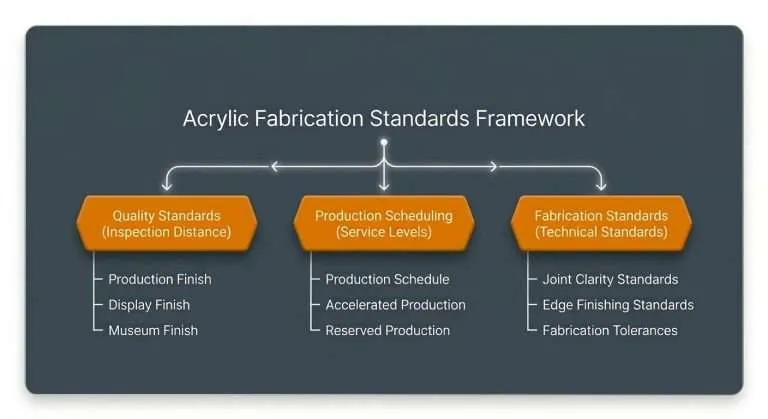
Here is where the map cashes out. Projects with early fabrication involvement arrive at their production window with specs already translated, proofs already moving, and no discovery phase left to absorb — which means the production commitment can be made earlier, when capacity options are widest. In the terms of our Production Scheduling standard, that matters most at the top tier: Reserved Production allocates dedicated capacity to guarantee a specific ship date, and dedicated capacity is by nature finite — booking it early, against a campaign date that cannot move, is a materially different position than shopping for it late. Early involvement is what makes early booking possible. For the agency running a launch, that chain — early touch, early spec, early Reserved booking, guaranteed date — is the practical answer to the question this post opened with. The concept-stage call is free; bring the whiteboard photo.