Exhibitors plan against the wrong date. The show opens when the show opens, but nothing about your booth is due that morning — by then the crates have been received, stored, staged, and delivered to your space by somebody else. The date that actually governs a fabrication schedule sits well in front of the show, at a receiving dock you will never visit, and every link behind it is a duration somebody has to commit to in writing. This article is the chain, link by link: where each number comes from, which links you own, and what to do when the arithmetic comes out negative.
The anchor is the advance warehouse window, not the show date
Most shows offer two ways to get freight into your booth. Direct-to-show-site delivery means your truck arrives at the venue during a narrow appointment window keyed to a marshalling yard, on a day the show floor is already in motion. Advance warehouse delivery means your crates arrive at a third-party receiving facility ahead of the show, are held there, and are trucked to your booth space for move-in by the show’s general contractor.
The open and close dates for that advance warehouse are published by the general contractor in the show’s exhibitor service kit, along with the receiving and material-handling charges that go with them. Those dates vary by show, by venue, and by year — read them out of the kit for your specific show rather than assuming a familiar window carries over.
Plan against the warehouse and the whole chain gains slack instead of losing it. A freight delay is absorbed by the storage period rather than becoming a missed appointment on show-site day. A crate that arrives damaged is discovered while there is still time to react — and for acrylic exhibit work “react” can mean a replacement panel fabricated and shipped, which is a real option with time still on the clock and a fantasy on move-in morning. Receiving confirmation gives your project plan an actual checkpoint. Direct-to-site delivery, by contrast, converts every upstream slip into a same-day emergency in front of your booth space.
The honest tradeoff: advance-warehouse receiving carries handling charges the exhibitor kit spells out, and there are builds where direct-to-site genuinely wins — a single large structure on a dedicated truck with a targeted move-in time, where double-handling is the bigger risk than a late arrival. For most acrylic exhibit work the extra handling is still the better bargain, because a crate engineered around the geometry is what absorbs that handling, while the same-day scramble direct-to-site invites is where polished faces actually get marred.
So the anchor date is the day you intend your crates to be received at the advance warehouse — comfortably inside the published window, not on its last permitted day.
The backward chain, link by link
Every link below has a duration, none of those durations are universal, and any article that hands you a week count for them is inventing it. What travels between shows is the structure — the sequence, and who owns each number. Fill in the blanks from your show’s kit, your carrier’s lane, and your fabricator’s quote for your specific build.
| Link (counting backward) | Who owns the number | What actually sets it |
|---|---|---|
| Show move-in | The show — fixed, published | Nothing you control. The point you count away from. |
| Advance warehouse receiving | You, inside the published window | The target date you pick, plus the cushion you keep between it and the window’s close. |
| Freight transit | Your carrier | The specific lane — fabricator’s dock to the warehouse city — and service level, plus your buffer. Transit is a property of the lane, not a number that generalizes. |
| Crating and packout | Your fabricator | Not parcel boxing: crates built around the geometry, with masking, interleaving, and cushioning sized to protect polished faces and finished edges. Happens after final assembly, not alongside it. |
| Production span | Your fabricator, for your drawing | Part count, processes (cutting, thermoforming, printing, bonding, finishing), finish grade, integrated lighting or hardware. Ask for the span for your build, not a shop average. |
| Proof and prototype approval | Shared — and mostly you | Each round confirms color, fit, and finish before a run commits, and each round is elapsed calendar time that includes your side of the loop. |
| Design lock | You | Date zero. Every link above is computed from a fixed design; changes after lock don’t shorten the chain, they restart the part that already ran. |
Two links deserve a closer look before you trust the arithmetic. The production span moves with decisions you make at spec stage: whether the build ships pre-assembled or flat-packed changes both the crate count and the labor waiting at the booth, and some of its internals are physics rather than scheduling — solvent bond cure can be shortened, not skipped, and a thermoformed part cannot start until its tool exists. And material selection hides inside it: specific colors, thicknesses, and custom sheet carry their own procurement time, which belongs at the spec stage, not after the first parts come off the machine.
Add the blanks. Subtract from your target receiving date. If the answer lands comfortably in the future, you have a plan. If it lands in the past, you do not have a planning problem — you have a scheduling-tier decision, which is a different conversation, and the next section is that conversation.
What the scheduling tiers actually commit to
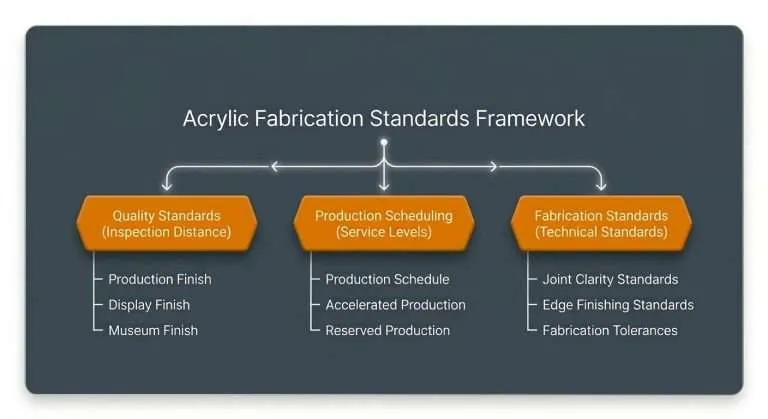
Dates are governed by a defined standard, not by how urgently the job is described. Our Production Scheduling standard defines three tiers, and the distinction between them is the whole point:
- Production Schedule — the standard queue: jobs are placed by available fabrication and assembly capacity and completed in sequence with other scheduled work. No guaranteed ship date.
- Accelerated Production — a better queue position when available capacity allows. Improves timing; does not guarantee a ship date.
- Reserved Production — dedicated fabrication capacity, allocated to guarantee a specific ship date.
Only Reserved guarantees a date. A show that opens on its published date whether or not your crates have arrived is the textbook Reserved Production project: the downside of a miss is not lateness, it is the booth build, the freight, the floor space, and the staff travel all spent on an empty space. Treating that as a standard-queue job with hope attached is a bet, not a plan. We build exhibit work to exactly this profile — exhibition enclosures for Hewlett Packard and Marriott among them — and the tier language exists because show dates are where estimate-versus-commitment ambiguity does its worst damage.
Be precise about what Reserved changes, though: it changes whose queue your job occupies, not the physics of the build. Cure times are still cure times. What it removes is the one variable you cannot see from outside — the other work already on the floor. And it does not touch acceptance criteria. Scheduling governs dates; the surface result is set by the grade you chose from the Acrylic Quality Standards, dimensions are held to the documented Fabrication Tolerances, and bonded seams are judged against the Joint Clarity standard. A committed calendar changes the schedule, never what “acceptable” means.
Why show season compounds the problem
Dedicated capacity is finite by definition. It is an allocation, not an effort level — once committed to another exhibitor’s date, it is not available to reserve against yours.
That is the part of the calendar exhibitors consistently miss. Every exhibitor at every winter show is counting backward into the same fall fabrication weeks, and they are sharing those weeks with holiday retail programs running on the same machines. The identical booth, with the identical drawing and finish spec, is a different project ordered in September than in November: early in the season all three tiers are live options and the chain has slack in several links; later, the menu narrows to whatever dedicated capacity remains unallocated, and the honest answer to “can you hit this date” starts depending on facts that have nothing to do with your build.
The practical consequence is blunt: for a fixed show date, ordering earlier is more effective schedule insurance than escalating the tier later. The tier protects a date; the calendar decides which tiers are still on offer.
The two links you control — and should govern like a fabricator
Two links in the chain sit entirely on the exhibitor’s side, and they are where most show schedules actually break — not on the shop floor.
Approval loops
A fabrication calendar is something a shop can commit to in writing. Your internal sign-off calendar is something only your team can commit to — so give it the same treatment. Name one accountable approver per artifact: the drawing, the print proof, the first article. Put a date on each, on the same countdown as everything else. Decide in advance what happens if a date passes. Brand review, legal review, a licensor’s approval, an executive who travels — all legitimate steps, and each one needs a date rather than an assumption, because a Reserved slot guarantees fabrication capacity, not your own signatures.
Graphics readiness
Printing sits late in the chain, which disguises the fact that artwork is an upstream dependency. Color is printed color-managed CMYK matched to the brand references you supply and confirmed at proof approval before the run — a scheduled link, not a formality. Send vector art (AI, EPS, or SVG) for logos and type, or high-resolution PNG or JPG for imagery; files are reviewed at quote, so anything needing higher resolution surfaces then. Have final logo files in hand at design lock and this link behaves. Discover at proof stage that the only available mark is a low-resolution raster pulled off a website, and the clock has already been running.
Turning this into a repeatable decision date
The chain is the deliverable, not any particular answer it produces. Build it once and it becomes reusable across your annual show calendar; where the same structure ships show after show, the inputs that change are mainly the warehouse window and the freight lane.
Two seasonal notes worth folding in. Shows that open in early January put the entire production span across the winter holiday period, where shop and carrier calendars both hold fewer working days — which is why a January show is a fall decision, not a December one. And for a recurring exhibit program, a build engineered to flat-pack, travel, and be reused shortens the chain dramatically for every show after the first: a graphics refresh against an existing structure is a far shorter countdown than a new build. The same logic runs through retail and POP display programs built around fixed reset dates.
The useful output of this exercise is not a schedule. It is knowing, on the day you decide, which tier your date actually requires — and asking for it while it is still available.
Working a show date backward and want the production span filled in with a real number? Send your drawing, artwork, or just the concept, along with the show and your target receiving date, and we will scope the build, the finish spec, and the scheduling tier that fits the calendar you actually have. Talk to us.