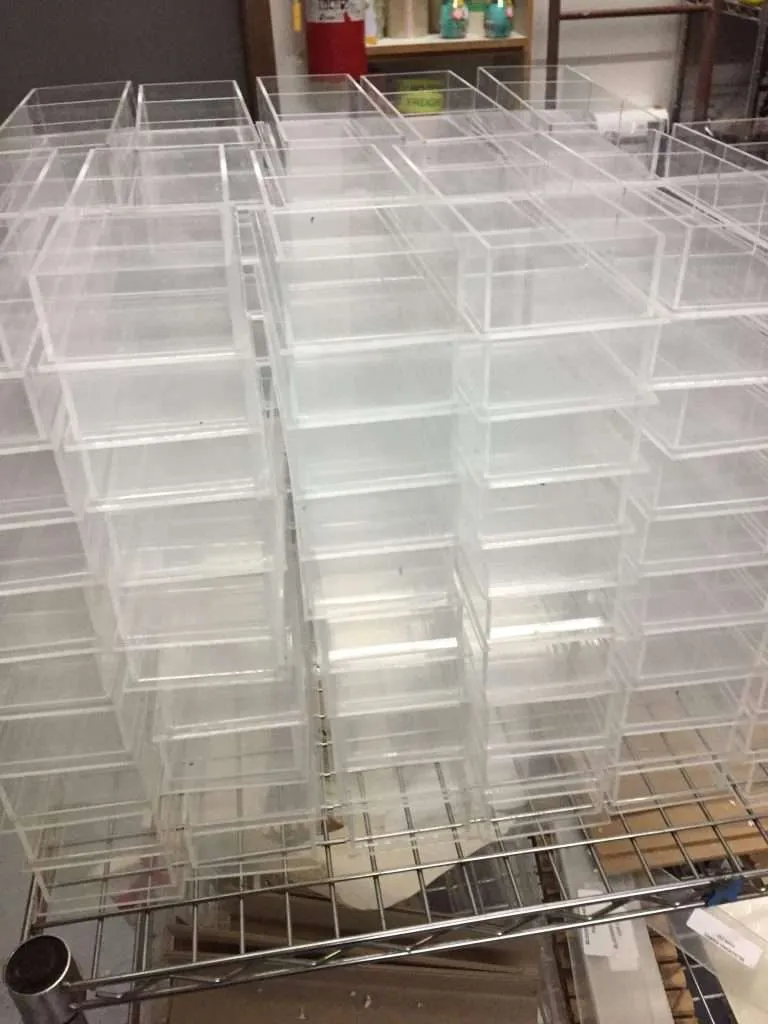
Here is a piece of arithmetic worth running before it runs you. A New Year floor set — resolution-season merchandising, post-holiday transitions — goes up in the first days of January, often overnight. Freight has to land before that. Kitting and staging before freight. Fabrication before all of it. No assumptions yet, just subtraction — and the subtraction fixes the deadline: fabrication has to be complete by mid-to-late December. Now add what the calendar says about the weeks running up to that deadline — this part is industry knowledge, not arithmetic, and worth labeling as such. December-set and late holiday display work is finishing, Q1 trade-show exhibit production is starting, year-end deliveries are landing, and holiday closures are shrinking the working days on the shop and freight sides alike. A January program released late must be fabricated entirely inside those weeks, with nowhere left to slip; one released early can be built ahead of them.
The order that avoids that collision is placed in September or October, while everyone’s attention is still on Black Friday. That is the whole argument; the rest is why the window hides, and what to do inside it.
The deadline is arithmetic. The congestion is the calendar.
Run the same subtraction for the spring reset and the difference is plain: a set that goes up in March must be finished by late February — an endpoint that sits well clear of the year’s peak, with slack behind it. The subtraction pins only the endpoint in each case, not the months the fabrication occupies; what makes the January endpoint the hard one is where it lands. Its final weeks are the most contested on the fabrication calendar — a fact about how the industry’s year is shaped, stated here as calendar knowledge rather than derivation, but one that repeats every year for the same structural reasons.
What contested weeks mean physically: fabrication capacity is stations, not sentiment — a router bed, a forming station, a bonding fixture, a curing rack. Two programs cannot hold the same station at once, and schedules flex only when a station is free; in December one rarely is. Solvent bonding can be compressed but its cure is chemistry, and the joint clarity a display is specified to does not survive a shortened cure. Thermoforming adds a tool that must exist before the first part is formed. A late January program does not simply need to run faster — it needs a slot, and the slots were being claimed while it was still a line in someone’s planning deck.
Why this window hides in plain sight
The January set replaces the holiday set on the same shelf, in the same fixture hardware, specified by the same buyer — and that buyer is at maximum load landing the holiday program during precisely the weeks the January order has to be placed. The person who must release the New Year spec is the person least free to look past December. That is not anyone’s failure — it is the structure of the job, and it is why this window needs to live on a calendar rather than in anyone’s attention.
One design lever deserves honest treatment, because it gets reached for every year. A flat bonded-and-polished construction removes the forming step and the tool that must precede it, and where the geometry tolerates facets, that is a legitimate way to buy schedule. Where the design genuinely depends on a continuous curve, flattening it spends the fixture’s whole point to save days — and moving the order earlier is the cheaper trade by a wide margin.
What a fall order actually buys
Schedule position is assigned when a job is released to production with an approved spec — not when a buyer decides internally that it is happening. A New Year program specified in late September enters the schedule alongside the holiday work rather than behind it, and the difference between those two positions is the difference this whole post is about.
The gap between “decided” and “released” is approval time. Finish grade gets set under the Acrylic Quality Standards — Production, Display, or Museum Archival, chosen by the distance the piece is viewed from — along with an edge finishing method and the dimensional ranges the parts must hold to under the Fabrication Tolerances standard. A program still deciding its finish grade in November is not in the queue; it is in a conversation.
Brands whose category peaks in January — fitness, wellness, home organization — carry the most exposure: their biggest floor moment of the year depends on the year’s most contested fabrication window. For them the fall order is the difference between choosing a scheduling tier and being assigned one. Of the three Production Scheduling tiers, only Reserved Production guarantees a specific ship date. A brand that misses the early window and still holds an immovable install date is a Reserved Production customer by definition; ordering in the fall is what keeps that a choice rather than a rescue.
One conversation, two seasons
September and October buyers are usually already on a call about last-call holiday work. Adding the January program to the same conversation claims both slots on one commitment, and the efficiencies are concrete: one sheet buy across both programs — same material, color, and thickness — improves yield and removes a second procurement cycle; graphics go through color-managed CMYK matched to your brand references and one proof cycle instead of two, with no drift between sets; and two sets occupying the same fixture hardware back-to-back get held to the same grade, edge method, and tolerances, so the January units drop into hardware the holiday units just left. Conflicts surface early, too — if both programs want the same forming station in the same week, that shows up in October, while there are still options. Risers, merchandisers, shelf-edge trays, and freestanding units carry across seasons; our POP and retail display work is built around exactly that kind of recurring program.
The freight wrinkle worth budgeting for
January in-hands dates sit directly behind the heaviest freight congestion of the year, so a program can be finished on the shop floor and still miss its set date while carriers work through peak recovery. Three decisions carry most of that risk: set the ship date ahead of the install date rather than flush against it; choose flat-pack or pre-assembled with the December receiving dock in mind — pre-assembled removes field labor when store staff have the least of it, flat-pack lowers freight cost, and either way it is a spec-stage decision; and kit and label by destination, so nothing gets re-sorted at a location with no room to sort it.
Start the January conversation now
If New Year floor sets are on your calendar, this is the month to scope them. Send drawings as PDF, DXF, or DWG and artwork as AI, EPS, SVG, PNG, or JPG — or just describe the fixture and the install date. We will confirm what is achievable and recommend the tier that fits. Talk to us while the schedule still has room in it.