By early September, a holiday display program stops being a design question and becomes a capacity question. If you are the brand-side buyer, the two dates that matter were never yours to set: the retailer fixed the floor-set date, and the shop calendar between now and that date is largely spoken for. Neither of those facts means nothing can be built. They mean every element of the program now gets judged by one criterion — what its construction costs in calendar time — and the buyer who understands that criterion still has real moves left. This post is those moves.
What “capacity is committed” actually means
Fabrication capacity is not one pool of hours. A retail and POP display program consumes specific machine and bench time in sequence: sheet cutting, forming if the design has curves, graphics, edge finishing, bonding and cure, assembly, then packaging and kitting by destination. Each block has to finish before the next can start, and several cannot run in parallel on the same job. Bonding is the clearest example — solvent and UV-cure joints can be compressed, but cure time cannot be eliminated, because it is chemistry rather than scheduling.
A committed holiday window means those sequenced blocks are already allocated to programs that specified earlier — this is the season the shop builds around, and multi-store program work of exactly this shape, including retail programs for brands like Lacoste, is what fills it. Adding a job to a full calendar does not create hours. What you still control is how many blocks your design requires, and how long each one takes. That is the entire late-window playbook, and it splits into design levers and scope levers.
Reserved Production is the operative mechanism now
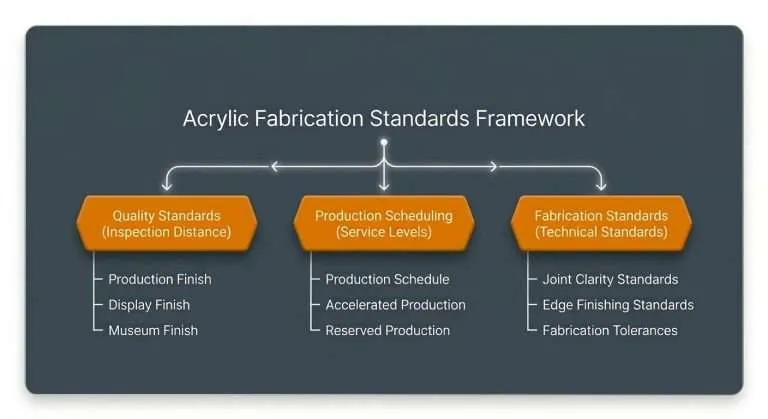
The three Production Scheduling tiers behave very differently this late, and the difference is worth stating precisely: Reserved Production, which allocates dedicated fabrication capacity, is the only one of the three that guarantees a specific ship date.
In June that distinction is a preference. In October it is the whole decision. A retailer’s floor-set date does not move for a late display, which makes a late-window holiday program the textbook case for the one tier that commits to a date — and makes a standard-queue estimate something no one on the brand side should carry into a planning meeting as if it were a promise. Reserved’s practical limit is the honest part: dedicated capacity has to still exist inside your window to be allocated, which is why this conversation gets shorter every week it waits.
Design levers that shorten a production span
Every lever below removes real hours from the schedule, and every one costs something. The buyer’s job is to spend the ones the program can afford.
| Lever | What it removes from the schedule | What you give up |
|---|---|---|
| Flat construction instead of thermoformed | Tooling build and forming setup — a formed part cannot start until its tool exists | Continuous curves. Bends and bonded joints give faceted geometry instead of a seamless contour |
| Single-material build | Sourcing and coordinating secondary stock, plus mixed-material assembly and fastening steps | Metal, wood, and hardware accents, and some structural and mounting options |
| Cut vinyl applied to a finished panel | The graphic as a sequenced block: printing direct to the panel means the panel waits its turn at the printer, while an applied graphic lets the panel finish on its own track | Durability and edge-to-edge color. UV ink bonds into the surface and holds hairline detail better; cut vinyl suits lettering, logos, and flat shapes |
| Standard thicknesses only | Custom sheet procurement, which sits largely outside the shop’s control | Design freedom at the margins. Most POP geometry works in standard thicknesses anyway |
| Ship flat, assemble in store | In-house assembly, cure blocks, and packaging engineered around a built unit | Field labor and setup consistency — flat-pack ships in smaller cartons but relies on hardware and instructions traveling with it |
One lever that looks tempting and is not: dropping the finish grade below what the placement needs. Cosmetic grade is chosen by Inspection Distance — the distance the piece is actually viewed from — and the defined distance for each grade is published on the Acrylic Quality Standards page. Specifying Production grade for a floor unit seen across an aisle is sound. Specifying it for a countertop piece a shopper handles at arm’s length is something the store notices in week one, and week one of this program is the week that matters. Choose the grade the viewing distance calls for, then let the other levers do the work.
Flat-pack in particular only saves time if the parts still fit. Knock-down panels, slots, and hardware locations are governed by the assembly ranges in the Fabrication Tolerances standard — those ranges are what keep a store associate from fighting your display on the sales floor during set week.
Scope levers move the calendar further than design levers
The largest lever is not construction at all. It is how many doors ship before Black Friday.
Consider a program planned as a single 500-door rollout in December. Split hypothetically into a 50-door flagship pilot before Black Friday plus the full rollout timed to the January reset, and it gets easier in three ways at once. The pilot asks less of the remaining window — less volume through each sequenced block, fewer destinations to kit and ship. It is a real production article rather than a prototype, so specs, packaging, and kitting are proven — and sell-through measured — before the volume run. And the January reset is a genuine retail milestone with its own calendar, not a consolation prize: it is when store teams are already changing fixtures, which makes it the natural second landing for the volume doors.
Forcing all 500 doors into December, by contrast, asks every sequenced block to compress at once during the busiest weeks of the shop’s year. The pilot-plus-reset structure delivers the same annual footprint on a schedule that can actually be committed to — and gives the buyer sell-through data to wave at the next planning meeting.
If you are deciding this week
What makes a late-window quote fast is specificity: finished dimensions, quantity, destination count, and the in-hands date at the store — not the ship date you assume it implies. PDF is preferred for fabrication files; DXF and DWG are accepted. Send artwork as AI, EPS, SVG, PNG, or JPG. A dimensioned sketch is enough to scope feasibility and confirm which tier the remaining window supports.
For next year, the decision window opens in summer — the point when tooling for formed parts, custom sheet stock, layered graphics, and a Reserved slot are all still available at once, and none of the levers above has to be spent.
Working against a fixed floor-set date? Send us the date and the scope and we will tell you plainly what the remaining window supports.