This comparison is usually written by someone with a stake in the answer, which is why it usually reaches the conclusion its author sells. We fabricate acrylic as our specialty — so the most useful thing we can offer is the part most acrylic shops leave out: a plain account of the jobs where acrylic is the wrong choice. Getting that question right at the specification stage is what keeps a program from being re-tooled after the first field failure or the first cosmetic rejection.
Start with the concession: where polycarbonate is simply correct
Impact. Polycarbonate’s impact resistance is not somewhat better than acrylic’s — it is categorically better. Acrylic is a rigid, glass-like polymer that fails by cracking or shattering when struck hard enough. Polycarbonate absorbs and redistributes that energy: hit hard, it dents, deforms, or eventually cracks in place rather than breaking into fragments. Manufacturer literature for branded polycarbonate sheet — SABIC’s Lexan among it — puts the difference at roughly 30 times the impact strength of acrylic, and about 250 times that of glass. The multiple varies by grade and test; the order of the two materials never does, and no thickness selection on the acrylic side closes it.
Cold. The gap widens where it is cold. Polycarbonate keeps most of its toughness well below freezing; acrylic grows more brittle as the temperature drops. A part that survives handling in a heated showroom can crack from the same knock on an unheated loading dock in January — so freezer enclosures, unconditioned industrial space, and exterior installations that will be struck in winter all point the same direction.
Abuse. Polycarbonate also forgives rough field work — drilling near an edge, over-torqued fasteners, a panel flexed into place during install — that would craze or crack acrylic. Where the install crew, not the design, sets the worst case, that forgiveness is worth real money.
So the rule is short: if the part exists to stop something, get hit, or protect a person from a moving hazard — machine guarding, impact barriers, high-abuse partitions, glazing expected to take a strike — specify polycarbonate. Not as a compromise. As the correct answer.
Where acrylic genuinely wins, and the mechanism behind each
Acrylic’s advantages are not a consolation list. Each comes from a specific property and shows up on a specific kind of part.
Optical clarity without an inherent cast
Clear acrylic transmits about 92 percent of visible light — the practical ceiling for a transparent plastic, since roughly 4 percent reflects at each face and the material itself absorbs almost nothing. More important than the number: what passes through carries essentially no color. Polycarbonate runs slightly lower and, by the nature of the polymer, carries a faint gray cast that compounds with thickness and with every additional pane in the sightline. On one thin sheet you may never see it. On a five-sided case, a layered build, or against a white product or a calibrated brand color, it becomes a visible shift. When the material’s job is to disappear so the product reads accurately, acrylic disappears better.
Scratch resistance in the surfaces people touch
Acrylic is the harder surface of the two, and that hardness belongs to the bare material rather than to anything applied over it. Uncoated polycarbonate marks and hazes comparatively easily under handling, cleaning, and routine abrasion. Hard-coated grades exist on both sides — we source abrasion-resistant acrylic as a specialty grade — but the logic differs: on acrylic a coating upgrades a surface that was already hard; on polycarbonate the coating is doing the primary work, and once it wears through, the softer substrate is what your customer touches. For merchandising fixtures, cases, and counter units — wiped down daily, handled constantly — acrylic holds its finish longer with nothing in the stack-up to delaminate or complicate refinishing.
Outdoor stability
Acrylic is inherently stable under sunlight and holds its clarity outdoors across long service. Uncoated polycarbonate yellows under UV exposure and loses optical quality over time; outdoor-rated polycarbonate exists, but it reaches that rating through a UV-resistant surface layer — the same dependence-on-a-coating logic as scratch resistance, with the same failure mode at cut edges and worn spots. For exterior signage, illuminated faces, lens covers, and outdoor display components, acrylic is the material that still looks like install day years later.
One distinction is worth holding separate, because specifications routinely blur it. UV-stable describes the sheet’s own durability: it does not yellow or haze in sunlight. UV-filtering describes what the sheet does to light passing through it: it blocks UV from reaching the artwork, textiles, labels, and pigments behind it. These are two different specialty acrylic grades, and specifying one does not give you the other. For a museum or archival case the requirement is usually UV-filtering; for an exterior sign face it is UV-stable.
The edge — where acrylic separates hardest
Acrylic takes a polish that polycarbonate cannot match. Our Edge Finishing Standards define six methods — raw/saw-cut, sanded, laser-cut, flame-polished, buff-polished, and diamond-polished — each matched to where the edge will be seen and named before anything is cut. The revealing one is flame polishing: the controlled pass that brings an acrylic edge up clear and glossy clouds and degrades polycarbonate’s softer, more heat-sensitive surface instead. A cosmetic polycarbonate edge has to be built up mechanically through sanding and buffing, and still does not arrive where a polished acrylic edge does.
This matters more than it sounds, because two specifications interact here. The part as a whole is graded under our Quality Standards by Inspection Distance — Production finish is judged from roughly four feet, Display from about two, Museum Archival from about one. A part specified at Display or Museum Archival with its edges in the sightline is a part whose edges will be read from arm’s length — and at that range, the edge method alone often decides the material before any other property gets weighed.
Joints that read as one continuous piece
Solvent cement chemically fuses mating acrylic surfaces into a single continuous piece; done correctly, the joint is structurally strong and visually near-invisible. That is the standard construction behind clear boxes, cases, display walls, and enclosures, and the bond line is held to the defined criteria in our Joint Clarity Standards rather than judged by eye after the fact. Polycarbonate assemblies are typically joined with adhesives or mechanical fastening — sound engineering, but never the same seamless optical result. If the assembly has to read as one object rather than several panels attached to each other, that is an acrylic outcome.
Stiffness per unit of thickness
Acrylic has the higher elastic modulus, so at equal thickness it is the stiffer sheet: an unsupported span, a shelf, or a large case face deflects less. In practice that means a given panel size holds flat without stepping up thickness or adding structure — which lands on fixture design, packed weight, and freight, not just on the part.
Fabrication differences that surprise specifiers
The two materials also behave differently in the shop, in ways no property table shows.
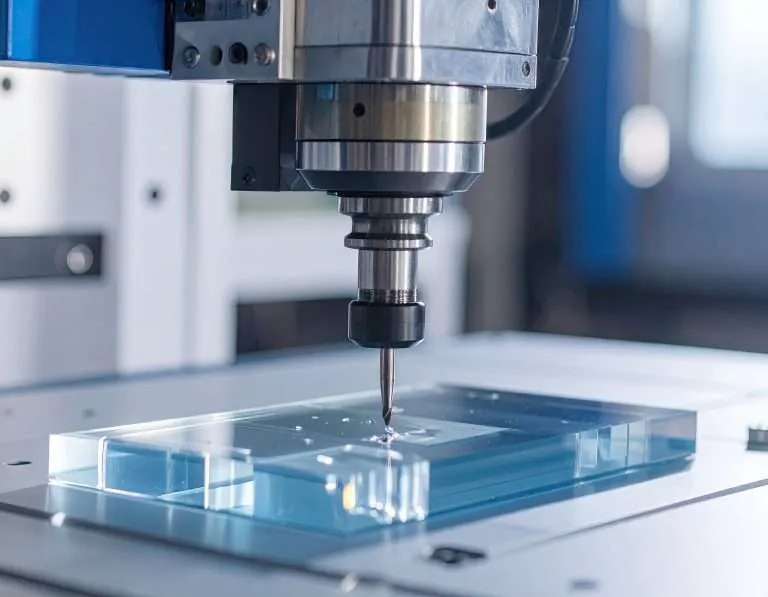
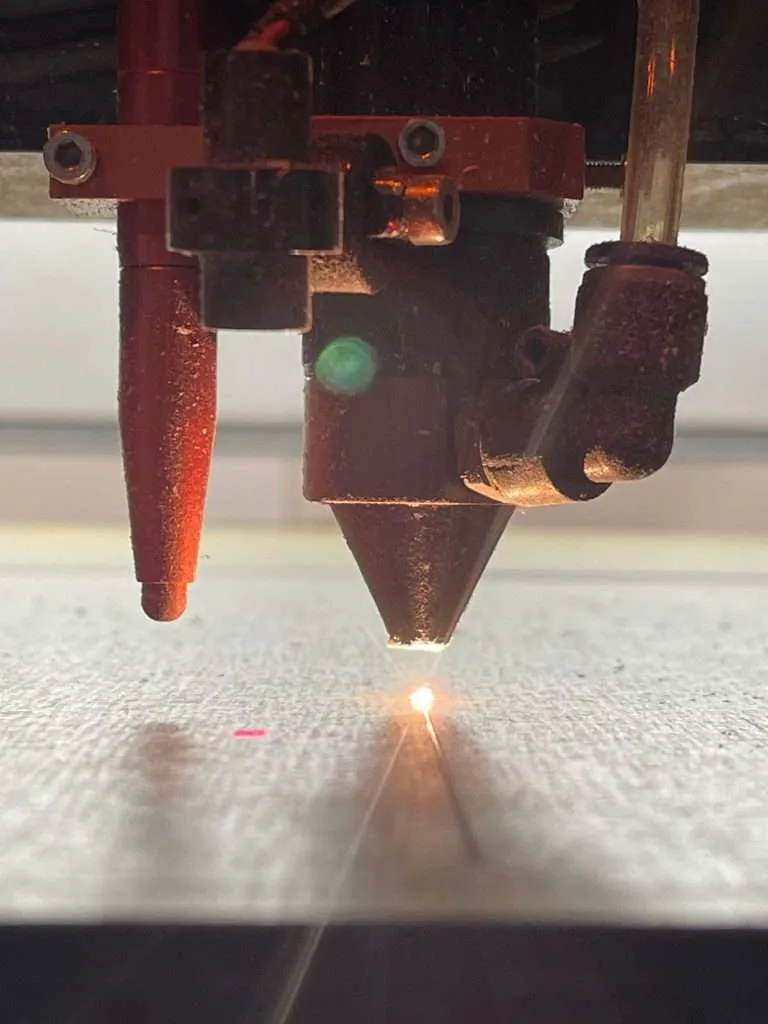
Laser cutting. Cast acrylic is close to an ideal laser material: the beam vaporizes it cleanly, leaves a smooth glossy edge straight off the bed, resolves fine features, and cuts internal shapes mechanical tooling cannot reach cleanly. Polycarbonate is not that material — it absorbs the beam and thermally degrades rather than vaporizing, so the kerf scorches and discolors instead of self-finishing. Polycarbonate is a saw and CNC material, and a polycarbonate part with a cosmetic edge requirement gets cut and then finished mechanically, every time. Thick stock, machined pockets, and mating edges go to CNC in either material, so the method follows the geometry — but only acrylic gets the laser’s finished-edge shortcut.
Finishing labor. Because an acrylic part can often go from laser bed to display-facing edge without a secondary operation, the finishing step frequently collapses into the cutting step. On polycarbonate it rarely can. That difference in operations, multiplied across a run, is one of the largest hidden gaps between the two materials’ finished cost.
Assembly method. Solvent bonding joins acrylic parts and hides the joint in one operation. Fastened or adhesive-joined polycarbonate assemblies bring hardware, tolerance stack-up at every joint, and visible joining detail — all of which must be resolved in the design rather than absorbed by the material.
The decision, by application
Most specification arguments dissolve once the part is named:
| Application | Specify | Why |
|---|---|---|
| Retail and POP displays, merchandisers, risers | Acrylic | Clarity with no cast, polished edges, harder handled surfaces |
| Display cases, presentation boxes, covers | Acrylic | Solvent-bonded joints that read as one continuous piece |
| Machine guarding and impact barriers | Polycarbonate | Impact resistance is the governing requirement, by a wide margin |
| High-abuse partitions, public-corridor glazing | Polycarbonate | The realistic worst case is a hard, unplanned strike |
| Cold storage, freezer enclosures, unheated space | Polycarbonate | Keeps its toughness in the cold, where acrylic grows brittle |
| Outdoor faces, illuminated signage, lens covers | Acrylic | Inherent UV stability, not a rating that depends on a surface layer |
| Rough-handling installs, high-traffic locations | Polycarbonate | Tolerates the knocks, flexing, and field drilling acrylic will not |
| Trade-show components shipped and rebuilt repeatedly | Mixed — by zone | Acrylic where it is seen; polycarbonate where it is struck or stressed |
Mixed assemblies are common and usually correct: an acrylic face bonded and polished for the sightline, with a polycarbonate panel where a person or a machine actually contacts the part. Which answers the question the concession above leaves open: we build the polycarbonate part too. We fabricate in acrylic as our specialty and incorporate complementary materials — other plastics, metal, wood, hardware — as a build requires, so the material split follows the engineering rather than the vendor. If the whole part should be polycarbonate, we will say so before anything is cut, and then build it rather than pointing you at another shop.
Cost: factors, not a verdict
No honest blanket statement says one material is cheaper. The cost of a finished part comes from a short list of factors, and the two materials sit differently on each:
- Raw material. Sheet cost differs by material, grade, color, and thickness, and moves with the market — one input, not the answer.
- Sheet yield. How the parts nest into the sheet often outweighs the per-sheet price difference entirely.
- Process selection. Acrylic parts that can be laser cut skip an operation polycarbonate cannot. Thick stock and machined features go to CNC either way.
- Finishing labor. The specified edge and surface level drives real hours, and the available shortcuts differ sharply between the two.
- Assembly. Solvent bonding versus fastening changes both the hours and the hardware in the bill of materials.
Which way the total lands depends on the part: a laser-cut acrylic component with a polished edge and a bonded seam can come in below its polycarbonate equivalent because two operations disappear; a thick machined panel with a concealed edge may land the other way. Resolve it at the specification stage, alongside the Fabrication Tolerances for the chosen process — a material change is free then, not after tooling.
How to bring this to a fabricator
Tell us three things and the material question usually answers itself: what the part does, what is likely to hit it, and how closely it will be looked at. Those map onto impact requirement, finish grade, and edge specification, and resolve the choice faster than any property table. For a retail or POP display program, the answer is nearly always acrylic. For a machine guard, it is not — and we will be the ones to tell you so.
Send a drawing, a PDF, or a description of what the part has to do, and we will tell you which material we would specify and why — including when that answer is not the one we fabricate most. Start a spec conversation; the gallery shows what those grades look like built.