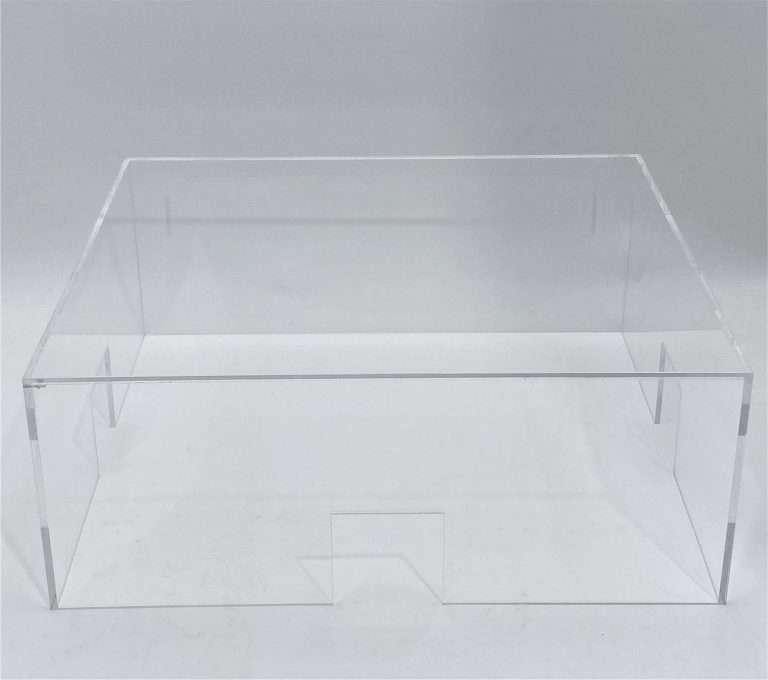
Anyone who has walked a retail floor has seen it: a clear acrylic shelf, loaded with product since the fixture went in, with a visible dip in the middle. It held the weight on day one. It still holds the weight. But it no longer looks the way the rendering looked, and on a clear shelf the sag reads from across the aisle. The point of this post is that “it holds the weight today” and “it stays flat for years” are two different questions — and that the answer to the second one is a design decision that belongs to the person drawing the fixture.
Why a shelf keeps bowing
Acrylic under sustained load does not simply deflect once and stop. Over time, a continuously loaded span can continue to bow — the material creeps under load, slowly, in a way that a quick load test at receiving will not show. This is the reason a shelf that measured flat when the fixture was assembled can look tired later, with the same product on it. Any shelf design that only considers the load on day one has answered half the question.
What actually drives sag
Six variables set how much a shelf deflects, and they interact, which is why there is no single answer to “how thick should it be.”
Unsupported span. The distance between supports is the dominant variable, and its effect grows faster than the span itself: lengthening a span adds sag out of proportion to the length added. An intermediate support, which shortens the span directly, is the most effective change available.
Shelf depth. A deeper shelf carries more product and therefore more load, and depth also changes how the load spreads. A deep shelf loaded along its front edge behaves differently from the same shelf loaded uniformly.
Load and how it is distributed. Total weight matters, but so does where it sits. A heavy item centered on the span is the worst case; the same weight spread evenly, or placed near the supports, deflects the shelf less.
Sheet thickness. Thicker sheet is stiffer, and its stiffness rises steeply with thickness — but it is also heavier and costlier, and past a point it is the least efficient way to buy stiffness, which the next section explains. The choosing acrylic thickness post covers the broader thickness decision.
How the ends are supported. A shelf that simply rests on two brackets behaves differently from one captured in a channel at both ends, bonded into side panels, or supported along its full back edge. The more the ends are restrained, the stiffer the shelf acts.
Time under load. The variable most drawings forget. A shelf that will be loaded continuously for years should be designed to a stricter expectation than a display shelf that is restocked and rotated weekly.
The structural moves that beat raw thickness
Buyers who learn that sag is a thickness problem tend to solve it by specifying thicker sheet. Often that works, and often there is a better answer — a shape change that stiffens the shelf far more per unit of material than thickness does. These are design options for the drawing, not prescriptions.
A front lip or return. A downturn along the front edge — line-bent from the same sheet, or bonded on as a strip — turns a flat plate into something closer to a beam, and the stiffness gain is large relative to the material added. It also hides the shelf edge and catches product, which is why so many well-designed retail shelves already have one. A return along the back edge does the same job from the other side.
Supports and dividers doing double duty. A vertical divider that separates product also acts as an intermediate support if it is bonded to the shelf above and below. Fixture designs that need dividers anyway get a shorter unsupported span for free; it is a matter of placing the dividers where the span wants them rather than only where the planogram does.
Support placement. Moving the supports inward from the ends — so the shelf cantilevers slightly past them — reduces the center span and shares the load between the overhang and the middle. On a long shelf this can be the difference between adding a center support and not.
Each of these is a fabrication conversation: a lip means a bend or a bond, a divider-as-support means a bonded joint that carries load, and each lands within the per-process ranges in the Acrylic Fabrication Tolerances standard. What they have in common is that they are decisions made on the drawing, which brings us to who makes them.
Who owns the design
The span is the customer’s design decision. The sheet manufacturers publish engineering data on load and deflection for their products; for numbers — how much a given thickness deflects over a given span under a given load — that published data, for the specific product being used, is the source to work from — and the only source of numbers this post points to.
What we do is this: when something on a drawing looks obviously off — a long clear shelf in thin sheet with no lip and no center support, carrying heavy product — we say so before we cut, and the design call stays with you. We will tell you when something looks off. That is a habit of the file review every drawing gets, and it is not a guarantee that every design risk is caught; the load the shelf will actually carry, and for how long, are things the designer knows and we do not.
Where this shows up beyond shelving
The same physics governs every horizontal acrylic span under load. Vitrine covers and large horizontal spans face it on their top panels, where the load is the panel’s own weight and the span is the whole case — the large-span vitrine design post works through that case. Display risers carry product on a shorter span, so the same variables apply with less leverage — the load on the riser, not the name of the part, decides whether the span question is live. Countertop overhangs are cantilevers, where the lip-and-return moves matter even more; the countertop display spec guide covers how those are drawn. In each case the drawing owns the span, and the shelf stays flat for the reason the drawing gave it.
Have a shelf or span you are unsure about? Send the drawing with the expected load, and if something looks off we’ll say so with the quote.