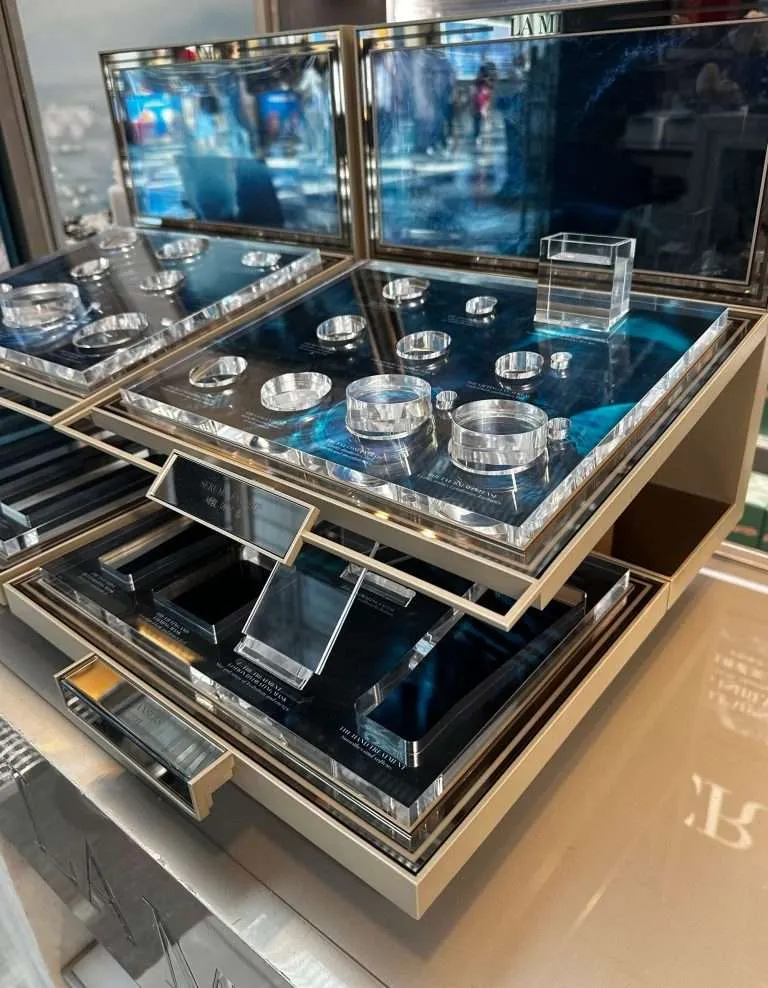
Here is the damage census every exhibit manager eventually assembles: the acrylic almost never gets damaged during the show. It gets damaged in the truck, on the forklift, and above all at teardown — the 11 pm repack performed by a labor crew that has never seen the exhibit, will never see it again, and is being paid to empty the hall, not to curate your crate. That crew is the real design requirement. An exhibit program’s acrylic survives in proportion to how seriously its packaging was designed for the worst hour of its life.
Co-design the parts and the crates
Crating designed after fabrication is an afterthought wearing foam. Designed together, parts and crates make concessions to each other that neither can make alone: parts get handling edges — somewhere safe to grip that isn’t a polished face; protective masking is retained on transport-vulnerable surfaces and removed at install rather than at the shop; and the crate interior is built as shaped cavities, routed or foam-formed, so every part has exactly one place it fits. The cavity approach beats loose fill decisively, and not mainly for protection — a shaped interior makes the repack self-evident. Loose fill makes it a jigsaw puzzle, and at 11 pm the puzzle loses.
One thing to settle before the crate is designed: crating is a value decision, not a line to trim. On a significant display — the kind that is a program’s whole presence at a show — the priority is that it arrives in good condition, and the crate is the wrong place to economize. Its cost is factored in once, at the start; a damaged face is paid for at every show it was supposed to be standing at.
Teardown-proofing is a spec, not an insult
Designing for a crew that has never seen the exhibit is not condescension; it is addressing the actual conditions of service, the same as designing for humidity or load:
- Photo diagrams of the packed state, mounted inside the crate lid — where the packer is already looking.
- Numbered parts matching numbered cavities — no judgment required, no exhibit knowledge assumed.
- Orientation marks that survive re-strapping — stenciled or recessed, not a paper label that leaves with the first stretch wrap.
The test is the same one that governs volume assembly: could someone who has never seen this exhibit repack it correctly, at pace, with only what’s in front of them? Every “obviously it goes like this” in the packing scheme is a future damaged part.
Weight is money at every stage
Show logistics bill by weight at nearly every step — drayage above all — and the bill arrives per show, for the life of the fleet. Two disciplines compound here as cost factors. Part-weight discipline: formed returns, bonded stiffeners, and frames can deliver the stiffness of sheer thickness at a fraction of the mass, and an exhibit panel is a prime candidate for that substitution. And crate-weight discipline: crate mass often rivals content mass, so an engineered crate — built where the loads are, not uniformly massive — pays its design cost back across every show it attends. A fleet that weighs less is a program that costs less, every single time it moves.
Spares ride in the crate
The spares decision is made before the first show, once, by asking which parts are known-fragile (the faces that lead every damage census) and which hardware goes missing (all of it, eventually). Those spares live in the crate permanently — a labeled cavity of their own — so the fix for a cracked face at 7 am on show day is in the hall, not in a shop two time zones away. Replenishing the spare after it’s used is a reorder against files on record, which is exactly the kind of recurring production a deliberately scheduled program handles routinely; replenishment for a fixed show calendar can even ride Reserved Production, the tier that guarantees its completion date.
Inspect the crates like you inspect the exhibit
Crates age faster than their contents — they take the forklift hits so the acrylic doesn’t. A crate with a crushed corner, a delaminating cavity, or a failed latch quietly converts good parts into replacements, one show at a time. Put crate inspection and refurbishment on the same calendar as exhibit inspection, between shows, when there is time to fix what the last teardown broke. The between-shows window is also when the exhibit itself gets its refresh pass — faces assessed at their specified finish grade, masking renewed, hardware counted back to the spares list.
If your exhibit fleet’s damage history reads like the census at the top of this post, the fix is a packaging design pass, not better luck — bring the part list and the show calendar, and the parts get designed for the crate they will live in — handling edges, retained masking, weight discipline — with the same seriousness as the show floor.