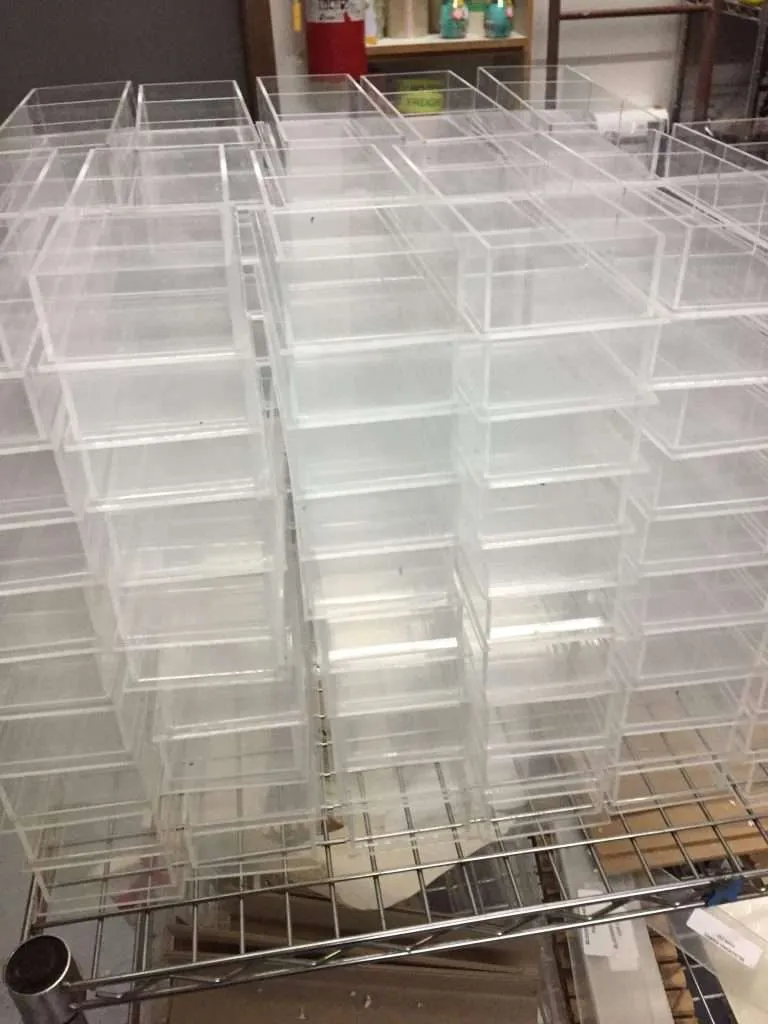
A display case order goes wrong in the gap between what the registrar assumed and what the fabricator assumed. The purchase order says “clear acrylic vitrine, polished edges” — and both parties believe they agree on what that means until the crate is opened. The fix is not a longer contract. It is asking ten specific questions before the order, and knowing what a good answer sounds like. A vague answer is information too: it tells you where this vendor will improvise.
1. What finish grade will this case be built to, and how is it inspected?
Why it matters: “High quality” and “flawless” are not inspectable. If the finish standard is an adjective, the acceptance decision at delivery becomes an argument.
A good answer: a named grade tied to a defined inspection method. We build to published quality grades defined by Inspection Distance — Production Finish inspected at approximately 4 feet, Display Finish at approximately 2 feet, Museum Archival Finish at approximately 1 foot. Whatever vocabulary the shop uses, the answer must include how the finish is verified, at what distance, under what conditions. A grade name without an inspection method is still an adjective.
2. Which joints are bonded, and to what standard?
Why it matters: Joints are where fabrication skill is most visible and where cases most often disappoint. A case can pass every panel inspection and still read as compromised because of bubbled or hazy seams at eye level.
A good answer: the fabricator identifies which joints in your specific case are solvent-bonded versus mechanically fastened, and names the clarity standard each bonded joint will meet — including which joints sit in the visitor’s sightline and therefore get the tighter standard. Our vocabulary for this is the Joint Clarity standards; the point is that joint quality should be specified per joint, not assumed globally.
3. What tolerances will you hold on this build?
Why it matters: A vitrine that must seat on an existing deck, register with a mount, or nest into millwork lives or dies on dimensional accuracy — and different cutting processes hold very different tolerances.
A good answer: stated numeric tolerances per feature, matched to the process producing that feature, before fabrication starts. If the answer is “we’re very precise,” ask again with a specific dimension: what tolerance applies to this case’s footprint? A capable shop answers with a number and identifies the critical dimensions on your drawing.
4. Will you use cast or extruded acrylic — and why, for this casework?
Why it matters: Some institutions carry a documented sheet-type preference in their casework specifications, and the real procurement risk is silent substitution against a written spec.
A good answer: the fabricator states which sheet type they will use for your case and commits to it in writing. And if your institution’s spec documents a preference, a capable shop honors it where practical rather than substituting silently. The red flag is not either sheet type; it is a fabricator who cannot say which they will use or why.
5. Can you provide UV-filtering documentation for the actual sheet lot?
Why it matters: “UV-filtering” on a quote line is a category, not evidence. Light-sensitivity decisions rest on what the installed sheet actually filters.
A good answer: manufacturer documentation for the specific product — and on request, traceable to the sheet lot used in your case — stating the filtering performance. A bare assurance (“all our material is UV”) is the wrong answer even when it happens to be true, because it leaves your loan file empty. Note the boundary: the fabricator documents the material; evaluating any material’s suitability for proximity to collection objects remains your conservators’ call, and a good vendor supports that review with data rather than pre-empting it with claims.
6. What happens if the opening date moves up?
Why it matters: Exhibition dates move. What you need to know in advance is whether the fabricator’s schedule has a mechanism for that or just optimism.
A good answer: an honest description of how their scheduling actually works. In our system: Production Schedule work is completed in sequence by available capacity, Accelerated Production moves a project forward when capacity allows — and neither guarantees a ship date. Only Reserved Production, which allocates dedicated fabrication capacity to your project, guarantees a specific ship date. That distinction is the test: a vendor who guarantees a date without dedicated capacity behind it is quoting hope. Ask what, structurally, backs the date.
7. How does the case ship, and does the masking stay on?
Why it matters: Acrylic surfaces are most vulnerable between the shop’s final inspection and your gallery floor. A perfect case damaged in transit is a schedule failure, not a discount negotiation.
A good answer: protective masking stays on through transit and is removed at or after installation, with crating described specifically — not “we pack carefully.” Ask who removes the masking, and whether the shop will specify the removal procedure for your crew if they are not on site.
8. Who installs — and where does your responsibility end?
Why it matters: The handoff point is where damage disputes are born. If it is undefined, it will be defined later, adversarially.
A good answer: a clear line, stated before the order: the fabricator installs, supervises your crew, or delivers to the dock — and inspection and acceptance happen at a named point against the named finish grade from question 1. The specifics matter less than that they exist in writing.
9. For touring work — can you produce matching spares, now or later?
Why it matters: A touring exhibition will eventually crack a panel in a city far from the shop. The question is whether a replacement will match the original case.
A good answer: the shop retains the fabrication drawings and material specifications and can produce a matching panel or component on demand — or will build spares into the original order. Ask how long records are kept and whether a replacement is fabricated to the same grade and tolerances as the original, not just the same footprint.
10. What do you need from us to quote this accurately?
Why it matters: This question tests the vendor’s process in reverse. A shop that quotes a custom vitrine from two sentences is pricing a guess, and the gap gets resolved later — usually against you.
A good answer: a specific request list — dimensioned drawings (PDF preferred; DXF or DWG accepted), object weights for deck loading, the finish grade and sightlines, site constraints, the date that actually governs. A fabricator who asks you hard questions before quoting is showing you how they will run the job.
Take these questions to any shop
Nothing above is proprietary. These ten questions work on any fabricator, and a capable one — ours or anyone’s — answers them specifically and in writing, because the answers are simply how the shop already works. That is the real screen: not whether a vendor says yes, but whether they can say yes in measurable terms. When you have a specific case to put through them, send us the drawings and we will answer all ten before you ask.