A registrar and a fabricator can sign off on the same sentence about a vitrine and still be picturing two different objects. That happens because “museum quality” — the industry’s usual adjective for this work — carries no viewing condition, no defect list and no acceptance criterion. It is a claim a vendor awards itself. Two shops can both make it truthfully, deliver visibly different cases, and neither has broken a promise — because no promise was ever specified tightly enough to break.
Museum Archival is the answer to that problem: a named finish grade with a defined inspection method behind it. It is the top of a three-grade scale, and the thing that makes it a standard rather than a synonym is a number — the grade tells you from how close the work will be looked at before anyone starts cutting.
An adjective is not an acceptance criterion
The practical test for any quality language is simple: could a person who was not in the room when the job was sold walk up to the delivered piece and decide, without argument, whether it conforms? An unmeasurable quality adjective fails that test immediately — your preparator has no procedure and your condition report has no field to fill in.
A defined grade converts the feeling into a procedure: stand at the distance the standard publishes for that grade, look at the piece under the light it will live under, and record what you can see. Conformance becomes an observation instead of an opinion — one your institution can make itself, without the fabricator present, at delivery and again at any later condition check. Because the distance is fixed, the observation is repeatable: the person writing the incoming condition report and the person checking the case two years later are performing the same inspection.
How Inspection Distance defines the grade
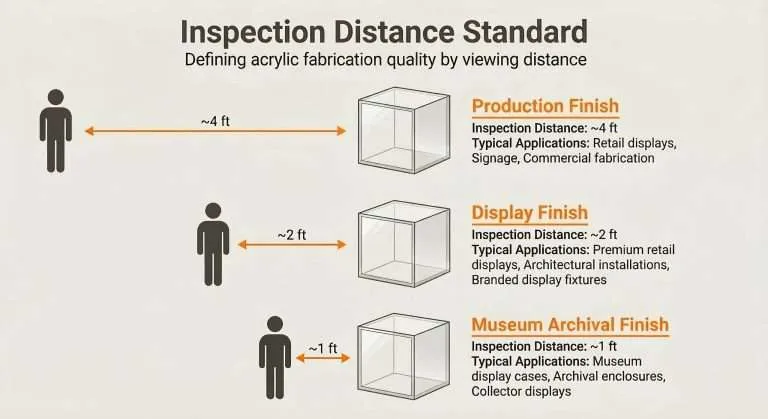
The Acrylic Quality Standards grade the cosmetic surface of a finished piece by the distance at which it must show no visible defects under normal viewing conditions. Three grades sit on the scale, each bound to a published distance:
- Production — inspected at approximately 4 feet. The standard is explicit about what this grade may show up close: minor micro-bubbles within adhesive joints, slight variation in flame-polished edges — characteristics invisible at 4 feet and irrelevant to parts that are structural, hidden, or seen only in passing.
- Display — inspected at approximately 2 feet. The working grade for most visitor-facing work: tighter joint clarity, more consistent edge finishing, tighter cosmetic control.
- Museum Archival — inspected at approximately 1 foot. The grade for surfaces a visitor will stand right up against — a tabletop vitrine people lean over is the canonical case. The standard’s language for what it takes: extremely high joint clarity, highly consistent edge polishing, minimal visible cosmetic variation.
The scale is about proximity, not prestige. Moving up a grade means the piece will be judged from closer in, which brings into scope defects that were genuinely invisible at the previous distance. That is a physical statement about how light and the human eye work, not a tier of vendor effort — and it is why the honest published detail about Production grade matters. A standard that tells you what you may see at the lower grades is one you can actually hold a delivered piece against; a standard that promises perfection everywhere is the adjective problem wearing a new coat.
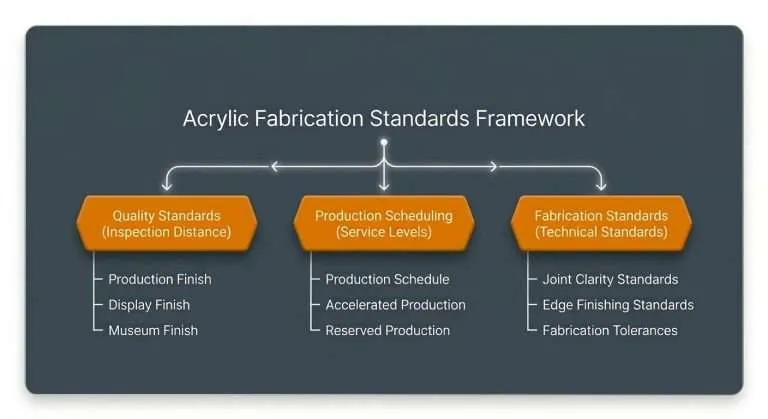
The grade judges the surface — full stop. It does not name the process that produced it, it does not govern dimensions, and it does not govern joints. Those live in their own standards, which is what makes the framework specifiable rather than circular: Edge Finishing names the method used on each edge, across six defined classifications from a raw saw-cut edge through diamond-polished; Fabrication Tolerances govern dimensions per process; Joint Clarity governs what a bond line is allowed to look like. A complete spec names all four, because a case can hold a beautiful surface grade and still seat badly on its deck.
What changes in the shop when the grade goes up
Grade is a process decision, made before tooling, and it propagates backwards through the build. Raising a case from Display to Museum Archival is not a matter of inspecting harder at the end — you cannot inspect a defect out of a finished part. It changes the work.
Display-facing edges move to the highest methods
Every finished edge starts as a cut edge, and the method is named per edge by sightline rather than as one sequence run over the whole part. At a 1-foot inspection distance, display-facing edges typically require diamond polishing — a diamond-tipped cutter machining the edge to an optically flat, glass-like face, a different operation on different equipment than the flame pass that honestly serves a Production-grade fixture. A sanded edge remains a terminal finish in its own right at any grade: the right call for a bonding key or a light-diffusion edge, not a failed polish. On a vitrine, the edges to specify most carefully are the vertical corners at eye height and the top perimeter of a cover — the ones a leaning visitor is closest to.
Surface handling tightens through the whole route
At 1 foot, the surface has to survive the shop as well as be produced by it. Masking stays on longer and comes off later; parts are staged and handled to avoid face contact; inspection happens between operations rather than only at the end, because a mark introduced before bonding cannot be reached afterwards. This is also why cast acrylic is the usual choice for the grade — its optical clarity and its behaviour under polishing hold up to close viewing better than extruded stock, which earns its place on higher-volume, less scrutinised work.
Joints get held to a higher clarity grade
Bond lines are where a case is most likely to give itself away at close range. Solvent bonding chemically fuses mating acrylic faces into effectively one continuous piece; UV-cure bonding light-cures a water-clear adhesive with controlled timing, which suits butt joints and detail work where the bond line itself is on show. Either way, a clean joint starts before assembly: the mating faces must be cut and finished to seat without a gap, because a joint cannot be better than the two edges feeding it. Recall what Production grade explicitly tolerates — minor micro-bubbles within the joint. Museum Archival work is defined by that being invisible at one foot, which is why specifying the grade without also naming a Joint Clarity grade leaves the most visible part of the build undefined.
What the grade deliberately does not cover
Museum Archival describes fabrication — the surface, and the process discipline needed to deliver it. It is not a conservation claim. Material screening for a collection — off-gassing questions, anything in contact with an object, anything that lands in the conservation column — belongs to your conservators, and we build to their specification rather than substituting a finish grade for it. Where a project requires materials verification or testing, that is available; and where a case calls for a specialty sheet — UV-filtering, anti-glare, anti-static, abrasion-resistant — those are selected by their manufacturer-documented properties at the spec stage, with the documentation on the table, not by our adjectives.
One more candid point: acrylic is softer than glass and shows handling marks more readily. A Museum Archival surface leaves the shop conforming to its grade; keeping it there through crating, installation and years of cleaning is a handling question your preparators own. That is a real trade-off against glass, and it belongs in the decision rather than in the fine print.
When Display is the right grade for institutional work
Specifying the top grade across an entire fit-out is a spec error, not rigor. It spends finishing labour on surfaces nobody will ever view from a foot away, and it flattens the signal — if everything is at the top grade, nothing in the package tells the shop where the scrutiny actually is.
The published distances make the sorting almost mechanical. Display, judged at 2 feet, is the honest call for a great deal of institutional work:
- Interpretive elements — label holders, panel mounts, rail-mounted graphics and didactic supports, read for their content at reading distance rather than examined as objects.
- Back-of-house work — storage covers, study-room enclosures, staff-side mounts and workroom fixtures that never join the visitor route. Production grade is often the accurate call here.
- Anything behind a barrier — elevated cases, high-mounted covers, and installations behind a stanchion line. If the closest a visitor can physically stand is 4 feet, a 1-foot inspection standard is not rigor; it is paying to defeat defects nobody can position themselves to see.
The useful discipline is to grade by sightline rather than by object value. A significant artifact in an elevated, barrier-set case may warrant Display on the cover and Museum Archival on nothing at all; a modest object in a table vitrine visitors lean over gets the top grade on every face they can reach. Mixed grading within one case is normal and correct — front and top faces at one grade, rear and interior structure at another — and easy to write down once the grades have names.
The spec block to write into your drawing
Everything above collapses into a short block. Name the grade and where it applies, and reference the standards pages as the definition source — that way the spec stays valid if a standard is revised, and everyone inspecting the case for its lifetime uses the same criteria. These lines lift straight into a drawing note:
- Finish grade — Museum Archival, front and top faces; Display, rear and interior
- Inspection distance — as published for the specified grade in the Acrylic Quality Standards
- Edge finishing method — named per edge, by sightline
- Joint clarity grade — named for display-facing bond lines
- Fabrication tolerance — per process, for cover seat and part fit
Each line is defined on its own page: the Acrylic Quality Standards own the grade and its distance, Edge Finishing owns the method, Joint Clarity owns the bond line, and Fabrication Tolerances own fit.
Add one more line for dates: for an opening with a fixed date on the calendar, name Reserved Production — the only Production Scheduling tier that guarantees a ship date.
Written that way, the spec survives staff turnover and travels with the drawing set.
Specifying a case or a program
If you are writing a spec for a single vitrine or a multi-case fit-out, send dimensions and where each surface will be seen from — PDF is preferred for quoting, and DXF or DWG are accepted. We will map each face to a grade, name the edge method and joint clarity to go with it, and recommend a production tier against your install date. Talk to us before the drawings are final; grade is cheapest to decide at the spec stage, and most expensive to argue about on installation week.