Every agency has shipped a deck with a hero concept nobody has engineered. That is not a failure of diligence — pitches run on speed and ambition, and engineering costs both. The failure happens later, when the client buys the concept and fabrication discovers the centerpiece can’t be built at the promised scale, on the promised date, or at anything near the implied budget.
There is a middle path between pitching blind and engineering work you haven’t won: a pitch-stage feasibility read from your fabrication partner. It is a real service — the agency guide covers where it sits in the larger relationship — but it works precisely because both sides respect what it is and what it isn’t.
What a feasibility read actually returns
Send the concept — a render, a sketch, a reference photo with rough dimensions — and a fabricator can responsibly tell you three things before you present it.
1. Buildable, buildable with changes, or not as drawn
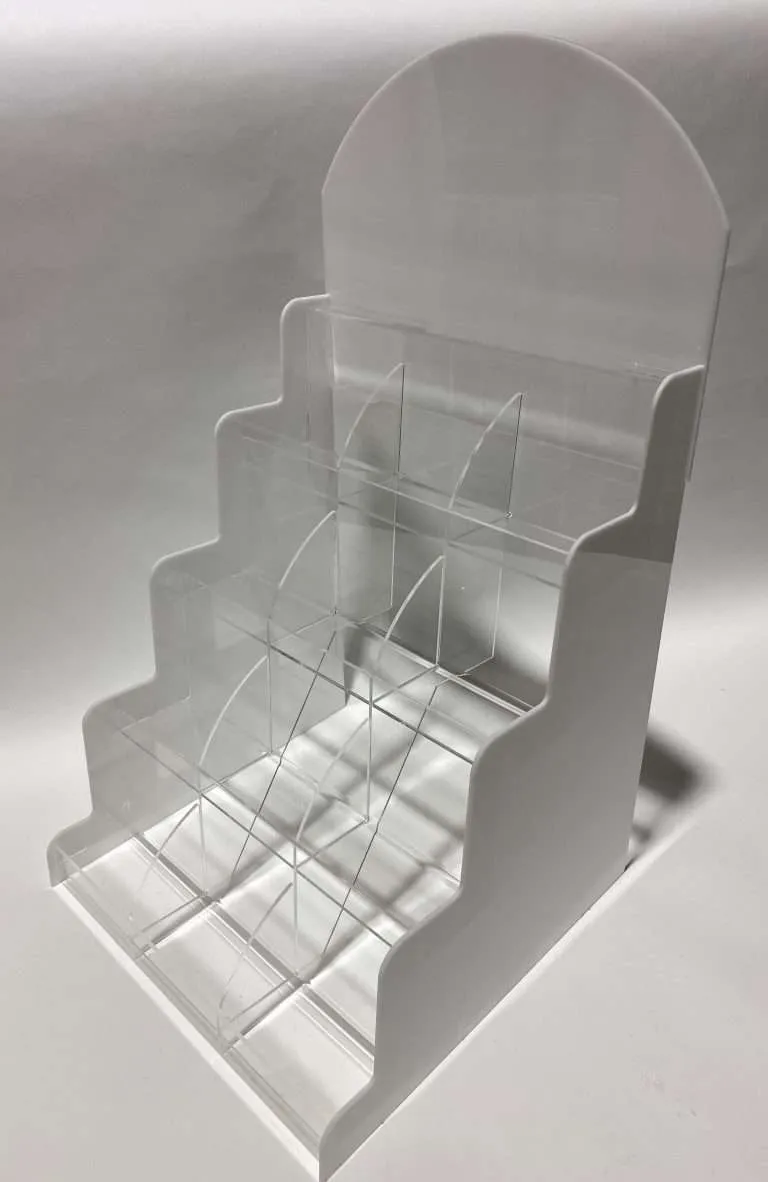
Most concepts come back in the middle category. The sweeping single-piece curve becomes two formed sections with a bonded seam; the floating shelf grows a return nobody will notice; the eight-foot monolith becomes modules that survive a truck. A good read names the specific moves that need changing and what the buildable version looks like, so the deck can show something fabrication will stand behind. The companion question — what makes a concept answerable in the first place — is covered in “can you make this?”.
2. The factor-level flags
At pitch stage you don’t get a committed number, because there is nothing yet to commit to — no locked dimensions, no finish specification, no quantity. What you get instead are the factors: which elements of the concept drive labor (hand-finished edges on every visible face), which drive material (dimensions that fight standard sheet sizes and wreck yield), and which drive calendar (thermoformed elements that need tooling before the first part exists). A producer who walks into the client conversation knowing which three features carry the cost can protect them — or trade them away — deliberately.
3. The timeline shape, in scheduling terms
Not a date — a shape. Whether the concept’s implied deadline looks comfortable on a standard Production Schedule, or whether it is the kind of fixed, immovable date that should be scoped as Reserved Production from the first conversation, because only Reserved Production guarantees a manufacturing completion date. Knowing which conversation you’re in before the pitch means the timeline slide is a plan rather than a hope.
What it deliberately doesn’t include
No drawings. No engineering. No committed numbers. Pitch support informs the promise; winning the work funds the engineering. That line protects both sides: the agency isn’t building its pitch on a quote that can’t survive contact with real specifications, and the fabricator isn’t doing speculative engineering for a project that may never exist. As the concept firms up, the path from a budgetary estimate to a firm quote is its own process — budgetary vs firm quotes walks through it.
Agencies that respect the line get better support, and keep getting it. Asking for a feasibility read is a professional request; asking for free shop drawings to put in a deck is how pitch support quietly stops being offered.
The confidentiality question, answered before you ask
Concepts shown at pitch stage are the agency’s competitive material, and fabrication partners who serve agencies operate accordingly: one client’s project is never discussed with or shown to another, and projects are kept separate as a matter of course. For genuinely proprietary work, an NDA is in place before the details are shared. The full picture — including white-label delivery and blind shipping once the work is won — is in white-label and client confidentiality.
Why the habit compounds
Agencies that run hero concepts past their fabricator at pitch stage stop pitching the impossible — and stop over-engineering the possible. Concepts arrive at the client already shaped by what fabrication can actually deliver, which means fewer post-win redesigns, fewer schedule crises, and no quiet downgrade of the thing the client fell in love with. The pitches that win hold up, because the promises are real; delivery holds up because nothing was promised that can’t ship.
That is the actual argument for making pitch support a habit rather than a favor you call in. The earlier the fabricator sees the concept, the cheaper every correction is — a principle that holds well past the pitch, as when to bring the fabricator in lays out. A feasibility read costs you an email and a render. The alternative costs you the project’s margin, and sometimes the client.