“All edges polished” appears on exhibit drawings the way “best quality” appears in contracts — as a wish wearing a spec’s clothing. It overpays on the dozens of edges nobody will ever see and still under-describes the handful that will be in every product photo from the show. Edge finishing on acrylic runs a defined ladder — the Edge Finishing Standards name six methods: raw/saw-cut, sanded, laser-cut, flame-polished, buff-polished, and diamond-polished — and an exhibit spec that assigns methods per edge class replaces “nice edges” with something a purchase order can actually hold. The assignment logic is simple: in a booth, spec money follows sight lines.
Map the ladder onto the booth
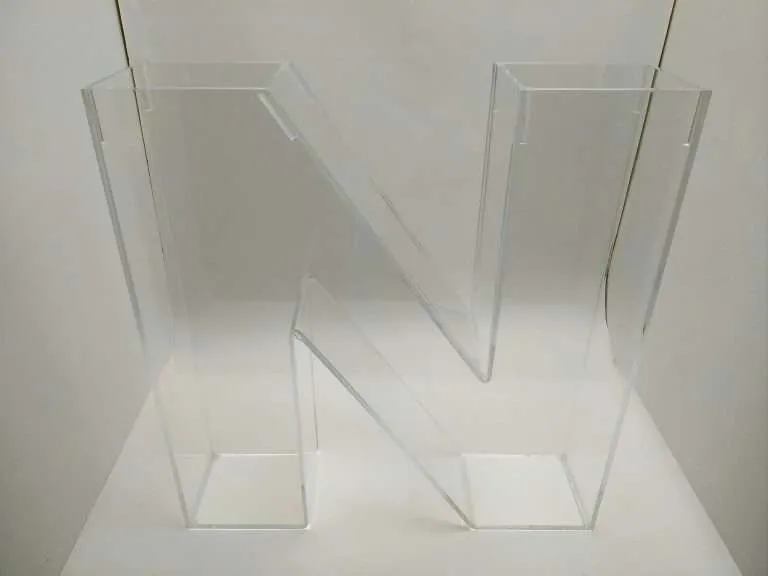
Hero territory: vitrine and showcase edges. The product case at the center of the booth lives at conversational distance, gets studied by exactly the visitors you most want studying it, and appears in every photograph the show produces. These edges are top-of-ladder territory — buff- or diamond-polished — and on the thick material hero cases tend to use, that is also the mechanically right call: on thick acrylic, diamond or buff polishing gives a cleaner edge than flame typically does. (Why thickness changes the answer, and where flame’s limits sit, is covered in flame polishing limits.)
The booth’s middle: counters, podiums, literature pieces. A counter edge gets touched more than examined — visitors lean on it, badge-scan over it, set coffee on it. Mid-ladder finishes carry this duty well, and on thinner components a flame-polished edge delivers a clean, clear result economically; our people can flame-polish any edge the material allows, and the recommendation between methods follows the component’s intended outcome, not a blanket rule. Laser-cut edges belong in this tier’s conversation too: on the thinner parts lasers suit, the cut edge arrives with a finish of its own.
Everything nobody sees: concealed and captured edges. Edges buried in frame extrusions, captured in channels, or facing the inside of a cabinet ship raw or sanded, and should. This is the line item where exhibit budgets quietly leak — polishing a captured edge is a pure cost with no audience. Calling those edges out for an economical finish is not corner-cutting; it is the same discipline that governs tolerances on exhibit work (exhibit tolerances and fit-up): precision and finish go where they do their job.
The exception that overrides sight lines: edge-lit components
One class of edge gets a polished finish no matter where it sits: the edge that feeds light into a panel. On edge-lit components, the light enters through an edge, and that edge’s finish is a functional surface — it is finished for optical clarity because the panel’s evenness depends on it, whether or not a visitor can see the edge itself. Brightness, not beauty, writes that line of the spec. Where lit panels fit in the booth’s design vocabulary is covered in edge-lit vs back-lit displays.
The exhibit-specific wrinkle: edges that travel
Exhibit parts live a different life from architectural ones — packed, trucked, unpacked and re-packed dozens of times across a program. That life adds a maintenance angle to the finish decision: a high-gloss polished edge displays a transit scratch the way a matte sanded edge simply doesn’t. This is not an argument against polish where polish belongs — the hero case earns it — but for parts handled constantly (shelf stock, demo fixtures, the pieces the booth crew moves every show), a matte mid-ladder finish can be the finish that still looks specified in year three. Pair the edge schedule with the packing plan (exhibit crating and shipping) and with a program design that expects reuse (designing exhibits for repeat shows).
Writing it into the spec
The convention that works, borrowed from how good drawings handle tolerances: name the method per visible edge class, and one general note for the rest. “Showcase assembly: buff- or diamond-polished exposed edges. Counter and podium exposed edges: flame-polished. Light-injection edges: polished for optical function. All concealed and captured edges: raw/saw-cut or sanded.” Four lines, and every bidder is pricing the same booth — which is the entire point of a standards vocabulary (the ladder itself, with each method defined, is published in the Edge Finishing Standards; the hands-on comparison is in edge finish methods compared).
Exhibit budgets are finite and openings aren’t movable, so put the finishing money where the eyes and cameras go, let the concealed edges be honest workhorses, and write it down in method names. The rest of the exhibit discipline — materials, timelines, logistics — lives in the trade show exhibits guide; an edge schedule attached to an RFQ at the quote desk is the mark of a booth that will price cleanly and photograph better.