Inside thermoformed retail and display work, the material question is rarely acrylic versus polycarbonate — it is acrylic versus PETG. Both are clear, both form, both show up in the same aisle of finished work, and each is routinely specified where the other belonged. The split between them is clean once it is stated in terms of what each material is for: PETG is the forming workhorse; acrylic is the clarity grade. An acrylic shop that also forms PETG has no incentive to blur that line, so here it is, drawn honestly in both directions.
What PETG wins, and why
- Toughness. PETG’s impact resistance is well beyond acrylic’s — it takes the drops, knocks, and abuse of high-traffic retail without cracking.
- Forming temperament. It forms at lower temperatures and without the pre-drying step acrylic forming disciplines require, which is part of why it runs so economically at volume.
- Cold work. PETG die-cuts and cold-bends without cracking — fabrication routes acrylic simply does not offer.
- The volume conclusion. Put together, this is why PETG is the standard material of high-volume formed packaging — blisters, clamshells, trays. Those are good reasons, and a formed part in that family is usually correctly PETG.
What acrylic wins, and why
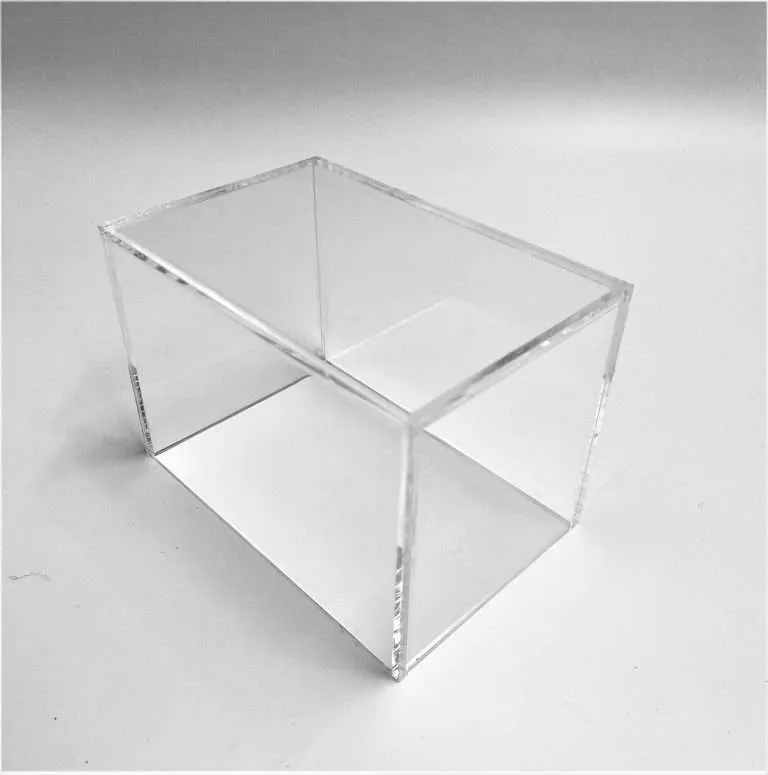
- Optics. Acrylic is noticeably clearer, with the water-clear read that makes a display disappear around the product. It is the material you specify when the point of the part is to be looked through or looked at.
- Surface hardness. Acrylic resists the scratching that dulls softer clears — PETG scuffs faster under handling and cleaning, and a scuffed face is visible quality lost.
- UV stability. Acrylic holds up outdoors; PETG is not an outdoor material. Anything sun-exposed leaves PETG off the shortlist.
- Edges. Here is the fact that decides more of these calls than any datasheet line: acrylic edges can be worked up the full ladder of the Edge Finishing Standards, through flame, buff, and diamond polishing. PETG edges cannot be finished to that standard. The moment a visible edge has to hold up at Display Finish under the Quality Standards‘ inspection distance of approximately two feet, that edge has effectively chosen acrylic.
- Stiffness and flatness. Acrylic is the more rigid sheet at a given thickness, and it shows on large flat faces: acrylic panels stay visually flat where PETG flexes and oil-cans. On a big display face, flatness reads as quality from across the room.
The forming decision in practice
Run the split across real work and it sorts quickly. Deep draws, blisters, high-abuse formed parts, formed packaging at volume — PETG, and correctly so. Formed display components whose surfaces and edges are the product — the countertop piece a shopper stands over, the formed tray whose polished front edge is at eye level — acrylic, because everything the customer perceives as quality lives in properties acrylic holds and PETG gives up. Plenty of formed retail work is correctly PETG, and a fabricator should say so; the mistake in the other direction is quieter and more expensive — a display meant to read as refined, formed in the workhorse material, delivering workhorse optics and edges into a spec that assumed better.
The maintenance line for the spec conversation
One more property pair belongs in the spec discussion rather than the brochure: PETG tolerates some cleaning agents that stress acrylic, but scratches faster under the cleaning itself. Which trade-off wins depends on who maintains the piece and how — a fixture wiped hourly in food service lives a different life than a case cleaned weekly by trained staff. Name the maintenance reality in the RFQ and the material answer usually names itself.
Where the comparison is acrylic against the other tough clear instead, that one is covered in Acrylic vs Polycarbonate: An Honest Comparison for Specifiers. And if you are holding a formed-part spec that could go either way, send it over — material selection belongs in the spec-stage conversation, and we form both.