The prototype on the conference table and the rollout in the warehouse are different engineering problems wearing the same design. A one-off can absorb anything — a little hand-fitting here, a touch-up there, an assembly sequence only its builder understands. A 500-store rollout can absorb none of it, because every hand operation in the design multiplies by the run quantity. Volume design, reduced to one sentence, is the discipline of finding those operations and deleting them before the run starts. Here is where they hide.
Sheet yield: the cost factor set at the drawing
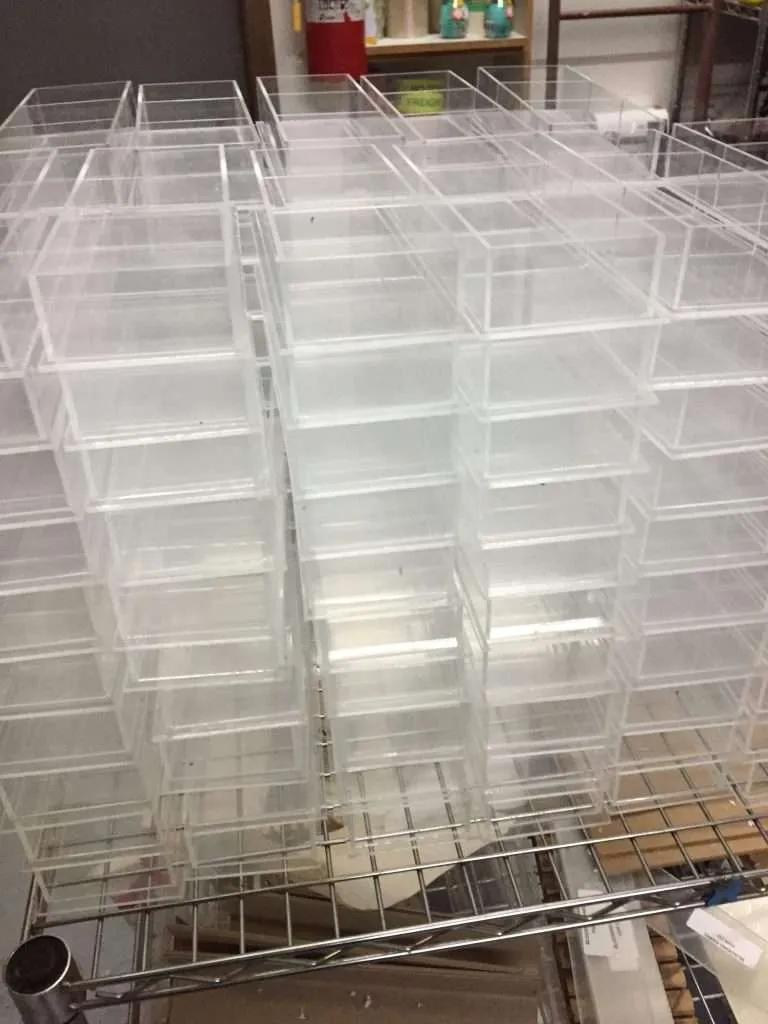
Acrylic is bought by the sheet and used by the nest. At quantity 5, a part dimension that strands an unusable strip on every sheet is a rounding error; at quantity 500, that strip has been purchased hundreds of times. This is advice that comes with the quote, unprompted: what the parts as drawn yield on the sheet sizes available — standard or oversize — and whether a slight change to one dimension would nest more parts per sheet and bring the cost of the run down. A small change that lets parts nest cleanly changes the economics of the entire run without changing anything a shopper will ever notice, which is why we flag it before the drawing locks rather than after the material is ordered. Yield is one of the few cost factors a designer controls completely, and it is set the day the drawing is dimensioned.
Design for fixtured assembly
At volume, assembly runs on fixtures, and the design decides whether fixtures can do their job:
- Self-locating joints. Tab-and-slot construction locates parts positively; a butt joint locates them wherever the assembler’s hands put them. The first is repeatable by construction, the second by vigilance — and vigilance doesn’t scale to 500.
- Orientation-proof parts. A symmetric part has no wrong orientation; an asymmetric part that looks symmetric is a defect generator. Make orientation either impossible to get wrong or obvious at a glance.
- Consistent bond gaps. Joint clarity at volume comes from fit-up the fixtures can reproduce, with dimensional repeatability referenced to the per-process ranges in the Acrylic Fabrication Tolerances standard — the design should assume parts anywhere inside their band still assemble and still look right.
The test for all three is the same: could a person who has never seen this unit assemble number 374 correctly, at pace, with the parts and the fixture in front of them? If the answer depends on skill or memory, the design still contains a hand operation.
Pack-out is part of the design
A rollout display isn’t finished when it’s built — it’s finished when a store associate unboxes it undamaged and sets it on the counter correctly. Units per carton, dunnage the associate can remove without dragging it across a polished face, masking that comes off cleanly, and assembly or placement instructions tested on someone who didn’t design the unit are all design deliverables. The cheapest time to discover that the insert scratches the front panel is before 500 inserts exist.
The pilot run: what a prototype structurally cannot tell you
A prototype answers whether the design is right. It cannot answer whether the design produces well, because a prototype is hand-built by definition — its builder quietly absorbed every fit problem, sequence ambiguity, and fixture gap without recording them. A pilot quantity put through actual production — real fixtures, real pack-out, real pace — is what surfaces those, while a problem still costs a revision instead of a warehouse of rework. Skipping the pilot doesn’t skip the discoveries; it just relocates them to the full run.
Reorder economics: design for year two
Rollout programs repeat — refreshes, new doors, replacement units. Once fixtures, nesting files, and approved references exist, a repeat run starts from the production record instead of a blank sheet, which is where recurring programs earn their stability. The design decisions above compound here: a unit built from self-locating parts with its production record on file reorders as a purchase order, not a project. For retail and POP programs, that repeatability is the product the brand is really buying — this quarter’s display is also next year’s.
And when the rollout has a floor date the trade calendar won’t move, the schedule side belongs in the plan as early as the design: the Production Scheduling tiers exist precisely so a fixed retail date can be backed by Reserved Production capacity rather than hope. A rollout program is worth a design review before the drawing locks — bring the prototype and the quantity, and the volume problems get solved while they’re still cheap.