Most of the cost conversation around a custom acrylic part happens after the drawing is done: quotes, quantities, schedules. But one of the largest cost factors is locked in earlier than that, at the moment someone types a dimension into CAD. Acrylic is bought as sheets, and every part you order is nested onto those sheets. The number of parts a sheet gives up — the yield — is set by your part’s dimensions, not by anything the fabricator does. A shop can nest cleverly, rotate parts, and pack offcuts, but it cannot make a 25-inch part fit twice across a 48-inch sheet.
That makes yield the one major cost lever a designer controls before a quote ever exists. This post walks through how it works, with real geometry, so you can see where the cliffs are.
Sheets are the unit of purchase; parts are what you actually need
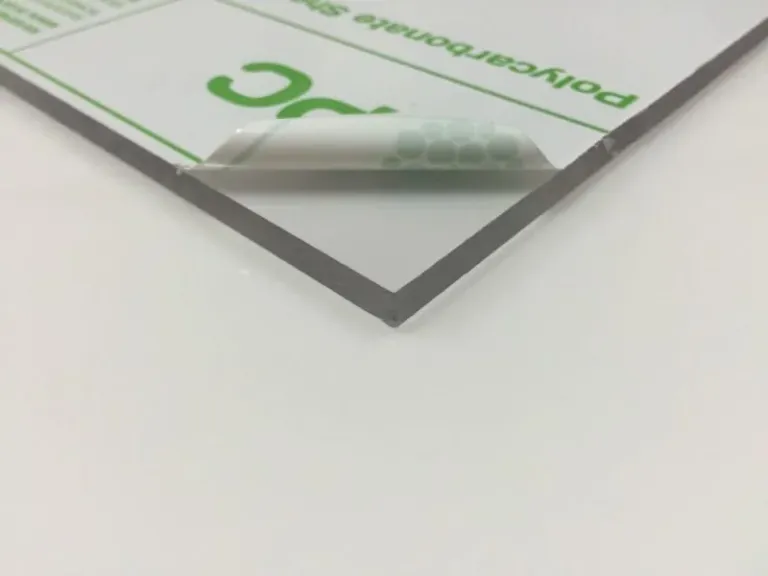
Sheet plastics — acrylic, polycarbonate, PETG, and the rest — come from suppliers in standard sheet sizes. The specific sizes vary by material, thickness, and supplier, and for any real project the right move is to design against the stock your fabricator will actually be cutting, which is a one-question email. But the principle is universal: material is bought by the sheet, and a sheet is a fixed rectangle.
Your part is also a rectangle, or at least it lives inside one — nesting software works with each part’s bounding envelope plus required spacing. Divide the sheet by the envelope in each direction, round down, and you have the yield. That rounding down is the whole story. Material cost per part isn’t a smooth function of part size; it’s a staircase. Between steps, making a part smaller saves you nothing. At a step, a fraction of an inch changes how many parts every sheet produces for the entire run.
A worked example: half an inch, one third more parts
Take an illustrative sheet of 48 × 96 inches and a part drawn at 12.5 × 12.5 inches. Ignore cut spacing for a moment and run the arithmetic:
- Across the 48-inch dimension: 48 ÷ 12.5 = 3 parts, with 10.5 inches left over.
- Along the 96-inch dimension: 96 ÷ 12.5 = 7 parts, with 8.5 inches left over.
- Yield: 3 × 7 = 21 parts per sheet, and a strip of stranded material down two edges.
Now redraw the same part at 12 × 12 inches — a 4% reduction in each dimension:
- Across: 48 ÷ 12 = 4 parts, nothing left over.
- Along: 96 ÷ 12 = 8 parts, nothing left over.
- Yield: 4 × 8 = 32 parts per sheet.
A half-inch trim on each side turned 21 parts into 32 — roughly 50% more parts from the identical piece of material. Spread over a production run, that difference compounds on every sheet ordered. And it ran the other way, too: whoever drew the 12.5-inch version paid a 34% material penalty for half an inch they may not have needed.
Real nests are more forgiving than this grid arithmetic — parts rotate, mixed parts interlock, and the leftover strips sometimes host smaller components. But the staircase is real, and no software escapes it. The question worth asking on every dimensioned drawing is: is this dimension functional, or is it just the number I typed first? If a display base can be 12 inches instead of 12.5 with no loss of function, that decision is free at design time and expensive to revisit after tooling, artwork, and approvals are built around it.
The half-sheet trap
The most punishing version of this is a part dimension just over half a sheet dimension. On our illustrative 48-inch-wide sheet, a part 25 inches wide fits once across, stranding a 23-inch remainder — nearly half the sheet — that cannot hold a second part. At 24 inches or less (minus cut spacing), two fit. The same trap exists at just over a third, just over a quarter, and so on down the fractions, but the half-sheet case wastes the most material and shows up constantly in practice: panels, shelves, and dividers have a way of landing at “a little over two feet” for no structural reason.
If a critical dimension in your design sits just past one of these fractions, that is exactly the moment to talk to your fabricator before freezing the drawing. Sometimes the dimension is functional and the yield penalty is simply the cost of the design. Often it isn’t, and nobody ever checked.
Kerf and spacing: parts can never touch
The clean division above is slightly optimistic, because parts cannot nest edge-to-edge. Every cut consumes material — the kerf — and every part needs clearance from its neighbors and from the sheet edge, where material can carry handling marks or dimensional variation from the supplier.
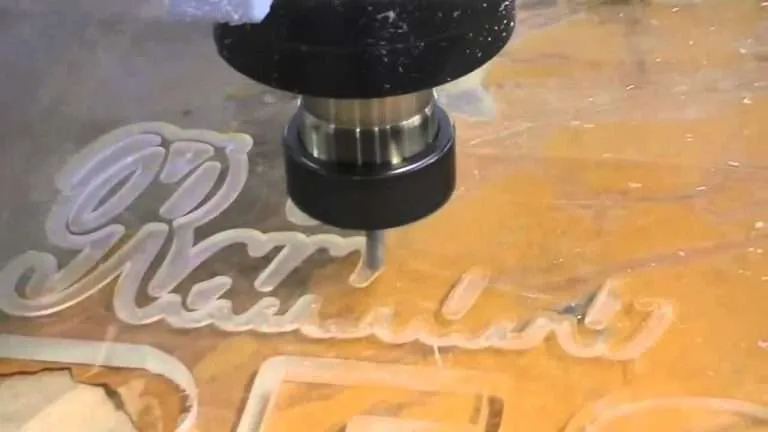
How much spacing depends on the cut method. A saw blade removes a visibly wide kerf; a CNC router consumes the diameter of its tool between adjacent parts; a laser removes a much thinner line of material but still needs clearance between profiles. Fixturing and part geometry add their own requirements. The practical consequence for a designer: don’t design to the theoretical zero-spacing yield. A part that fits the sheet four-across only if the cuts were infinitely thin will fit three-across in reality, and you’ve hit the staircase from the wrong side. When a design is close to a yield boundary, ask the shop what spacing their process needs — the answer depends on how the part will be cut, which also affects the achievable precision (see our published fabrication tolerances for how tolerance ranges differ by process).
Design the family, not the part
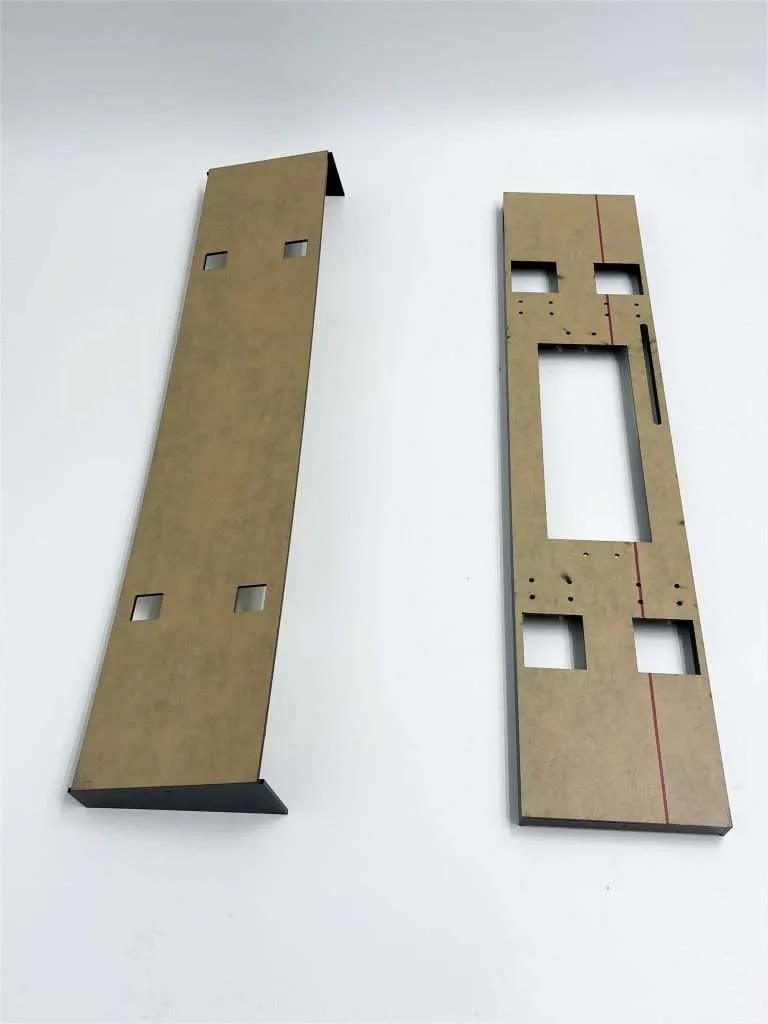
Yield thinking gets more powerful when a product has multiple components. A retail display is rarely one part — it’s a base, walls, a shelf, maybe a header. If those components share a single material thickness, they can share sheets: the walls nest beside the base, and the shelf comes out of the strip the base stranded. The offcut that was waste in a one-part analysis becomes the raw material for the smallest component in the family.
This has two design implications:
- Consolidate thicknesses. Every distinct thickness in a design is a separate sheet inventory that must be purchased, nested, and consumed on its own. A family drawn in one thickness where function allows nests as one pool of material. Sometimes a component genuinely needs to be thicker — a structural base, say — and that’s fine; the point is to make thickness a deliberate choice rather than an accident of drawing components on different days.
- Size to the offcuts. If the main panel strands a 10-inch strip on every sheet, a support bracket designed at 9 inches rides along at essentially no material cost, while the same bracket at 11 inches opens fresh sheets.
None of this requires the designer to run nesting software. It requires knowing the sheet the shop will cut from and doing division — or simply sending the component drawings over together, as a family, and asking how they nest.
When a custom sheet size wins
Occasionally the arithmetic refuses to cooperate: the part dimension is genuinely functional, it lands in a yield-hostile spot on every standard sheet, and the run is long enough that the stranded material adds up sheet after sheet. For those cases, custom sheet sizes exist — material producers can supply non-standard dimensions, and it’s an option we use when a project requires it. The trade is lead time: custom material has to be sourced and produced rather than pulled from stock, which adds time to the front of the schedule. It’s a tool for committed, recurring production of a specific yield-hostile geometry, not for a first run — and it’s another reason to have the yield conversation early, when the schedule can still absorb the sourcing window.
Yield is one cost factor, not the whole quote
A caution against over-rotating on any single lever: material yield is one input to fabricated cost, alongside labor intensity, finish grade, and printing or other decoration. A part that nests beautifully but specifies polished edges on every face carries the cost of that finishing work regardless of how efficiently it came off the sheet — edge finishing is done part by part, and a Museum Archival finish takes what it takes on part 32 of the sheet just as it does on part 1. The quality grade a project actually needs — judged by where viewers will stand, not by habit — often moves cost more than nesting does. Deep fabrication (bonded joints, formed features, hardware installation) is likewise labor that yield arithmetic never sees.
So treat sheet yield as what it is: the cost factor that is entirely in the designer’s hands, decided before anyone else is involved, and nearly free to optimize at drawing time. The other factors get decided in the spec conversation — and the best time for both is before the dimensions freeze. If you’re drawing a part or a product family now, send us the drawings and the intended quantities; a few minutes of nesting review before the design locks costs nothing and occasionally finds a half inch worth a third of your material.