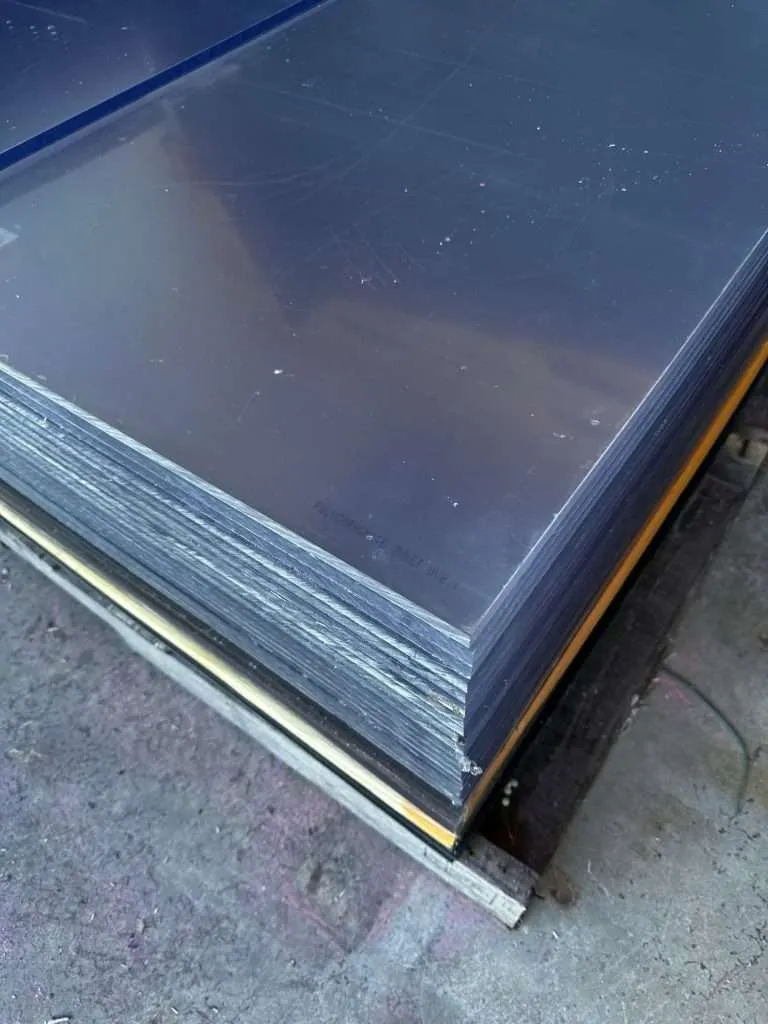
Acrylic’s weight is one of the few specification questions with a genuinely clean answer, because it comes down to one published number. Acrylic sheet has a relative density of 1.19 — the figure Plaskolite, one of the sheet manufacturers we work with, publishes on its OPTIX data sheet — which works out to about 6.2 pounds per square foot for every inch of thickness. Everything else is multiplication.
The table
| Thickness | Weight per square foot |
|---|---|
| 1/8″ | 0.77 lb |
| 3/16″ | 1.16 lb |
| 1/4″ | 1.55 lb |
| 3/8″ | 2.32 lb |
| 1/2″ | 3.10 lb |
| 3/4″ | 4.64 lb |
| 1″ | 6.19 lb |
| 1-1/2″ | 9.29 lb |
| 2″ | 12.38 lb |
Two honest footnotes. These are nominal-thickness figures — sheet is manufactured to a commercial thickness tolerance, so a real panel lands near the table value rather than exactly on it. And the density figure is the manufacturer’s published typical property; for a project where weight is contractual (a rigging calculation, a freight class), pull the current data sheet for the exact product being specified. The same goes for comparing materials: glass and polycarbonate each publish their own densities, and the right comparison is data sheet against data sheet for the actual products in question, not folklore.
Worked examples
The table earns its keep on real sizes, so: a 24″ × 36″ retail sign panel in 1/4″ is 6 square feet × 1.55 = about 9 pounds — one person, ordinary hardware. A 4′ × 8′ lobby feature panel in 1/2″ is 32 square feet × 3.10 = about 99 pounds — a two-person lift before anyone discusses the wall. A 18″ × 24″ display base in 2″ slab is 3 square feet × 12.38 = about 37 pounds in a piece small enough to look casual, which is exactly how thick-slab work surprises people at the dock.
Why weight runs the mounting conversation
A hung acrylic panel is a static load that lives on its anchors for years, and the arithmetic above is the input to every hardware decision downstream: how many standoffs, what the wall itself can take, whether the panel needs engagement with structure rather than drywall anchors. The pattern in the worked examples is the one to internalize — weight grows with area and thickness at once, so a panel that doubles in size and steps up one thickness has far more than doubled its demand on the wall. Large wall-mounted work (the back-painted-panel class of project) is a two-person, engineered-anchor install as a baseline assumption, with the anchor engineering belonging to the building side of the project. Weight also feeds sag on horizontal spans — a shelf carries its own weight before the merchandise arrives — and span behavior is a multi-variable design question (span, depth, load, thickness, supports) covered qualitatively in large-span design for fabrication; for numbers, the sheet manufacturer’s published span data is the reference. Mounting hardware itself is covered in standoff mounting systems.
Why weight runs the freight conversation
Shipping cost is a weight-and-dimensions game, and acrylic projects cross its thresholds quietly. The parcel-versus-freight line is the big one: a packaged piece that stays within parcel limits travels one way, and a piece past them palletizes — and the packaging is part of the packaged weight, since crating a fragile clear part properly adds real pounds (how exhibits handle this: exhibit crating and shipping). Thick work deserves special respect here: the 2″ display base in the example above ships like the dense object it is, and a design built from thick slab throughout can land in freight territory at sizes that look parcel-sized on the drawing. Trade-show veterans already know the end state of this logic — at the venue, weight is billed by the pound as drayage.
Weight as a design lever
The useful closing thought: weight is a spec you can design, not just compute. When the table says the mount or the freight budget is in trouble, the moves are standard fabrication thinking — thinner material stiffened by structure instead of mass (formed returns, bonded ribs, a frame doing the structural work), bonded construction from thinner stock instead of monolithic slab, or splitting one heavy piece into site-assembled sections. Where the visual weight of thick material is the point — and in display work it often is — spend it deliberately on the pieces the eye touches, not uniformly through parts nobody sees. Choosing thickness in the first place is its own decision tree, covered in choosing acrylic thickness; the material fundamentals live in the material selection guide. And when a project’s weight math starts driving real money — rigging, freight class, install crew size — put the dimensions in the RFQ and the weight math gets worked at the quote.