“Clear plastic” is not a specification. Neither is “acrylic,” most of the time. When a drawing arrives that says one or the other, what it usually means is that a material decision was deferred, and it is now going to be made by whoever quotes the job, under whatever assumptions they bring to it. Sometimes that works out. Sometimes a retail fixture ships in polycarbonate that scratches to haze in its first month on the floor, or a machine guard ships in acrylic that cracks the first time a part is dropped against it, and the failure gets blamed on “the plastic” rather than on the selection that was never really made.
This guide is the selection framework we use when a project comes in without a material called out, or with one called out that doesn’t fit the job. It starts with criteria, not materials, because the most common selection error is starting from a material you already like and rationalizing backward. And it is honest about the rows acrylic loses, because we fabricate polycarbonate, PETG, HDPE, PVC and MDF alongside acrylic, and a recommendation you can trust has to be one we’re free to make in any direction.
Start with the criteria, not the material
Every candidate material is an answer to a set of questions. Ask the questions first:
- Optical clarity. Does the part need to disappear? Is it viewed through, or merely at? Does clarity need to hold at thickness, across a long edge, or through a bonded joint?
- Impact resistance. What actually hits this part in service, how hard, and what happens if it breaks? A cracked riser is a replacement; a shattered guard is an incident.
- Scratch resistance. Who touches it, how often, and with what? Retail traffic, cleaning crews with the wrong rag, and shipping abrasion are all scratch tests the spec sheet never mentions.
- UV and outdoor stability. Will it live in sunlight or under intense lighting for years? Yellowing is slow, cumulative and unfixable in the field.
- Formability. Are there compound curves, deep draws, or formed features? Some materials thermoform generously; some fight you.
- Bondability. Is the part assembled from multiple pieces, and do the joints need to vanish? Materials differ enormously in whether a joint can be made optically clean, or made at all.
- Edge-finish quality. Are the edges visible in the finished piece? A material that cannot take a polished edge caps the achievable finish grade no matter how careful the fabrication is.
- Stiffness. How much does the part flex under its own span and load, at the thickness the budget allows? Sag reads as cheap even when nothing has failed.
- Temperature range. What are the real service temperatures, including the inside of a delivery truck in July and the heat load of enclosed lighting?
Rank these for your project before reading further. Most projects have two or three criteria that genuinely matter and six that are along for the ride. The material that wins your top two or three is almost always the right answer, even when it loses several of the others.
The honest comparison
Here is how the common candidates score, stated plainly. No material wins everything. The instinct to find one that does is what produces bad specs.
Acrylic
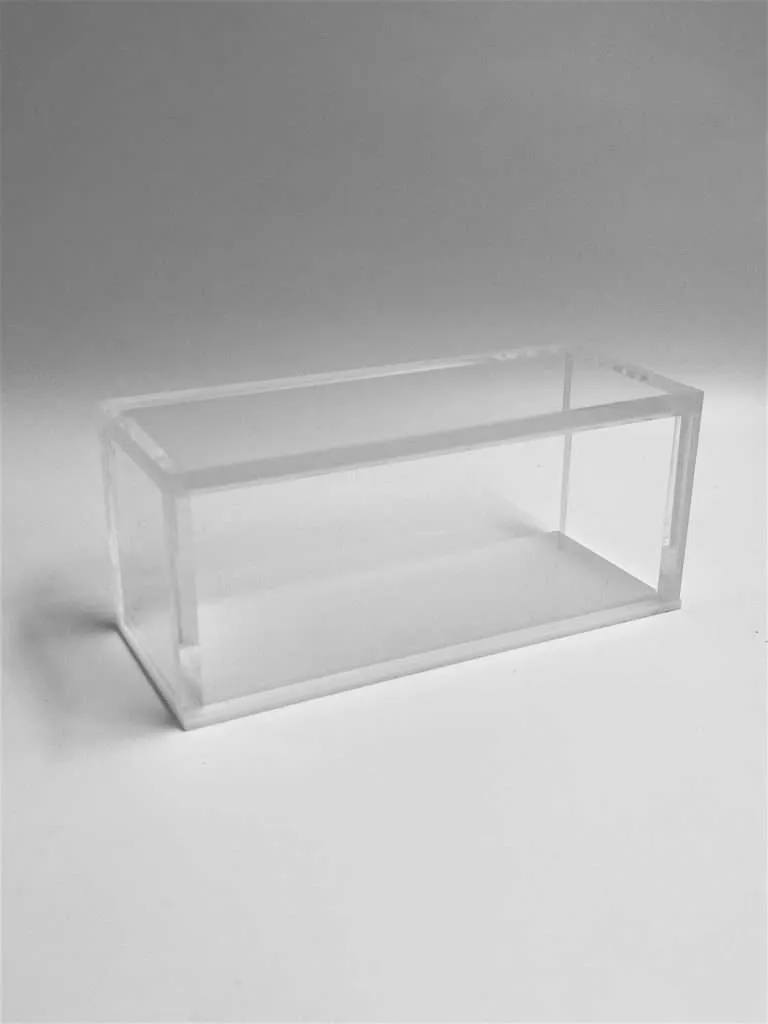
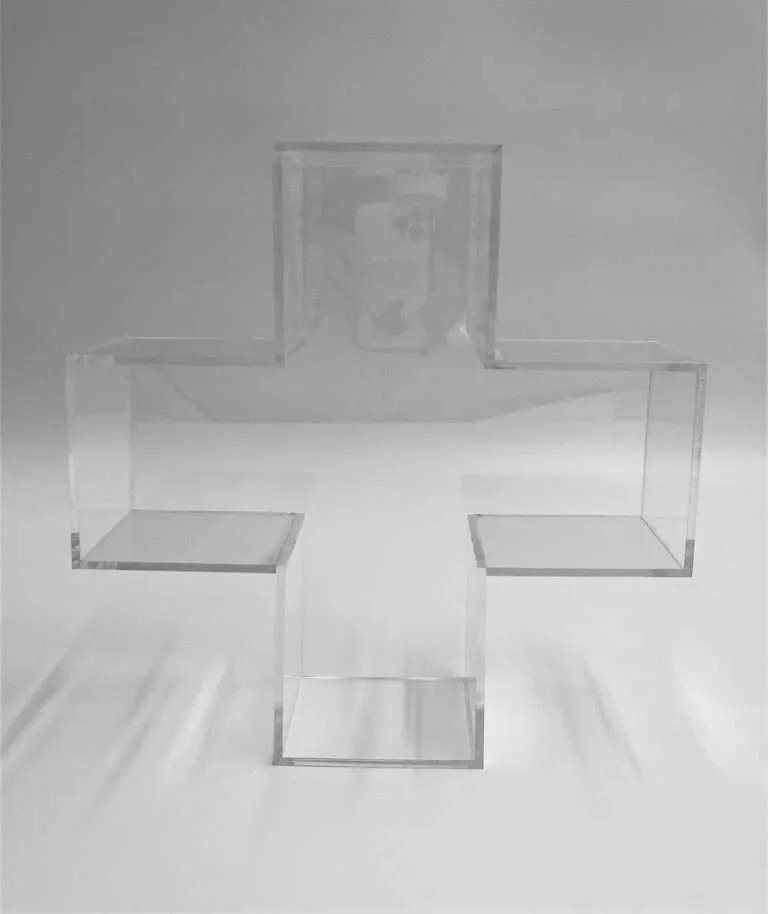
Wins: optical clarity, UV stability, polishable edges, bondability, stiffness at a given thickness. Acrylic is clearer than standard float glass, which carries a green cast that becomes obvious at thickness and along edges; acrylic stays water-clear in both directions. It is inherently UV-stable, which is why it has been the default for outdoor sign faces for decades: it resists the slow yellowing that degrades most transparent plastics in sunlight. Its edges can be worked through the polishing sequence, from saw-cut through sanded, flame-polished, buff-polished and diamond-polished, up to an edge that reads as glass. And it solvent-bonds: two acrylic parts can be joined into what is optically one part, which is the entire foundation of seamless display casework. Our joint clarity standards exist because acrylic makes that level of joint achievable in the first place.
Loses: impact resistance and scratch resistance, in opposite directions. Acrylic is far less impact-resistant than polycarbonate; struck hard enough, it cracks rather than deforming. And while its surface is harder than most transparent plastics, it is softer than glass, so it scratches under abuse that glass shrugs off. It also has a modest service-temperature ceiling; it is not the material for hot environments or parts near significant heat sources.
Polycarbonate
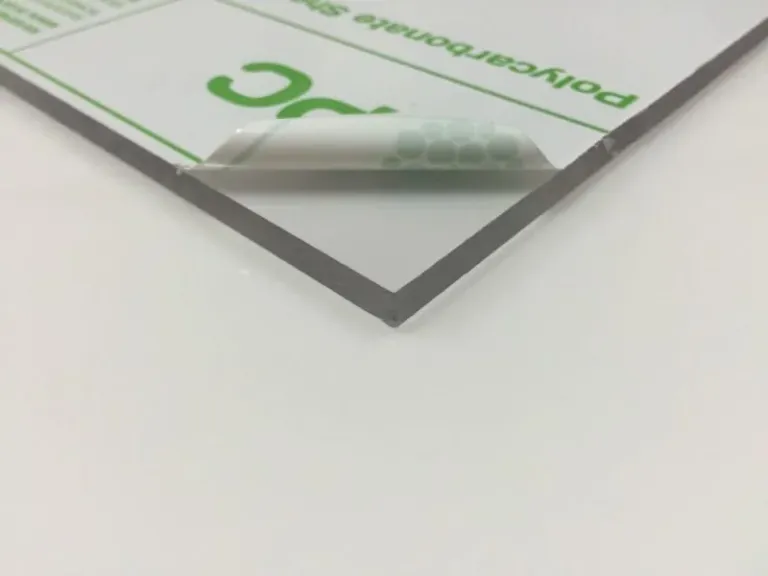
Wins: impact resistance, and it is not a close call. Polycarbonate is dramatically tougher than acrylic or glass; it deforms and absorbs energy where they crack or shatter. That single property makes it the default for machine guards, safety barriers, and any transparent part whose failure mode matters more than its finish. It also tolerates higher service temperatures than acrylic.
Loses: nearly everything cosmetic. Polycarbonate’s surface is soft and scratches readily, so an unguarded polycarbonate face in a high-touch environment hazes over. Unprotected, it yellows in UV exposure, which is why exterior polycarbonate is usually specified with a protective cap layer or coating. Its edges resist the polishing sequence that makes an acrylic edge disappear; a machined polycarbonate edge stays visibly a machined edge. And it does not take an optically clean bonded joint the way acrylic does. Polycarbonate is a safety material wearing a transparent material’s clothing, and it should be specified exactly when safety is the job. The full pairing gets its own treatment in our acrylic vs. polycarbonate deep dive.
Glass
Wins: scratch resistance, by a wide margin. Glass has the hardest surface of anything in this comparison; it survives cleaning regimens and casual contact that mark every plastic here. It is also fully rigid and dimensionally indifferent to temperature swings that matter for plastics.
Loses: weight, fragility, fabrication flexibility, and clarity at thickness. Standard float glass reads green when you look through its edge or through heavy sections, where acrylic stays neutral. Glass is heavy enough to change shipping, mounting and handling requirements, and when it fails, it fails dangerously. It cannot be solvent-bonded into seamless assemblies, cut into complex profiles as freely, or reworked in the field. Glass earns its place in architectural glazing and applications where its surface hardness is the whole point; for fabricated display and fixture work, its losses usually outweigh its one decisive win.
PETG
Wins: forming ease and impact at low cost. PETG thermoforms generously, takes deep draws and tight detail, and tolerates a forgiving process window, which is why it dominates vacuum-formed packaging, blisters and trays. It is also substantially tougher than acrylic, giving formed parts a resilience that matters when they’re handled constantly.
Loses: surface hardness, edge finish and long-term outdoor stability. PETG scratches more easily than acrylic, its edges do not polish to the same standard, and it is not the material you choose for years of sunlight. Think of PETG as the material for parts that are formed first and flat second; when the geometry is dominated by draws and returns rather than by polished faces and edges, PETG is frequently the right call.
HDPE
Wins: toughness and chemical resistance, in opaque applications. HDPE is nearly indestructible in normal service, shrugs off chemicals that attack transparent plastics, machines cleanly, and doesn’t care about moisture. For tanks, trays, wear surfaces, jigs, fixtures and industrial components where nobody needs to see through the part, HDPE is often the quietly correct answer.
Loses: every optical criterion, because it isn’t playing that game: HDPE is opaque. It also resists bonding; HDPE assemblies are mechanically fastened or welded, not glued, which shapes how parts made from it should be designed.
The supporting cast: PVC and MDF
Two more materials run through our shop constantly, not as competitors to acrylic but as components alongside it. Expanded PVC is lightweight, opaque, easy to fabricate and takes print and paint well, which makes it a workhorse for panels, backers and non-structural elements inside larger builds. MDF takes paint to a furniture-grade finish and provides stable, economical structure, which is why it shows up as plinths, cores and internal skeletons inside display work whose visible surfaces are acrylic. Neither belongs in the transparency conversation; both belong in the assembly.
Why acrylic is the display material anyway
Read the loss column above and acrylic looks vulnerable: less tough than polycarbonate, softer-surfaced than glass. So why does display, retail and exhibit work default to acrylic so consistently?
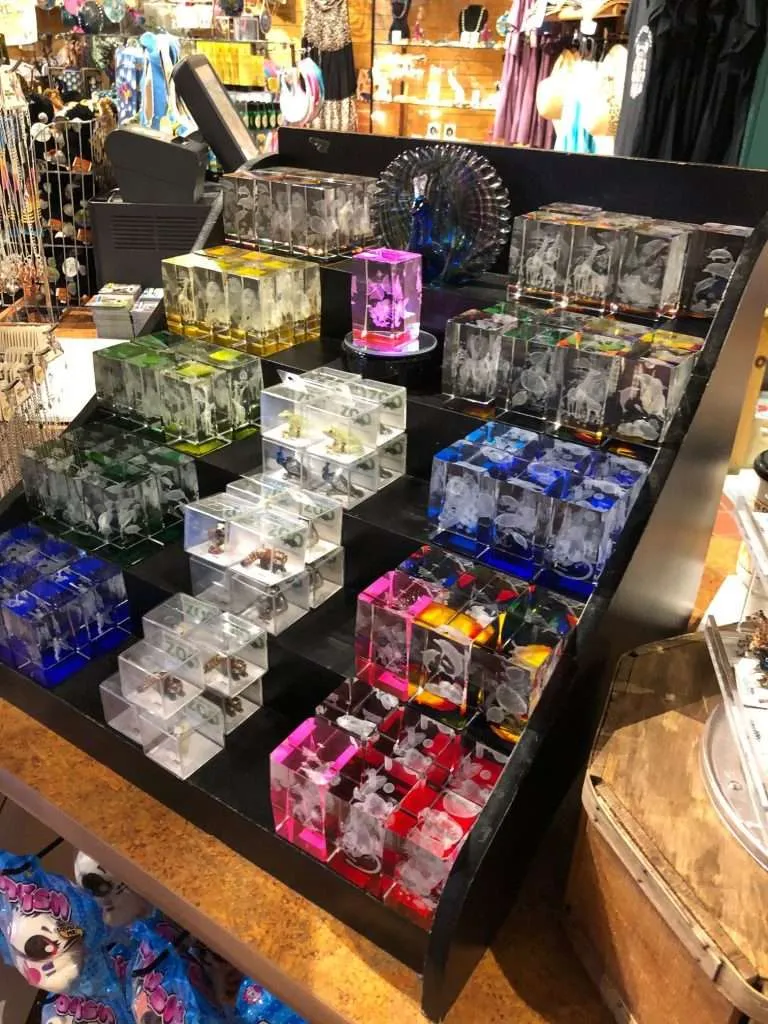
Because the display job description maps almost exactly onto acrylic’s win column. A display component is asked to be invisible, to stay flat across its span, to take an edge beautiful enough to be part of the design, to join into assemblies without visible seams, and to hold up under store or gallery lighting for years without yellowing. That is: clarity, stiffness, edge finish, bondability, UV stability. Five criteria, five acrylic wins. The criteria acrylic loses barely appear in the job: a display case is not struck with tools, and its cleaning regimen is controllable in a way a machine shop’s is not.
This is also where finish expectations should be set in measurable terms rather than adjectives. Our quality standards define finish grades by inspection distance: Production Finish is inspected at approximately 4 feet, Display Finish at approximately 2 feet, and Museum Archival Finish at approximately 1 foot. Acrylic is the material in this comparison that can actually deliver the top of that ladder, because it is the one whose edges and joints can be worked to survive inspection at arm’s length. Specifying polycarbonate and Display Finish in the same breath is asking the material for what its softer surface and unpolishable edges resist giving; the framework catches that contradiction at the spec stage, before it becomes a dispute at delivery.
Decision paths for the common cases
Most real projects collapse into a handful of patterns. Here is how the criteria resolve them:
- Guard or barrier that must survive abuse: polycarbonate. Impact is the job; cosmetics are secondary. If the barrier is also high-touch and appearance matters, say so at the quote stage, because that tension is real and worth designing around rather than discovering in service.
- Outdoor sign face or any long-term exterior transparent part: acrylic. UV stability is the deciding criterion, and it is acrylic’s most underrated win. An exterior face that yellows is a rebrand on a schedule nobody approved.
- Formed packaging component — blister, tray, deep-draw part: PETG. Forming ease and toughness dominate; polished edges and decades of UV exposure are not in the job description.
- Display case, riser or POP unit: acrylic, for the reasons above. This is the core of our retail display work, and it is where acrylic’s edge and joint capabilities stop being nice-to-haves and become the product.
- Industrial functional parts — chemical-contact trays, fixtures, wear components: HDPE. When the part is functional and opaque, toughness and chemical resistance decide it.
- Mixed-material assemblies: both, or all of the above, each where it wins. A single fixture can carry an acrylic display surface, a polycarbonate panel where the public makes contact, a PVC backer, and an MDF core, with metal, wood and hardware incorporated as the design requires. There is no rule that a project has one material; there is only a rule that each component has a reason.
That last path deserves emphasis, because it is the one buyers most often miss: material selection is per-component, not per-project. The question is never “should this fixture be acrylic or polycarbonate?” It is “which surfaces of this fixture need clarity and edge finish, which need impact resistance, and which need neither?” Answer at the component level and the either/or dissolves. Some of the best-performing builds in our gallery are exactly this kind of quiet hybrid, and read as a single material to everyone but the fabricator.
What material choice does and doesn’t decide
Two clarifications that save spec-stage confusion.
First, material choice does not set dimensional precision; process does. Laser cutting, CNC routing and saw cutting each carry their own typical tolerances, and those follow the process across materials far more than they follow the material. Choose the material against the criteria above; choose the process against the geometry and the tolerance the design actually needs. Conflating the two produces specs that over-constrain one and under-constrain the other.
Second, material choice does not settle the finish conversation; it bounds it. Acrylic makes Museum Archival work possible; it does not make it automatic. A material selection and a finish grade are two separate lines of the spec, and a complete spec carries both.
Nor does material choice move the schedule in any direction worth planning around; what does is the scheduling tier itself, and among our tiers only Reserved Production guarantees a specific ship date.
Writing the material line of the spec
A material selection that lives only in someone’s head is a selection waiting to be unmade at the quote stage. Once the framework has produced an answer, put it in the spec in a form a fabricator can act on and, just as important, can flag if it’s wrong:
- Name the material per component, not per project. “Body: acrylic. Contact panel: polycarbonate. Core: MDF” is a spec; “material: clear plastic” is a question.
- State the driving criteria. One line per component saying why: “polycarbonate for impact at the public face” tells the fabricator what to protect if a substitution is ever proposed. A material callout with its reason attached is far harder to quietly downgrade than a bare one.
- State the finish grade in the standard’s terms, and tie it to the components it applies to. Production Finish on internal structure and Display Finish on visible faces is a normal, economical split; leaving the grade unstated invites either overbuilding or disappointment.
- Describe the environment. Indoor or outdoor, lighting, cleaning regimen, who touches it and how often. Several criteria in this guide are decided entirely by facts about the environment that never appear on a drawing.
- Send the geometry in a form we can quote from directly: PDF preferred, DXF or DWG accepted. Dimensioned drawings beat prose descriptions every time, and they surface the process-tolerance questions early.
Five lines. That is the difference between a quote built on your decision and a quote built on someone else’s assumption.
The questions this framework answers
Every pairwise comparison a buyer might ask is a projection of the same criteria. Acrylic vs. glass is a clarity-and-fabricability question against a scratch-resistance question. Acrylic vs. PETG is a polished-faces question against a formed-geometry question. Acrylic vs. HDPE is barely a comparison at all, because the first criterion, does anyone look through this part, decides it. Cast vs. extruded acrylic is a narrower conversation about the same sheet chemistry, and where a customer has a forming preference between them, we honor it where practical. Of these pairings, acrylic vs. polycarbonate is the one we’ve published in full depth, because it is the pairing where the stakes of getting it wrong run highest in both directions: a display that scratches to haze, or a guard that cracks.
For everything else, run the exercise this pillar opened with. List the criteria, rank the top three for your project, and score the candidates honestly, including the rows your preferred material loses. If the ranking is genuinely ambiguous, that is not a failure of the framework; it is a signal that the decision belongs at the component level, or that a constraint is missing from the spec.
And if you would rather run that exercise with a fabricator in the room, that is what the quote stage is for. Send us the application, the environment and the abuse the part has to survive, and we will make the material recommendation we would want made for us, in whichever direction the criteria point. Start the conversation here.