Most content about gluing acrylic muddles the one distinction that matters: the difference between a cement that dissolves the joint together and a cement that fills it. Everything else — which product, which applicator, which clamp time — is downstream of that split, and a buyer who understands it can read any joint in any display and know roughly how it was made and why. Here are the four joining routes for acrylic work, compared honestly, with the acceptance standard that should govern all of them.
The fundamental split: weld vs fill
Solvent cements are water-thin liquids that briefly dissolve the two mating surfaces, which then fuse into one another as the solvent flashes off. The finished joint is not a layer of glue between two parts — it is acrylic, a chemical weld with near-zero added film. That is why a well-executed solvent joint on well-prepared edges can nearly disappear.
Polymerizable two-part cements work the opposite way: mixed components cure into a solid adhesive that occupies the joint as a distinct layer. The layer is the point — it fills, it bridges, it adds structural material — and it exists visibly, which the design has to own.
These are different tools, not grades of the same thing. Asking “which glue is better” is like asking whether a weld is better than a bolt: the question only means something once the joint’s job is stated.
Where thin solvent wins — and where it fails
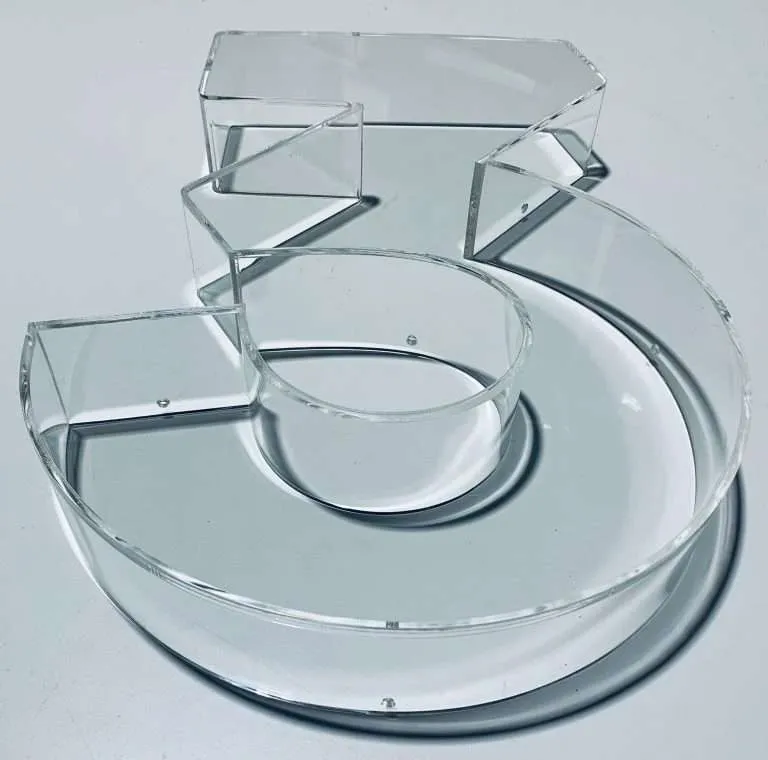
Solvent is the display-work default for tight-fitting machined joints. The technique is capillary application: parts fixtured in final position, cement wicked into the seam, fusing the interface. On edges prepared flat and square, it is fast, clean, and capable of the highest joint-appearance results — the method behind the clearest bonded casework, judged against our Joint Clarity standard.
Its failures are just as specific:
- Gaps. A water-thin liquid cannot fill a void. Where the fit is imperfect, solvent leaves bubbles and starved sections — the defects you see looking along the joints of a cheap case. Solvent bonding is really an edge-preparation discipline; the cement only ratifies what the machining achieved.
- Stressed material. Solvent meeting internal stress produces crazing — the fine fracture network that shows up at and near joints. Machining leaves stress at edges, which is why edge prep and, where warranted, thermal stress-relief before bonding are part of doing this properly.
Where two-part wins
Two-part cements take over where the joint asks for material, not just fusion: joints needing gap-fill, long or thick bond lines where even contact over the whole seam is impractical, higher structural demand, and outdoor assemblies. The trades: a visible glue line that must be designed for — kept to concealed or deliberately expressed locations — and a cure that occupies real schedule time, with parts fixtured while it happens. Cure and working times vary by product and are planned into the build rather than quoted from a blog; the practical point for a buyer is that a structural two-part joint is a slower, more deliberate operation than a capillary pass, and it is priced and scheduled as one.
UV-cure’s niche: on-demand timing
UV-curing adhesives change one variable that neither of the above can: when the bond happens. The adhesive stays workable while parts are positioned — at leisure, with adjustment — and then cures in seconds under the lamp. For precision alignment work, that on-demand cure is the whole value. The constraint is optical: the light has to reach the adhesive, so at least one side of the joint must be transparent to it — rarely a problem in clear acrylic work, which is exactly where the method lives.
The honest fourth option: mechanical joining
Sometimes the right joint is not a bond at all. Fasteners, hardware, and slot-and-tab construction win when disassembly, field assembly, or serviceability outranks joint invisibility — flat-packed retail programs, parts that ship separately and assemble on site, panels that must come off for maintenance. A bonded joint is permanent; specifying one on a part that will need to come apart is a design error no adhesive chemistry can fix. The decision framework between fastening and bonding is its own topic; the short version is that the joint’s service life, not its appearance, should make this call first.
The spec pattern: name the standard, not the chemistry
Here is the discipline that makes all of the above practical for a buyer. Do not specify the bonding method — specify the required result, per joint, and let method selection follow:
Vertical display joints: the required level per the Acrylic Joint Clarity Standards. Base joint (concealed): no clarity requirement. Removable rear panel: mechanical, fastener heads concealed.
The Joint Clarity standard is the acceptance criterion; the chemistry is the shop’s means of meeting it. A shop told “capillary solvent everywhere” by a specifier who read a forum will fight the parts where that method is wrong; a shop told what each joint must look like and do will pick the right tool per joint — which is the entire reason the standard exists. Joint appearance also interacts with the surrounding spec: the finish grades in our Quality Standards set how closely the whole assembly is judged, and joints on a Museum Archival piece inspected at approximately 1 foot live a very different life from joints on a warehouse fixture. State both, and the joint conversation is over before it starts.
If you are one step earlier in the design — deciding whether parts should bond at all — the material comparison in acrylic vs polycarbonate matters too: solvent-weldability is one of acrylic’s genuine advantages, and assemblies that need invisible joints are usually acrylic assemblies for exactly this reason.