Let’s set the contract for this post in the first paragraph: there are no prices here, and there won’t be. What there is instead is the thing producers actually need — the factors that move fabrication cost, so you can design toward a budget, read a quote intelligently, and understand why two concepts that look similar in a deck quote very differently in the real world. Factor literacy is what makes budget conversations short. A producer who can ask “is there a yield-friendly dimension near this one?” gets a better outcome in one email than “can we make it cheaper?” gets in five.
Sheet-yield economics: the factor designers control most directly
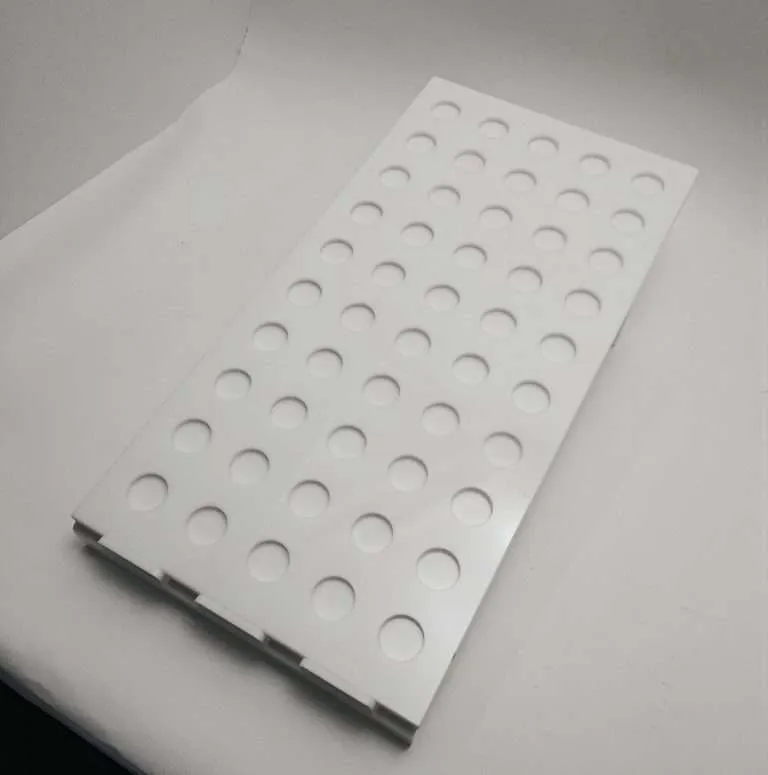
Acrylic parts are cut from standard sheet sizes, and the parts nest onto those sheets like a puzzle. Yield — how much of each purchased sheet becomes product versus offcut — is therefore baked into the design’s dimensions before anyone quotes anything. Two consequences matter to a producer:
First, waste travels. A part dimensioned so that each sheet yields a wasted strip carries that strip’s cost on every sheet the run consumes. On a one-off it’s noise; on five hundred units it’s a real line in the total that no negotiation removes, because it’s geometry, not margin.
Second, step-wise yield. Shrinking a part by a small amount sometimes changes nothing — and sometimes lets one more part nest per sheet, which shifts the material economics of the entire run at once. The reverse is equally true: growing a panel slightly past a nesting threshold can drop a whole part per sheet. The design implication is simple and almost free: when a dimension is aesthetic rather than functional, ask the fabricator whether a yield-friendly dimension sits near it. Sometimes the answer is no. Sometimes a fractionally different footprint nobody would ever notice changes the run’s material consumption meaningfully. That question is the single most producer-controllable factor in this post.
Labor intensity: the dominant swing factor
Between two parts of the same size and material, labor is usually what separates their quotes — and labor scales with specification choices producers make, often unknowingly:
- The edge ladder. The Edge Finishing Standards run from raw saw-cut to diamond-polished, and each step up buys appearance with labor. Finishing every edge of a part to the top of the ladder — including the edges glued into the assembly or facing the wall — is paying finishing labor for surfaces no one will ever see.
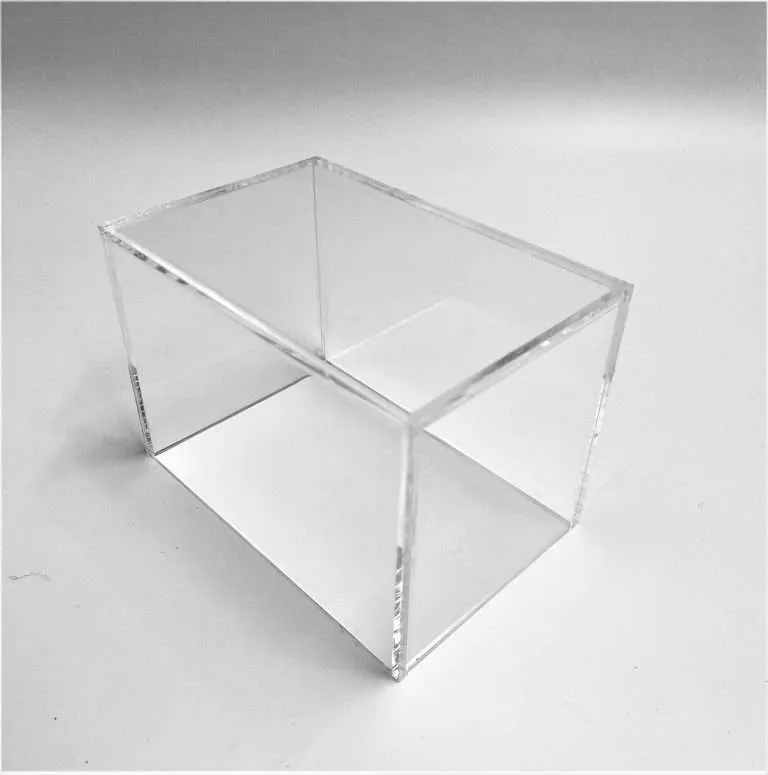
- Bonded assemblies multiply operations. A flat printed panel is cut and printed. A five-part bonded fixture is cut, machined, fixtured, bonded, cured, and finished — sequential labor on every unit. Part-count is a labor decision: every joint you design in is labor you’re specifying.
- Finish grade. Quality under the Acrylic Quality Standards is specified by Inspection Distance — Production Finish, Display Finish, or Museum Archival Finish — and tighter grades mean more careful fabrication and more inspection time per unit. Grade can be specified surface by surface — the customer-facing face at Display Finish, the concealed back at Production Finish — because a concealed surface has, in effect, no inspection distance at all. That is what makes grade a budget tool: appearance bought precisely where it’s visible.
This is why the finish-and-edge vocabulary is budget control, not pedantry: a spec that names grades and edge methods per surface is a spec that spends labor deliberately.
Tooling and setup: the step costs
Some costs attach to the run, not the unit. Thermoformed parts need tooling built once — after which every unit, and every reorder against the same tooling, amortizes it further. Print jobs carry setup; fixtures for bonding and machining are built once per program. Two producer takeaways: a formed part that looks expensive at 10 units may be the economical choice at 300, because the tooling divides differently; and reorders against existing tooling and retained programs are structurally better economics than first runs — a reason to think in programs rather than projects when a display family will recur.
Quantity’s real mechanics
Quantity changes cost through two honest mechanisms — amortization (the step costs divide across more units) and process choice: the same part at 5, 50, and 500 units may be built three different ways. Five units get cut and hand-assembled; five hundred may justify tooling, fixtures, and a different construction entirely. This is why fabricators ask about quantity early and why the honest answer matters: a quote built for 50 units uses 50-unit processes, and doubling the order later doesn’t just double the total — it may mean the wrong process was chosen and priced. Producers who share real quantity expectations, including the realistic reorder story, get quotes built on the right process the first time.
Retire the adjective; ask by factor
All of this converges on replacing one habit. “Can we make it cheaper?” hands the fabricator a guessing game — which of your design decisions are you willing to change? The producer who asks by factor keeps the design’s intent and moves its cost:
- “Relax the edge spec on the hidden edges” — same visible object, less finishing labor.
- “Is there a yield-friendly dimension near this footprint?” — same design language, better material economics.
- “Split the finish grades by placement” — Display grade where customers look, Production grade where they don’t.
- “What does this look like at the real program quantity?” — the right process, priced once.
- “Which joint could this design lose?” — one fewer bonding operation on every unit in the run.
Each of those reduces cost without reducing the design — which is the actual job of value engineering, as opposed to the adjective version that just sands the concept down until it’s cheap-looking as well as cheap. Factor literacy is the difference, and it travels: it will read a quote for a retail display program as fluently as a trade-show fixture. If you’ve got a concept and a budget that need introducing to each other, send the concept over — we’ll walk the factors against it before you commit the design, which is when every one of these levers still moves freely.