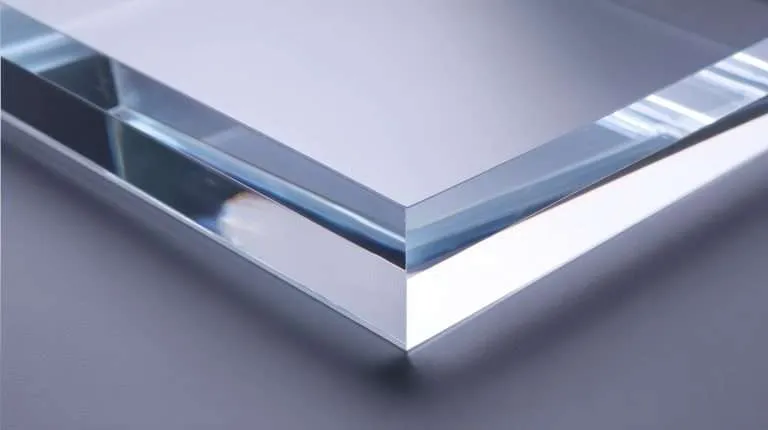
Somewhere between choosing acrylic and releasing the drawing, most buyers hit the same fork: the supplier’s catalog lists cast sheet and extruded sheet at the same nominal thickness, and the spec has to either pick one or stay silent. Neither answer is wrong by default. But picking blind — or specifying cast reflexively because it is the one with the reputation — can quietly work against the part, especially anywhere a machined fit depends on sheet thickness.
This post covers what actually separates the two materials, the one property difference that runs opposite to most buyers’ instincts, and a practical rule for when the drawing should name a sheet type. (If you are a step earlier and still weighing acrylic against polycarbonate, start with that comparison — it is the decision that comes first.)
One polymer, two manufacturing processes
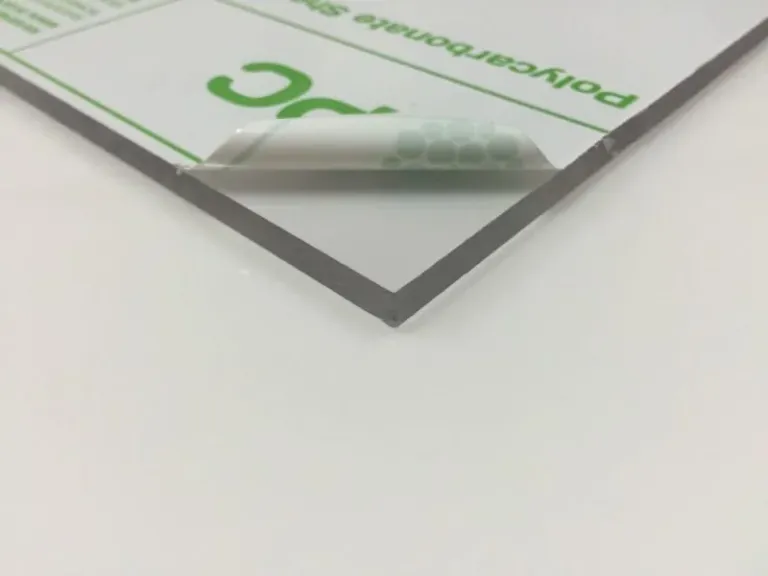
Cast and extruded acrylic are chemically the same material: polymethyl methacrylate. The difference is entirely in how the sheet comes to exist, and that difference explains nearly everything downstream.
Cast acrylic is polymerized in place as a sheet. Liquid monomer is poured between plates and cures into solid polymer at its final thickness. Because the polymer chains form in the sheet rather than being forced into it, cast acrylic ends up with a higher molecular weight and comparatively little internal stress. The trade-off is dimensional: the sheet’s thickness is set by a casting process, not a calibrated die, so it varies more from sheet to sheet and across a single sheet.
Extruded acrylic starts as polymer that is melted and pushed through a die at a controlled thickness. The die gives it what cast cannot: tight, repeatable thickness control. The cost of that control is a lower molecular weight and directional internal stress — the polymer chains carry a memory of being pulled through the die in one direction.
Higher molecular weight and low stress on one side; tight thickness control and directional stress on the other. Every practical difference between the two is some restatement of that trade.
The counterintuitive one: cast has the looser thickness tolerance
Buyers who know one fact about this comparison usually know that cast is the “better” sheet — and then assume better means tighter everywhere. It does not. On thickness, the relationship runs the other way: cast acrylic holds the looser thickness tolerance, and extruded holds the tighter one. Published sheet-thickness tolerance is commonly stated as approximately ±10% of nominal — our Fabrication Tolerances table carries the same band — and cast sheet lives toward the generous end of it while extruded sheet holds the tighter end.
When does that matter? Any time the sheet’s thickness is itself a functional dimension:
- Machined fits. A part that slides into a routed slot, dado, or channel is a fit between the mating part’s cut width and the sheet’s actual thickness. Extruded’s consistency means the fiftieth part slides the way the first one did; cast’s variation means the slot either gets opened up to the worst case or the fit changes part to part.
- Stacked assemblies. Where several thicknesses add up to an overall dimension, thickness variation accumulates.
- Fixtures and repeat runs. Tooling built around one sheet’s measured thickness meets the next lot’s different one.
This is why “cast is the good one” is not a spec. For a flat part whose thickness must agree with a machined feature, the humbler sheet is often the correct engineering answer. Thickness is only one line in the tolerance picture — cut features, assemblies, and formed dimensions each carry their own bands, and our fabrication tolerance standards put numbers on all of them so a drawing can call out what the part actually needs.
Machining and bonding: tendencies, stated honestly
The industry literature is consistent about the general behavior of the two sheet types on the machines, and it follows directly from the chemistry. We will state it the way it deserves to be stated — as widely documented material tendency, not as a guarantee attached to any particular part.
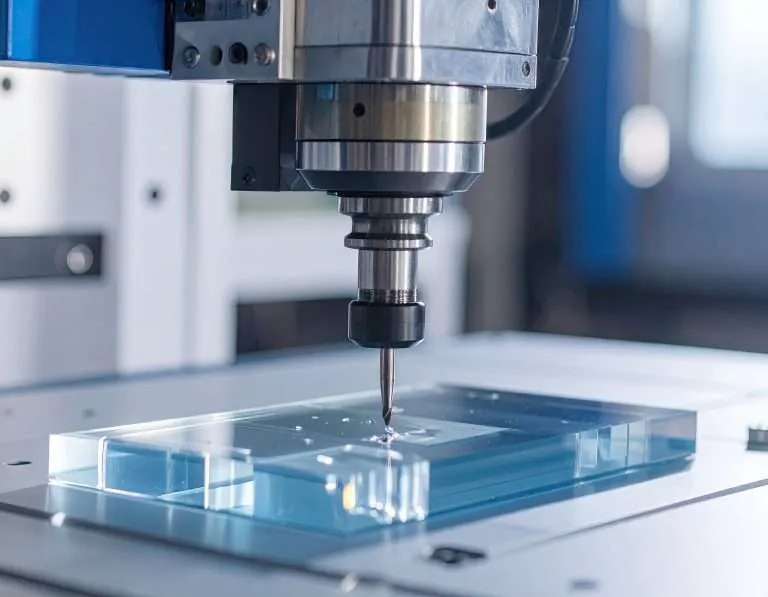
Under the tool, extruded acrylic’s lower molecular weight means it softens at lower temperatures, so it is generally described as more prone to melting and gumming during aggressive routing, drilling, and sawing. Cast is generally regarded as the more forgiving material under heavy machining for the same reason in reverse. In practice, feeds, speeds, and tooling matter at least as much as the sheet’s pedigree — a well-run job produces clean features in either material, which is why the deliverable worth specifying is the finished tolerance and edge classification, not the machining experience.
At the joint, extruded sheet’s directional internal stress is the commonly cited concern: solvent cements find stressed material more readily, and the literature associates extruded stock with a higher tendency toward crazing at solvent-bonded joints. Cast’s lower internal stress is the flip side. Here too, process discipline is the real control — joint prep is chosen per joint precisely so the finished bond meets the standard regardless of which sheet is on the bench. What a spec should govern is the visible result, which is what our joint clarity standards exist to make measurable.
One difference we do stand behind, because we see it on every job: engraving. Cast engraves cleaner and sharper, so when a part carries engraving, cast is the sheet we run it on — and that decides the sheet grade before anything is cut.
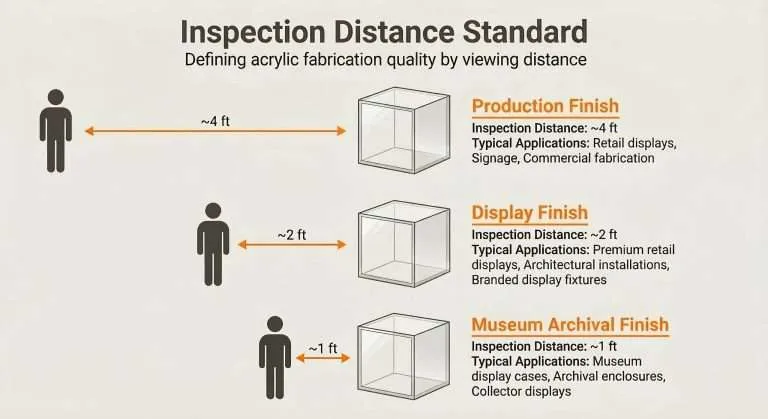
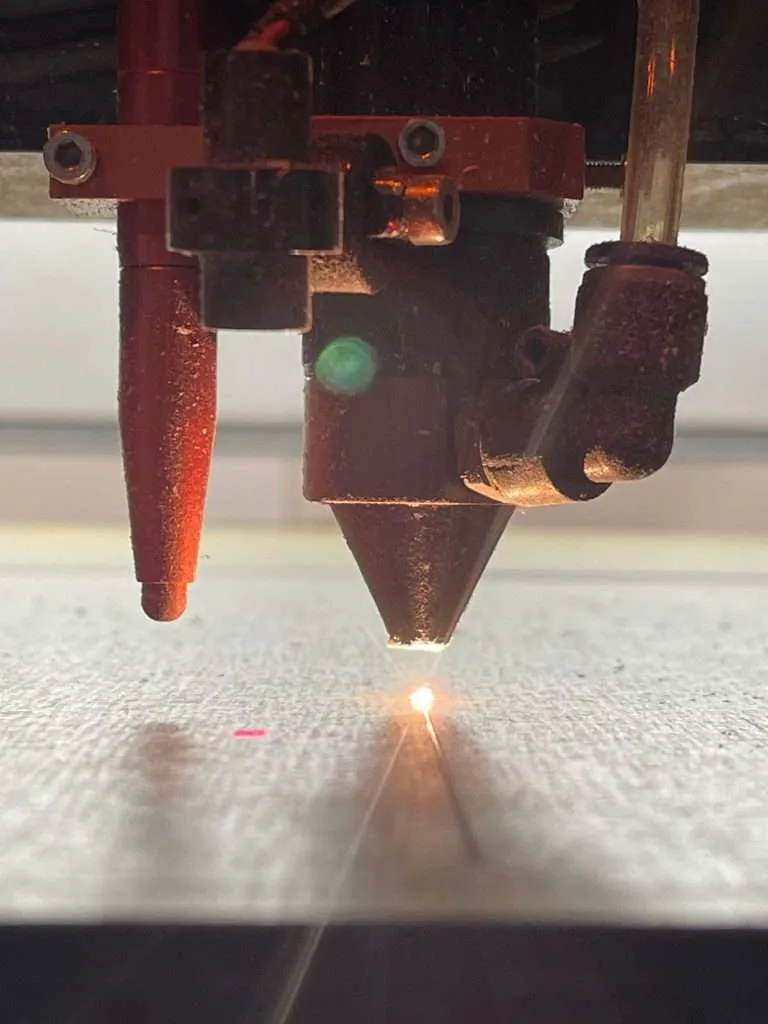
On laser-cut edge quality we make no claim in either direction, and neither should a spec. Plenty of sources assert one confidently each way; what a buyer can actually hold a part to is the standard. Laser-cut edges are specified and inspected against the edge finishing classifications — glossy, with a slight taper that grows with thickness — and that holds whichever sheet the job runs on.
Forming work: the spec and your preference drive it
Thermoforming is where cast-versus-extruded folklore runs thickest, and it is another comparison we decline to adjudicate from the armchair — we make no claim that one sheet type forms more predictably than the other. Two things are worth saying instead.
First, if your organization has a standing preference — a materials engineer who has qualified one sheet type for formed work, or an existing product line built on one — we honor that preference where practical. A qualified material choice is information, and it belongs on the drawing.
Second, formed dimensions carry their own tolerance reality independent of resin: per our published standards, thermoformed dimensions typically hold approximately ±3% to ±5% of the formed dimension depending on geometry. That band, not the cast-versus-extruded question, is usually the constraint that decides whether a formed design works — which is one more reason to settle tolerances at the spec stage rather than the folklore stage.
Routing the decision by process
Put together, the honest decision guide routes by what the part goes through, not by which sheet has the better reputation:
- Thickness-critical flat work — parts sliding into machined slots, stacked assemblies, fixtures for repeat runs: extruded’s tight thickness control is often the property that matters most, and it is typically the more material-efficient choice for straightforward cut-and-polish work.
- Machined or bonded work: cast’s higher molecular weight and lower internal stress are the widely documented reasons it is the traditional pick — a reasonable default, applied with the caveats above.
- Specialty colors and thicknesses: the wider range of colors, patterns, and non-standard thicknesses is produced as cast sheet — a specialty-color spec can settle the cast-versus-extruded question on its own, before any of the process logic above gets a vote.
- Formed parts: bring your qualified preference if you have one; otherwise let the geometry, the formed-dimension tolerance band, and the quote conversation settle it.
- Mixed-process parts — machined and bonded and thickness-critical: this is where the trade-offs genuinely collide, and where a five-minute conversation before the drawing freezes is worth more than any general-purpose rule.
What the drawing should say
The rule we would put on every spec: name cast or extruded when the choice carries a functional consequence, and stay silent when it does not. If a slot fit depends on sheet thickness, say extruded — or better, dimension the fit and let the material requirement follow. If the part is solvent-bonded structural work and you want the traditional low-stress substrate, say cast. If the part is a flat display component that gets cut, edge-finished to a named classification, and shipped, the sheet type is a process-selection detail, and specifying it adds a constraint without adding value.
A spec that names the sheet type only where it matters is easier to quote, easier to fabricate, and easier to hold to a measurable standard. If you are mid-drawing and unsure which lines matter for your part, send it over — routing that decision before the spec freezes is the cheap version of the conversation.