Construction has a document convention that handles complexity beautifully when both sides respect it: the architect draws intent, and the trades draw construction. The architect’s drawings say what the element looks like, where it lives, and how it should feel in the space. The fabricator’s shop drawings say how it is actually built — joints, thicknesses, hardware, tolerances, install method. The submittal loop exists because these are different documents with different authors, each expert in their half, and the loop is where the two halves get reconciled on paper instead of on site.
Fabricated acrylic elements ride this workflow like any specialty trade — and reward the teams that bring the fabricator in early enough for the reconciliation to improve the design rather than merely rescue it.
The document line, drawn clearly
A healthy project keeps the line bright. Intent documents own the design: geometry as experienced, finishes as perceived, relationships to adjacent construction, performance expectations. Shop drawings own the making: panel breaks and joint locations, actual thicknesses, edge conditions, mounting hardware and blocking requirements, clearances for thermal movement, and the dimensional baseline — which for acrylic work means referencing published per-process ranges from the Fabrication Tolerances standard rather than inventing tolerance numbers per project.
Trouble comes from crossing the line in either direction. Intent drawings that dictate construction — a specific joint detail drawn from a glazing habit that doesn’t transfer to bonded acrylic — commit the project to a fabrication method nobody costed. Shop drawings that quietly alter intent — a panel break added where the eye will find it — win the battle with the sheet size and lose the room. The submittal loop is the mechanism that catches both, provided the review reads for the right thing: the architect reviews shop drawings for conformance to intent, and the fabricator flags every place construction pushed back on it.
Where early input changes outcomes
The highest-value fabricator contribution happens before shop drawings exist, at DD, when the design is still soft and input is cheap. Three real patterns, each a save at DD and an expensive redraw at CD:
- Bonded corner → formed radius. A crisp bonded 90° reads beautifully in a rendering. Depending on the element, a thermoformed radius can be stronger, visually cleaner, and lighter on finishing labor — one continuous surface instead of a joint asking to be judged. Caught at DD, the radius becomes the design. Caught at CD, it’s a redesign conversation with a schedule attached.
- Panel exceeds sheet size. Acrylic comes from sheets, and a feature wall drawn as one uninterrupted surface eventually meets that fact. Early input turns the constraint into composition — panel breaks placed where the design wants lines anyway, reveals detailed as intent instead of confession. Late, the same breaks land wherever the material forces them.
- Captured edges relaxed. Edge specs written globally send polished edges into channels and frames where no one will ever see them. Grading edges by exposure — polished where the edge is the feature, saw-cut or sanded where it’s captured — redirects finishing labor to the surfaces that face people. It’s the edge-method vocabulary doing budget work inside the submittal process.
What to send for design-assist pricing
Design teams sometimes delay contacting fabricators because the drawings “aren’t ready.” For design-assist, they don’t need to be. Intent drawings at any stage plus three answers unlock a real response:
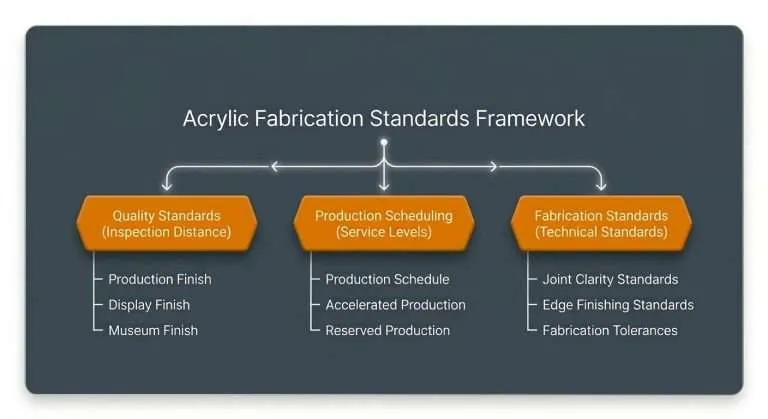
- Material and finish expectations — clear or color, frosted or printed, and the finish grade story: which surfaces face people at what distance, in Quality Standards terms if you have them, in plain words if you don’t.
- Quantity — one feature element and forty repeating panels are different fabrication problems wearing the same drawing.
- Schedule shape — not the finish date alone, but the sequence: when field dimensions could exist, when install must happen, what milestone the element serves.
Format-wise the front-office standard applies: PDF preferred, DXF/DWG accepted alongside. A dimensioned PDF of a DD-stage elevation with those three answers attached gets a useful budget response and useful buildability input; a polished CD set without them gets questions.
The submittal package, from the fabricator’s side
What arrives back through the loop should give the design team something to approve with confidence, and the spec section something to lean on: dimensioned shop drawings referencing the published Tolerances standard as their dimensional baseline; material documentation from the sheet manufacturer for the products specified — the documentation trail code and spec questions deserve, from the source that owns those claims; and finish and joint quality stated in Standards vocabulary — grades per surface by Inspection Distance, edge methods per edge condition, joint expectations for bonded elements agreed in measurable terms.
That last habit is the differentiator worth asking any fabricator for. “High quality throughout” survives in a submittal because no one can act on it; a package that states this face, Display Finish; this edge, buff-polished; this joint, reviewed at sample is machine-citable rigor — checkable at the punch list by someone who never attended a single project meeting. Specs get their authority from being verifiable by strangers.
Revision discipline, both sides
The loop only works if its documents are trustworthy, which is a discipline problem with a boring solution: numbered revisions, clouded changes, and a respected release-to-fabrication gate. Numbered revisions make “which drawing?” answerable. Clouds make changes findable instead of discoverable. And the release gate deserves its one clear paragraph: after release, material is ordered, programs are written, and tooling and fixtures are built against the released documents — so a “small change” after release is not a markup, it’s a new fabrication conversation with its own cost and calendar. Said early and honored by both sides, that sentence is schedule protection — and when the element serves an immovable install milestone, Reserved Production is the other half of it. The change that had to happen still happens; it just happens with its eyes open.
The whole workflow, compressed: bring the fabricator in at DD, keep the document line bright, review submittals for intent, and let the Standards vocabulary carry quality through paper it would otherwise leak out of. If you have an element heading toward CDs — especially one with a curve, an oversize surface, or an edge you care about — start the design-assist conversation now, while the input is still design instead of rescue.