On a surprising amount of signage, the edge is the product. A dimensional lobby letter is mostly edge from every angle a visitor actually stands at; a standoff-mounted panel wears its perimeter like a frame. And yet edge finish is the line most sign specs leave blank — or fill with “polished,” globally, which is its own kind of blank. The Acrylic Edge Finishing Standards define six methods precisely so a sign spec can say what it means, edge by edge. Here they are, and here is the rule that assigns them: sightline decides, not prestige.
The six methods, briefly
- Raw / saw-cut — straight from the cutting operation: matte, possibly showing machining marks. The efficiency edge, for edges nobody sees.
- Sanded — smoothed with progressively finer abrasives to a uniform matte. Visible-but-not-featured edges, or the preparation stage for polishing.
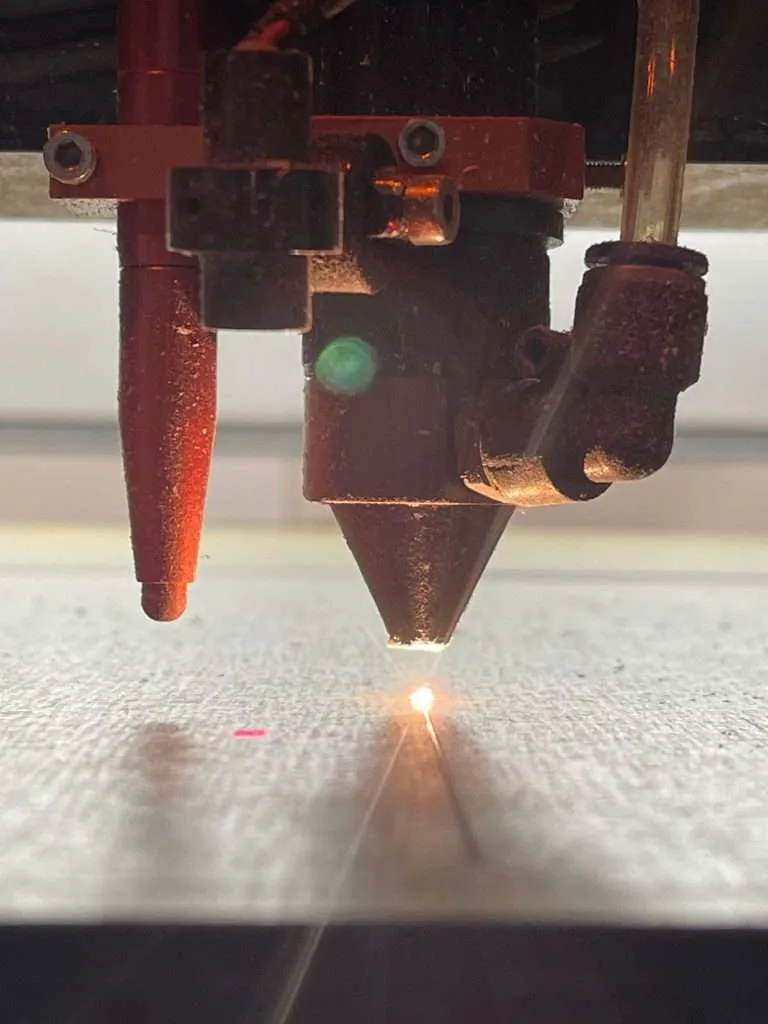
- Laser-cut — the laser’s melt can leave a smooth, glossy edge directly off the machine, depending on thickness and parameters, with slight taper through thickness; most effective on thinner material. The reason cut letterforms can ship with presentable edges and no finishing labor at all.
- Flame-polished — controlled heat melts the edge surface to a clear gloss. The workhorse polish for commercial display and sign work where optical perfection isn’t the brief.
- Buff-polished — abrasive compounds and polishing wheels, mechanically worked. More control and more consistent optical clarity than flame, with edge geometry preserved — the step up where refined, consistent edges are required.
- Diamond-polished — machined to the standard’s highest edge clarity, for the edge that is itself the point.
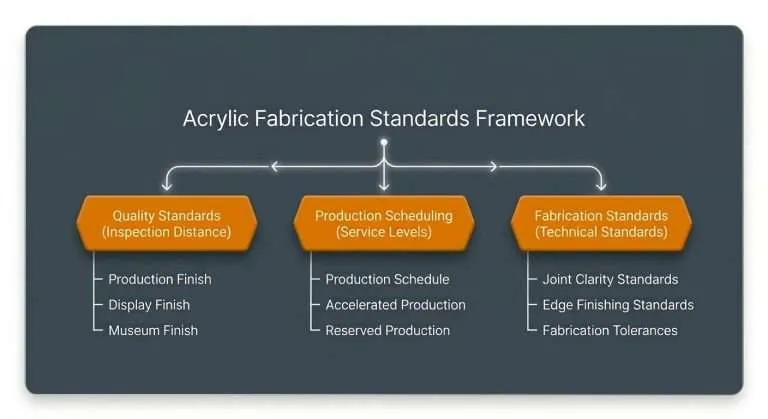
The standard pairs the ladder with the finish grades of the Quality Standards: Production Finish work may commonly use flame-polished or sanded edges, Display Finish work may incorporate buff-polished edges, and Museum Archival work often requires diamond-polished — a useful default map before sightline fine-tunes it.
Mapping methods to sign situations
Cut letters at distance. Laser-finished edges. Dimensional letters reading from across a lobby or above a storefront get their gloss straight off the laser. At the viewing distances letterforms live at, the laser edge is visually complete — finishing labor added past it is invisible from where anyone stands.
Standoff-mounted panels. A panel floating off the wall on standoffs presents its perimeter as a design element at reading distance. This is polish territory — buff-polished as the working answer, diamond-polished above it where the edge itself becomes the design feature — because the edge is examined, the geometry should stay crisp, and consistency across four sides is what the eye checks without knowing it.
Captured and framed edges. Raw or sanded. Edges buried in channels, frames, or wall reveals are structural fit, not appearance. Raw where fully concealed, sanded where a sliver might catch light — and not one method higher, because polish inside a frame is finishing labor delivered to nobody.
Read those three again and the pattern is the whole method: the finishing labor goes where the eyes go, and nowhere else.
The edge-lit exception
One situation overrides sightline entirely. The edge-lit rule: on an edge-lit sign, the light-entry edge must be polished regardless of who sees it. Edge lighting works by pushing light into the panel through an edge, and that edge’s finish is optical throughput — a rough or matte entry edge scatters light before it enters, and the whole face pays for it in brightness and evenness. The entry edge is frequently a hidden edge, tucked into the fixture channel, which makes it the exact inversion of every rule above: the one edge nobody ever sees is the one that must be finished best. It is the single place in signage where edge finish is functional rather than cosmetic, and specs that miss it discover the miss only after the sign is lit.
The cost-factor teaching
Edge labor scales with two things: the method chosen and the perimeter it’s applied to — no figures needed to use that fact. A spec that grades edges by face — front edges polished where the public reads them, captured edges raw where the frame swallows them — buys the visible quality at a fraction of the finishing labor of a polish-everything spec, on every unit, across the whole program. On multi-location sign families, where perimeter multiplies by door count, grading edges by face is one of the few line items a specifier controls completely and unilaterally. The polish-everything spec isn’t safer; it’s just unexamined.
The spec line
All of it compresses to a sentence your sign RFQ can carry:
“Edges: [method] on exposed faces, [method] on captured faces, per the Akrylix Edge Finishing standard.” And where the sign is edge-lit, one more sentence: “Light-entry edges polished.”
That line makes bids comparable — every shop prices the same edges — and makes delivery checkable, because a named method is verifiable in a way “polished nicely” never was. If you’re specifying a sign package and want a second pair of eyes on which edges earn their labor, send the elevations; we’ll mark the sightlines against them, including the one hidden edge that has to be perfect.