Material datasheets answer engineering questions: modulus, impact ratings, service temperatures. Designers decide on different grounds — what the material looks like at eye level, what shapes it permits, how an edge reads, what the piece will look like after six months in the field. This cheat sheet describes the three clear sheets the way a design decision actually gets made, and ends with the move most concept decks miss: specifying per component instead of per project.
Acrylic: the clarity benchmark
What it looks and feels like. Acrylic is the reference for optical clarity in sheet plastics — water-clear, rigid, with a glassy surface and real visual weight. It’s also the only one of the three that takes a genuinely polished edge: our Edge Finishing Standards define a six-method ladder — Raw, Sanded, Laser-Cut, Flame-Polished, Buff-Polished, Diamond-Polished — and the top of that ladder exists because acrylic can get there. On a clear piece, the edge is the design detail; the finish vocabulary post covers how to name it in a spec.
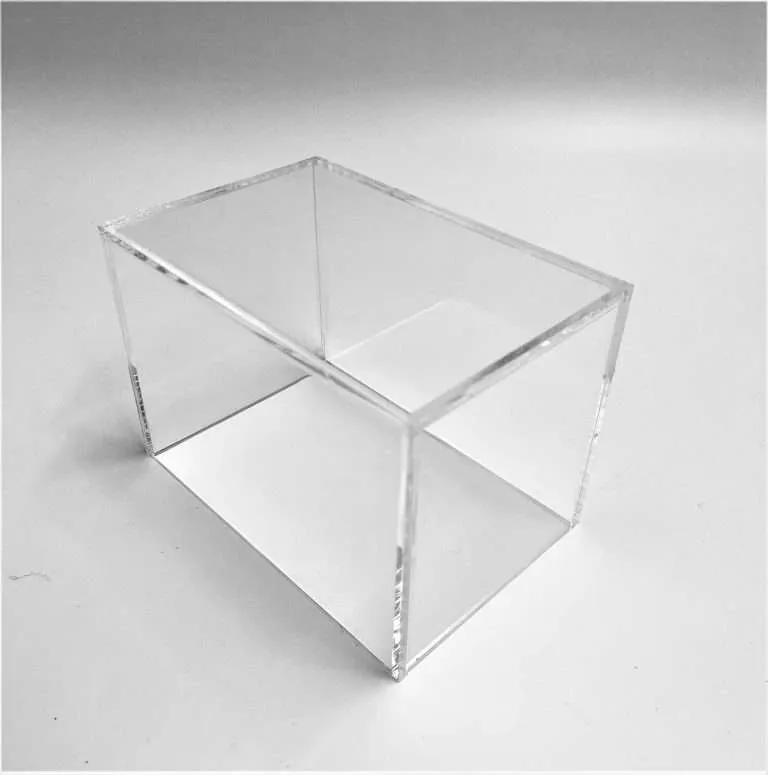
What it enables formally. The widest color, frost and tint range of the three by far. Clean bonded construction — solvent-bonded acrylic assemblies can read as a single piece, held to the Joint Clarity standard, which is what makes the seamless five-sided box a signature acrylic form. Intricate laser-cut profiles whose edges come off the machine smooth and glossy on thinner sheet. Line bends and thermoformed shapes.
How it characteristically fails. Acrylic is notch-sensitive: stress concentrates at sharp internal corners and tight fastener holes, and sheet manufacturers’ guidance treats generous radii and oversized holes as design requirements, not niceties. This is a design input, not a footnote — a concept with hard inside corners at load points is asking the material for its one weakness.
Polycarbonate: the toughness outlier
What it looks and feels like. Clear, but not acrylic-clear, and the difference shows at display distance. The surface is softer — it collects fine scratches faster — and the edge never reaches acrylic’s finish: flame polishing doesn’t work on it at all, and no method takes a polycarbonate edge where a diamond-polished acrylic edge goes.
What it enables formally. Survival. Polycarbonate is the material for parts that must take abuse — high-touch components, guards, anything that lives at hand height in public or at machine height in a plant. It forms and bends, and it bonds, though joint design shifts with the material rather than carrying over from acrylic practice.
How it characteristically fails. Gracefully — which is the point — but it clouds and scuffs where acrylic would still be pristine, and it refuses the laser: polycarbonate parts are saw-cut and CNC-machined, so fine laser-era detailing has to be rethought. Specify it where things hit the piece; spec acrylic where eyes do. The full comparison carries the case-by-case detail.
PETG: the forming-friendly middle
What it looks and feels like. Clear enough for working retail parts, visibly less brilliant than acrylic side by side, with a duller edge and surface. Nobody specifies PETG for presence.
What it enables formally. The sheet manufacturers’ literature positions PETG as the forgiving one — tougher than acrylic and friendly to forming. For lighter-duty parts — high-turnover trays and covers that get handled more than admired — it’s often the honest middle answer.
How it characteristically fails. On looks, over time: the surface dulls, and it never had acrylic’s edge or optical depth to begin with. The acrylic-vs-PETG comparison maps where the crossover sits.
The move designers under-use: specify per component
Real builds are mixed. The piece the customer sees and photographs is acrylic; the surfaces everyone’s hands and bags hit are polycarbonate; structure underneath is MDF or metal or wood, incorporated as the design requires. Material is a per-component decision, and making it at concept stage is free. A workable shorthand for each component:
- Is it the face of the piece? Eye-level, photographed, edge visible → acrylic, with an edge method named from the ladder.
- Does it get hit, leaned on, or handled carelessly? → polycarbonate, with the finish expectation set accordingly.
- Is it a working part that just has to be clear and survive turnover? → PETG earns a look.
- Will it be finished opaque or never seen? → it probably shouldn’t be a clear plastic at all.
Two spec habits that make all of this land
Treat thickness as a design material. The same form in thin and thick sheet reads as two different objects — thick acrylic has the visual weight of glass furniture; thin sheet reads light and commercial. Thickness is specifiable across the standard range, and the word is always thickness in a plastics spec.
Name the finish expectation, not an adjective. “Premium edges” survives contact with nobody’s purchasing department. A method from the edge ladder and a grade from the Acrylic Quality Standards survive everything. The agency guide covers how the whole handoff works when the vocabulary is shared from the first deck — and a concept-stage material question costs nothing to ask before the deck is final.