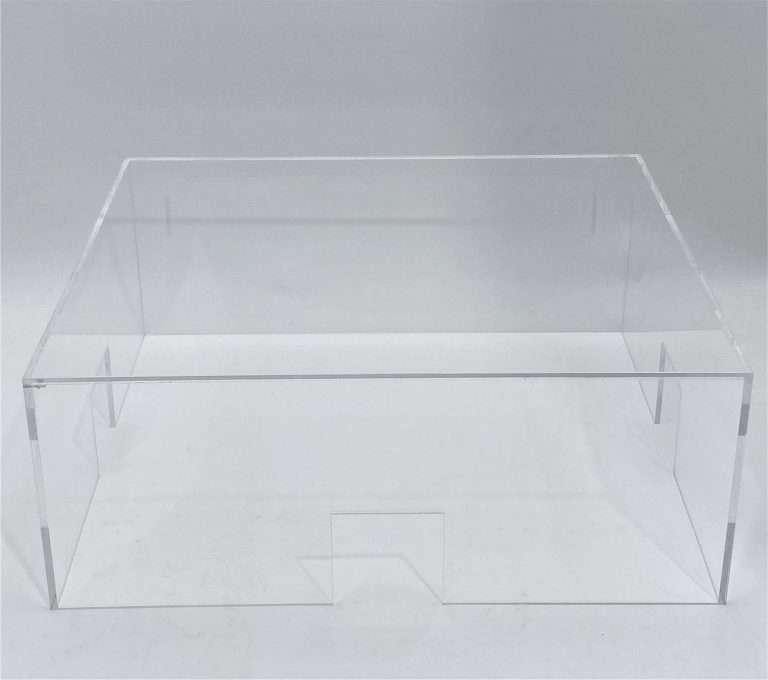
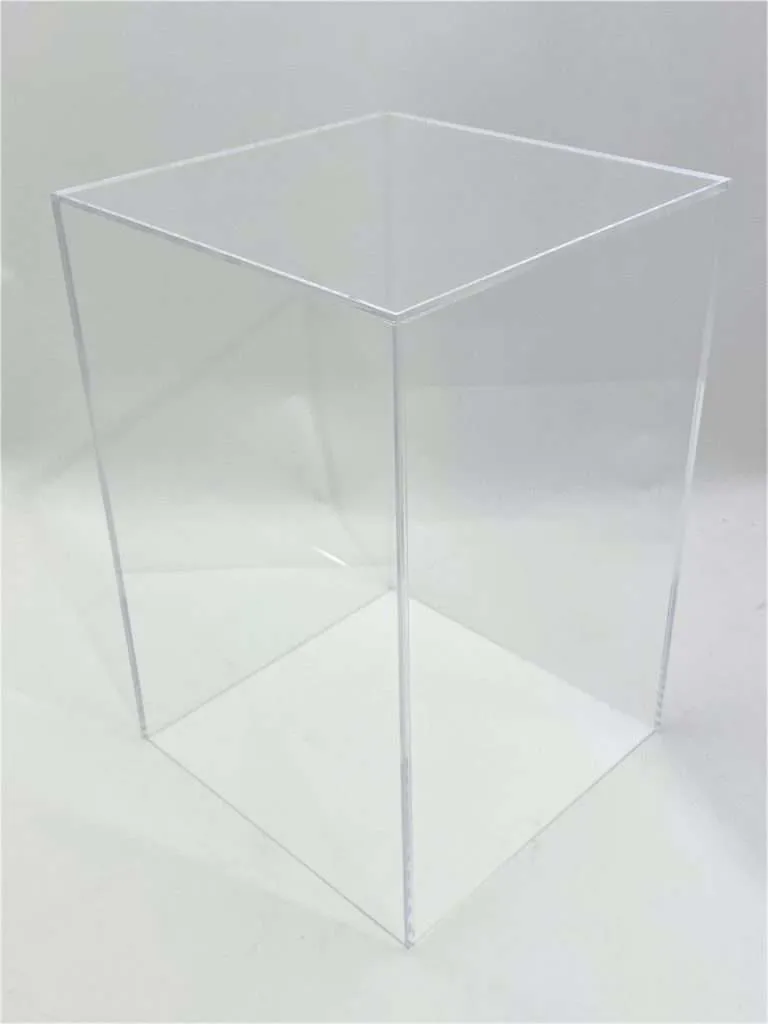
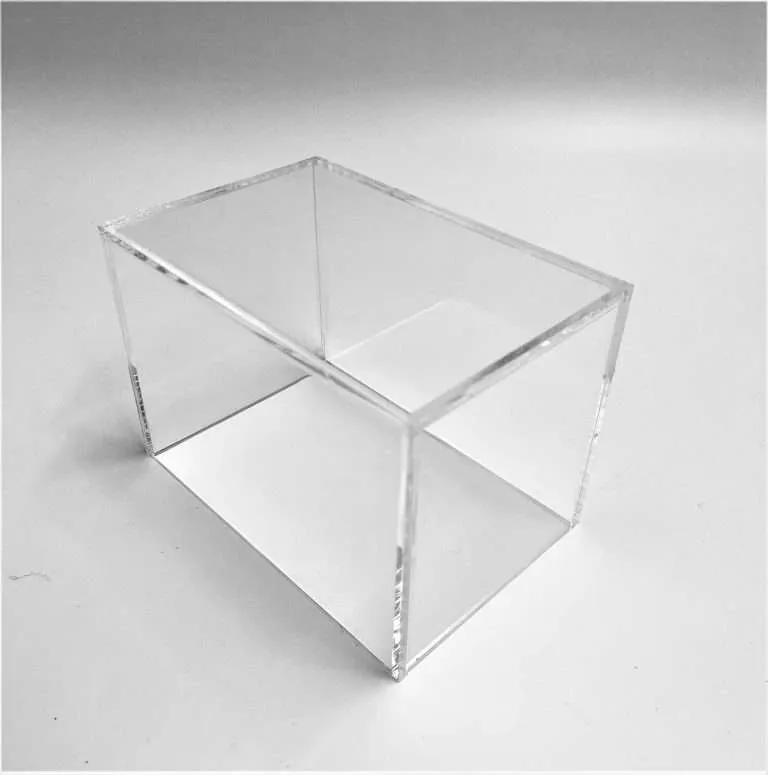
When a registrar, a lab manager and an exhibit designer each ask for an “airtight” acrylic case, they are asking for three different things. One wants dust kept off an object between cleanings. One needs the air inside the case to exchange with the room as slowly as possible, usually to hold a humidity level. One needs water to stay in — or out. The word is the same; the construction is not. Specifying the right one starts with saying which of the three you mean, and saying it as a requirement that can be checked rather than as an adjective.
Three requirements that share one word
Dust-resistant is a passive requirement: close-fitting parts, no open gaps, a lid or bonnet that sits on a surface or in a channel so airborne dust has no direct path in. Most display cases and vitrines are built to this expectation without anyone writing it down. It does not stop air exchange, and it is not meant to.
Sealed against air exchange is a conservation or laboratory requirement. The case is expected to exchange air with the room slowly enough that a conditioned interior — a silica-gel-buffered humidity, an inert gas, a dry atmosphere — holds for a useful period. This is a measurable property with a target, and institutions that need it generally have a number in mind or a conservator who does.
Watertight is the requirement for tanks, chambers and props that hold liquid, and for enclosures that face splash or immersion from outside. It is a different engineering problem from the other two, because liquid finds paths an air-exchange test is not looking for and because standing water loads the joints continuously. The bonded acrylic tanks and chambers post covers that construction on its own.
A case specified as “airtight” that the buyer actually needed to be dust-resistant will be over-built. One specified as “sealed” when the buyer meant watertight will be built to the wrong failure mode. Naming the requirement is the whole first step.
The constructions, described as built
Each requirement points to a construction. These are descriptions of how such cases are built, not ratings of what they achieve; the achievement is the test’s to report.
Fully bonded seams. Where the case has no opening — a five-sided bonnet, a sealed display block, a chamber with ports fitted later — every seam is solvent-bonded along its full length. A bonded seam has no gasket to age and no fastener to loosen, and on a clear case it is also the seam the viewer sees, so it is specified for joint clarity as well as continuity. The joint clarity for bonded vitrines post covers what a continuous, clear bond looks like and how it is called out. Where the bonnet itself has no opening, access is through the base or deck it sits on. Mating edges are scuffed before bonding, following the sheet manufacturer’s fabrication requirement, which is part of why a bonded seam is specified as a continuous joint rather than a line of contact.
Gasketed removable lids in a machined channel. Where the case must open, the lid lands on a gasket seated in a machined groove. The channel locates the lid; the gasket is the sealing element; the lid’s own weight or a few fasteners provide the compression. The gasket material is a selection the customer makes with their conservator, for reasons the next section explains. The vitrine sealing and dust mitigation post goes into the gasket and channel detail.
Compression closures with fasteners. Where the seal has to resist pressure — a chamber that is purged with gas, a dry box kept slightly positive — the lid is drawn down against its gasket with captive fasteners, latches or clamps, spaced closely enough that the gasket is compressed evenly along its length. The fastener pattern and the lid stiffness are the design; a thin lid between widely spaced clamps will bow and open a gap between them.
Access design. Ports, glove openings, cable pass-throughs and doors are each a hole in the seal, and each has its own closure. The instrument enclosures and equipment covers post treats access openings and pass-throughs in detail. Every access feature on the drawing should carry its own answer to “how is this sealed when closed.”
The trade-off conservators raise first
A tighter case is not automatically a better case for the object inside it. Case materials — adhesive residues from the bonded joints, and everything that is not acrylic: the deck, fabrics, paints, coatings, gaskets — can off-gas, and a case that exchanges air slowly with the room holds those vapors near the object instead of diluting them. Conservators know this well, which is why a request for a sealed case usually arrives together with a request about what the case is made of. Material selection matters more in a sealed case than in an open one, and it is a conversation to have before construction is specified. The conservation-safe case construction and Oddy-testing-aware materials posts cover how institutions approach that selection and what a fabricator can and cannot say about it.
How to specify it: a requirement, a test and a tester
The specification that works has three parts. First, the requirement, in the terms of the three categories above — dust-resistant, sealed to an air-exchange target, or watertight to a stated depth or exposure. Second, the test that demonstrates it: an air-exchange or leak-rate measurement, a humidity-hold period, an immersion or fill test with a duration. Third, who performs the test and where — the institution’s conservation staff, a laboratory, a commissioning agent, on site or on receipt. Those three lines turn an adjective into an acceptance criterion.
We build the construction to that specification: the seams, the channel, the gasket seat, the closure pattern, the access features, each to the drawing and to the per-process ranges in the Acrylic Fabrication Tolerances standard, with the cosmetic grade — Production, Display or Museum Archival Finish — held to the Inspection Distance the Acrylic Quality Standards define for the case’s setting. The performance test is the customer’s or their conservator’s to define and perform, and the specification should name both the test and the tester.
Beyond the gallery
The same three requirements show up far from museums. Laboratory dry boxes and desiccator-style cabinets are sealed-against-exchange cases with a humidity target. Sample enclosures and specimen cases are dust-resistant or sealed depending on what they hold. Exhibit props that hold water — a demonstration tank, a lit water feature in a booth — are watertight construction in a presentation setting. Each one specifies the same way: which requirement, which test, who runs it.
Planning a case or enclosure with a sealing requirement? Send the drawing with the requirement named in one of those three terms, and the construction questions come back with the quote.