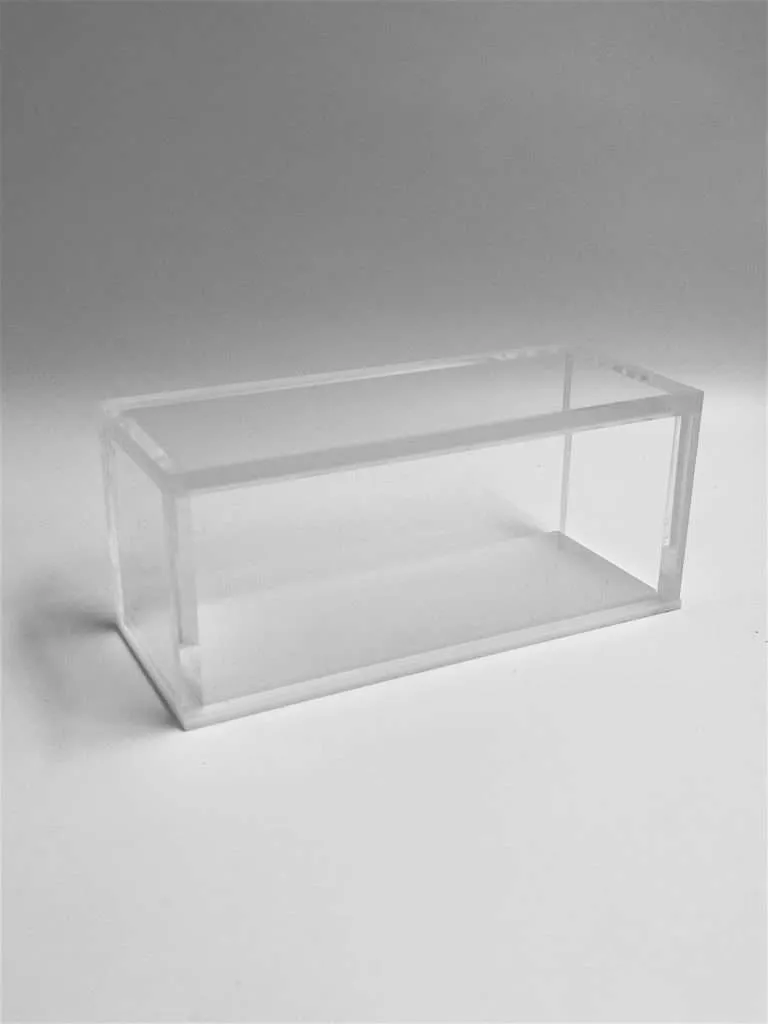
Acrylic spoils people. Solvent bonding fuses two acrylic parts into what is functionally one piece, and a well-executed joint on polished-edge work can be close to invisible — which is why “bonded” and “seamless” have blurred together in display-work vocabulary. Then a project lands in polycarbonate, PETG or PVC, the drawing says “bond per standard practice,” and the acrylic expectation collides with different chemistry. Same process name; different material; different joint. Here is what actually changes.
Why the playbook is material-specific
Acrylic solvent bonding works because the solvent softens both faces and lets them fuse as it leaves. That mechanism belongs to acrylic’s chemistry. Other clear and semi-clear sheet materials respond to joining their own way — some tolerate solvent-type joints with caveats, some want specific adhesive families, some resist adhesives broadly — and the governing document in every case is the sheet manufacturer’s fabrication guide, which states what the maker of that exact material says about joining it. That attribution matters: joint behavior varies by grade and brand, and the guide for the sheet on the order is the reference, not a generic rule for the polymer. (The common ground across materials: manufacturers call for clean, prepared mating surfaces — scuffing mating edges before bonding is standard preparation, and we follow the manufacturer’s requirement as a matter of course.)
Polycarbonate: respect the stress
We bond polycarbonate — to other polycarbonate and to other materials — and the material’s defining trait in joining is stress sensitivity. Polycarbonate’s toughness coexists with a vulnerability to certain chemistries at stressed locations, and a joint line is exactly where machining and assembly stresses live. This is why polycarbonate manufacturers’ guides put such weight on preparation and on using the adhesive families they specify: the wrong chemistry at a stressed edge is how a tough material develops fine cracks at the one place the part can’t afford them. Two practical consequences for specifiers:
- Mechanical fastening is a first-class alternative, not a fallback. On guards and equipment panels — polycarbonate’s home turf — bolted and captured designs are everywhere, because they sidestep joint chemistry entirely and make replacement easy. The trade-off conversation is the one in fastening vs bonding.
- Don’t spec the acrylic look. A polycarbonate joint can be strong and clean; writing “invisible seam” into a polycarbonate spec writes a disappointment into the contract. Say what the joint must do, then ask what it will look like.
PETG and PVC: the joint follows the part’s job
PETG shows up in our work in formed parts, trays and fixture components — applications where the joint is usually structural rather than showcase. PETG bonds, with its manufacturers’ guides specifying the suitable adhesive families, and the realistic expectation is a workmanlike joint on a workhorse material: fine in a fixture, not the move for a jewel-box display (that part wants to be acrylic in the first place — see acrylic vs PETG for the whole decision).
PVC — including expanded PVC, the sign and display workhorse — joins readily by adhesive, and in sign-and-display assemblies the joint is almost always hidden structure: backer to frame, gusset to panel, standoff block to sheet. Appearance barely enters; fit and coverage do. Expanded PVC’s fabrication behavior is its own subject, but for joining purposes the summary is: the adhesive family comes from the manufacturer’s guide, and the joint is engineered to be strong, not seen.
What this means for the spec
The Joint Clarity vocabulary exists because “bonded” alone says nothing about appearance — and that vocabulary was built on acrylic, where the full range from structural joint to presentation joint is on the table (see it applied in joint clarity on clear displays). On other materials, the honest spec works in two lines instead of one word: state the structural requirement (what the joint carries, what environment it lives in), and state the visual expectation separately — then let the material answer. Sometimes the answer is “that expectation needs acrylic”; sometimes it is “bolted, and better for it.” The comparison of joining methods across the board is in bonding methods compared, and the failure modes that follow from skipping the manufacturer’s prep are catalogued in solvent bonding failure modes.
One material’s playbook, applied to another material, is the quiet source of most joining disappointments we see at quote time. State the job, name the material, and let the fabrication process follow the sheet — the full standards vocabulary that keeps those conversations precise lives at the standards hub, and a drawing with a joint question on it is a fine thing to send to the quote desk as-is.