Ask an exhibit designer what matters in a vitrine and you’ll hear about clarity. Ask a registrar and you’ll hear two different questions first: how does dust get in, and how do we get in? Those two questions are actually one design problem, because every access provision — every lid, hinge, and removable panel — is also a seam, and seams are where dust travels. Sealing design in acrylic casework is the craft of giving staff the access they need while giving dust as little as possible, and it is decided at the drawing stage, not at installation.
Start with access: who opens it, and how often
The access decision drives everything downstream, so it comes first. The honest inputs are frequency — how often objects rotate — and authority: who is permitted to open the case, with what supervision. The four standard answers, in rising order of access convenience:
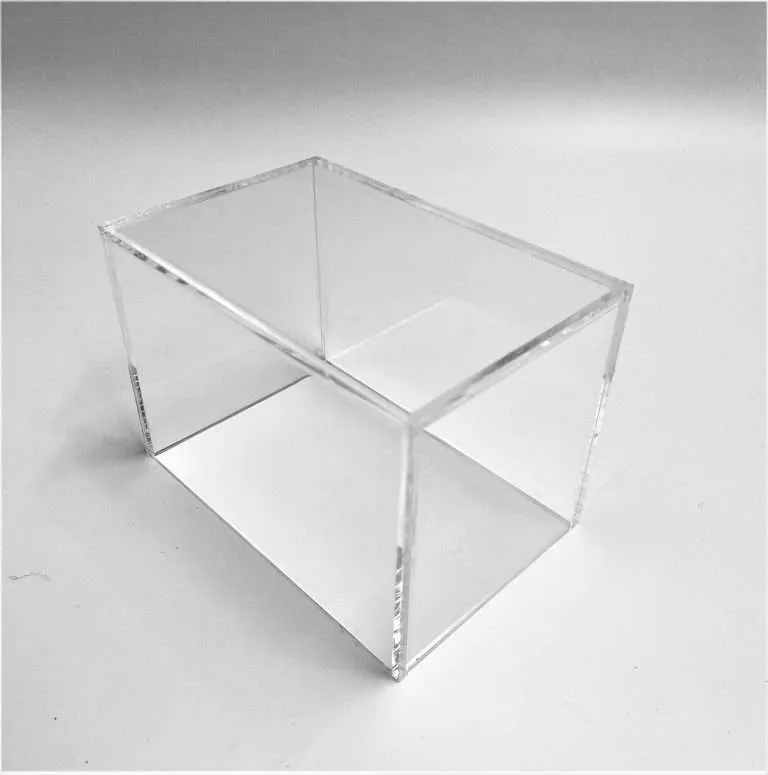
Lift-off bonnet. The five-sided bonded cover over a base or deck. No hardware, no hinge seam, one continuous interface at the base — the cleanest sealing story and the strongest visual. Its cost is operational: opening means lifting the entire cover, which for larger cases is a two-person event and for oversize ones a scheduled one. Right where rotation is rare and the object deserves the uninterrupted volume.
Hinged front or top. A door in the case. Access becomes a one-person, minutes-long operation — the right answer where rotation is frequent — at the price of a perimeter seam around the door and hardware that must earn its keep visually and mechanically. Hinge quality and closure design decide whether the door seats consistently against its interface or develops a gap that grows with use.
Sliding rear panel. The workhorse of wall-adjacent casework: access from the service side, invisible from the viewing side, with the sliding track as the managed seam. Track design matters more than it looks — a well-fitted panel in a machined track seats snugly; a loose one is a permanent gap dressed as a door.
Removable panel. The infrequent-access compromise: a panel that seats on a gasket or machined interface and is held by fasteners — more sealed than a hinged door, more accessible than a bonded volume. The natural home of tamper-resistant hardware where security is part of the brief.
The interface options, as actually built
Between cover and base, panel and frame, there are three standard interface constructions. None of them makes a case airtight, and none needs to — the job is dust mitigation, described here as built, without microclimate claims:
- Rebated channel gasket. A machined channel in the base or deck carries a compressible gasket; the cover’s edge lands in the channel and compresses it. This closes the direct path, accommodates minor dimensional variation, and gives the cover a defined, repeatable seat. Gasket material selection matters in collections settings — inert, conservation-appropriate materials, chosen with the institution’s conservator where the brief requires it.
- Felt-lined lip. A softer-spec cousin: the cover seats against a felt-lined rebate or lip. Less closure than a compressed gasket, but a real improvement over a hard seat, quieter to operate, and appropriate where the dust brief is moderate and the budget factors matter.
- Close-fitting machined skirt. No compliant material at all: the cover’s skirt is machined to fit the base’s rebate closely enough that the labyrinth itself is the mitigation. Elegant, durable, nothing to age or replace — and entirely dependent on machining accuracy, which is the point of the next section.
Machining precision is the real sealing enabler
Here is the part of sealing design that never appears in the brochure photo: the interface is only as good as the fit, and the fit is a machining outcome. A CNC-machined skirt and rebate that land within the published assembly range of our Fabrication Tolerances standard — approximately ±1/16″ to ±1/8″ for fabricated assemblies, with machined components tighter still — produce a cover that seats the same way every time staff replace it. A sloppy fit produces a gap, and no amount of gasket rescues a gap: the gasket compresses where the fit is close and bridges nothing where it isn’t. When you evaluate casework bids, the question that matters isn’t “is there a gasket?” — it’s “what tolerance is the interface machined to, and is that number in the shop drawings?” A fabricator working to published ranges can put it there; that’s what published ranges are for.
Where fabrication scope honestly ends
Some collections require more than dust mitigation: humidity-buffered microenvironments, silica gel management, active climate systems, monitored interiors. That work belongs to conservation specialists and environmental-systems providers, and a fabricator should say so plainly rather than gesture at it — a well-sealed case is not a controlled microclimate. What fabrication contributes to those projects is the vessel built to house the systems: base cavities and equipment chambers dimensioned for gel trays or conditioning units, access panels into the chamber separate from object access, pass-throughs machined where the conservator’s design needs them. The division of labor is clean — the institution’s conservation team specifies the environment; the casework is fabricated to give that specification a home.
Security hardware, selected by the institution
Access design’s final layer is who can’t get in. The standard options ride the constructions above: tamper-resistant fasteners on removable panels, lockable sliding tracks and hinged doors, concealed cleats that make a bonnet’s removal non-obvious to anyone without the knowledge and the second pair of hands. These are options the institution selects against its own security brief — public gallery versus staffed reading room versus traveling venue — and the right time to select them is while the case is lines on a drawing, because retrofitted security hardware always shows.
Sealing, access, and security travel together, and all three are specification decisions before they are fabrication ones. If you’re writing a casework brief now, put the rotation frequency, the opening authority, and the dust expectations in it explicitly — those three lines do more for the outcome than any adjective. Then send it to us: we’ll come back with the access construction, the interface detail, and the machining tolerances written on the drawing, where a registrar can hold the built case to them.