Most lab fixtures are specified by inheritance: the new enclosure is whatever the old enclosure was, because that one worked. It’s not a crazy method — until the fixture changes job. The guard that was fine as a splash shield gets asked to stop a rotor fragment; the cover that only had to be clear gets asked to live over a solvent bath. Acrylic and polycarbonate look interchangeable in a photo and behave nothing alike in service, so here is the decision on its actual axes.
The four axes that decide
Optical clarity: acrylic. Acrylic is the clearer material and stays that way — it resists UV-driven yellowing inherently, while polycarbonate’s surface picks up fine scratches faster and hazes sooner under cleaning. For a fixture whose job is to be seen through for years — observation windows, instrument covers, demonstration enclosures — acrylic wins the long game.
Impact: polycarbonate, decisively. Where failure means a flying fragment or a determined impact — physical containment around rotating equipment, guards in the path of real energy — polycarbonate’s toughness is usually the whole decision. This is the same logic as industrial guarding, and the machine guard design guide and guarding comparison carry it in depth.
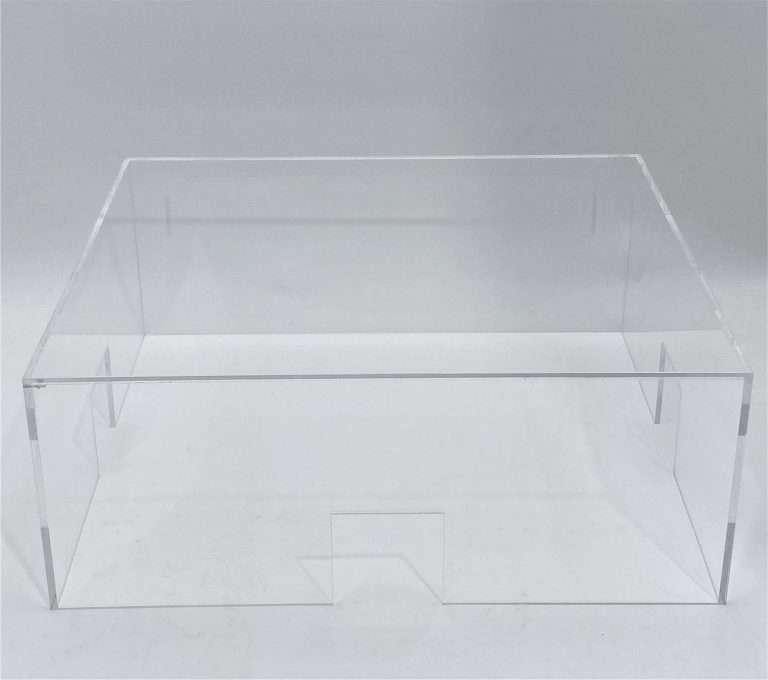
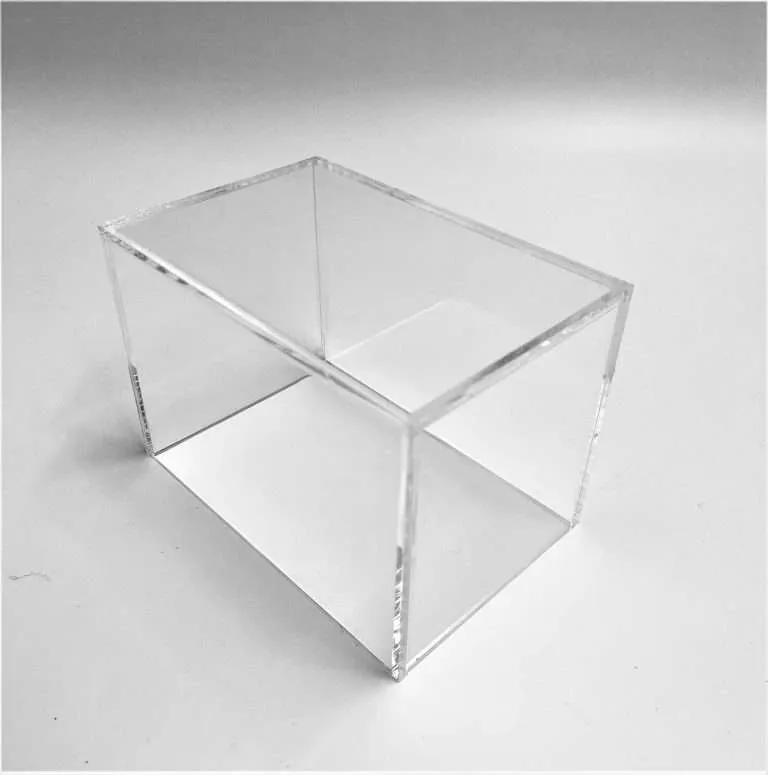
Buildability: acrylic, and it changes the geometry you can have. This is the axis specifiers most often miss. Solvent-bonded acrylic construction makes the seamless chamber possible: five-sided boxes, tanks and chambers, enclosures with bonded ports and internal features that read as one piece. Polycarbonate bonds too — we bond it to other polycarbonate and to other materials — but the joints read differently, and polycarbonate fixtures more often lean on mechanical fastening: visible hardware, gasketed joints, design around fasteners. Acrylic also machines and polishes beautifully, and takes the laser — polycarbonate is never laser-cut; it’s saw-cut and CNC-machined, so fine profile work belongs to acrylic. Choose the material and you’ve largely chosen the construction character; it’s worth knowing that before the geometry is drawn.
Scratch behavior: neither is glass. Both materials are plastics and both need care in cleaning — abrasives and the wrong solvents are the enemies. Acrylic holds its surface somewhat better; polycarbonate forgives impact instead. Plan the cleaning protocol with the material, not after it.
Chemistry: the honest answer is a chart, not a slogan
Both materials have real chemical vulnerabilities, and they’re different ones. Manufacturers’ guidance flags classes rather than guarantees: chlorinated and aromatic solvents are trouble for both; strong bases attack polycarbonate in particular; alcohols and some cleaners attack stressed acrylic, which is why crazing shows up at fastener holes and bends first. None of that is a substitute for the actual check: take the resin manufacturer’s chemical-compatibility chart for the specific sheet product and read it against the reagent list that will really be in the room — including the cleaning chemicals, which are often the harder exposure to survive. If the fixture will see chemistry daily, that chart belongs in the spec package. (And if the real answer is “constant aggressive chemistry,” the right material may be neither — that conversation is worth having at the spec stage.)
Situational verdicts
- Guards over moving machinery → polycarbonate; impact dominates everything else.
- Optical enclosures, demo cases, instrument covers → acrylic; clarity and finish dominate, impact is incidental. Enclosures and covers covers the fixture family.
- Bonded chambers, tanks, sealed enclosures → acrylic; the construction method is the requirement.
- Shields in radiation-adjacent work → acrylic is what we’re asked to fabricate for that setting — beta shield fabrication covers what the shop builds — with performance requirements and any ratings specified by the lab, not the fabricator.
- High-touch fixtures in teaching labs → polycarbonate earns its keep wherever undergraduates do.
The one-question shortcut
If the spec meeting is short, ask this: what breaks it in your lab — impact, chemistry, or nothing? “Impact” points to polycarbonate. “Chemistry” points to the compatibility chart before it points to either material. “Nothing — it just has to be clear, clean and precise” points to acrylic, which is the answer for most fixtures that aren’t guarding something energetic.
Either way, the finish and precision expectations should be named, not assumed — the Acrylic Quality Standards exist so a lab fixture spec can say exactly what “good” means. The wider context for the material in research settings lives in the lab and research guide, and a fixture drawing with a question mark on its material line is exactly the kind of thing to send over.