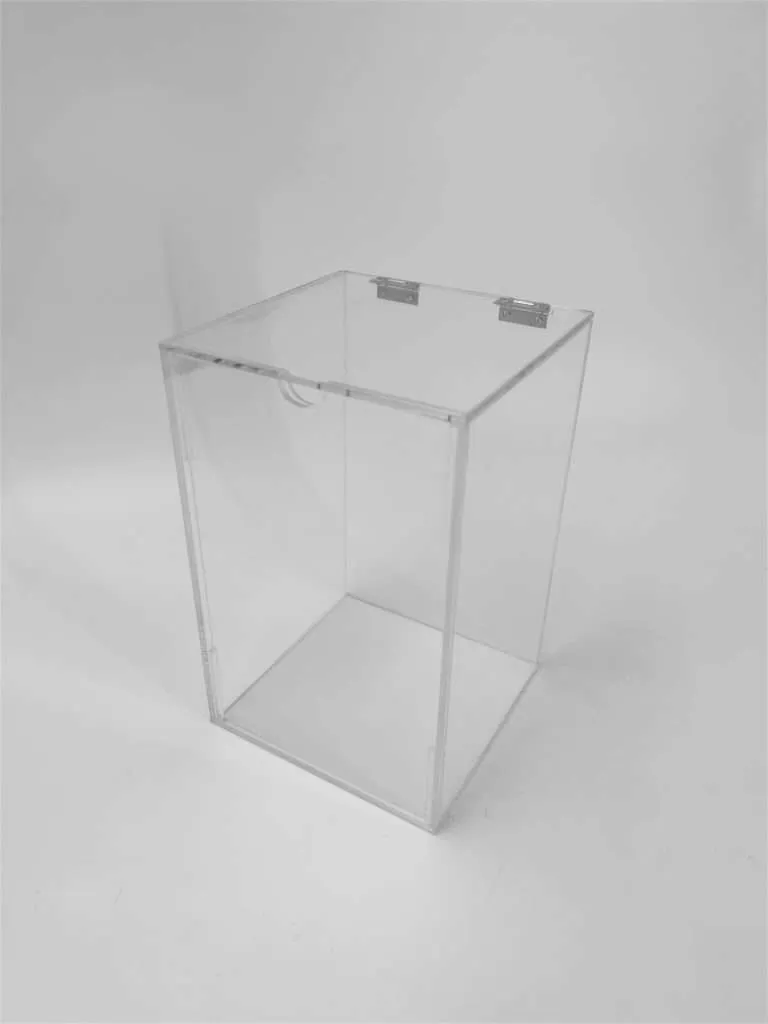
A custom lab enclosure is easy to specify backwards: the material chosen first (“make it out of acrylic — that’s what these are made of”), the environment discovered later, one cleaning cycle or one dropped tool at a time. The durable way to choose runs the other direction. Start from what the enclosure has to survive — what gets spilled on it, what hits it, how hot it runs, and whether people need to see through it — and the material usually picks itself from a short list of four.
The four questions
What gets spilled or wiped on it?
Chemical exposure is the question labs underweight, because the damage is slow. The bench’s wipe-down chemistry — not just the reagents in the experiment — is part of the enclosure’s environment, and some common lab cleaning agents attack clear plastics over time (on acrylic the signature is crazing — fine surface cracks that are permanent by the time they’re visible). The honest division of labor: the lab states the chemicals, the sheet manufacturer’s published compatibility chart narrows the materials, and the fabricator builds from what survives that cut. No fabricator’s assurance substitutes for the chart.
What hits it?
An enclosure around moving equipment, student traffic, or anything energetic enough to throw a part has an impact requirement; a dust cover over a balance does not. Impact is where polycarbonate earns its reputation — and where the lab, not the fabricator, owns any formal performance requirement (the lab’s safety review states the standard and the thickness; we build exactly that).
How hot does it run?
Clear plastics have working temperature ceilings, and an enclosure over heat-shedding equipment lives at the warm end of the room’s range. The manufacturer’s data sheet carries the service-temperature guidance for the specific sheet — state the heat load in the RFQ and the material conversation can respond to it.
Does anyone need to see in?
Visibility sounds binary and isn’t. A demonstration enclosure is all about optics; a reagent cabinet needs a window at most; a chemical-handling tray needs none. Paying for optical clarity on faces nobody looks through is a common quiet overspend in lab work.
Material by job
Acrylic is the default where visibility matters: the clearest of the four, and the one whose bonded joints can be genuinely presentable — which is why display-grade science (teaching enclosures, demonstration cases, anything photographed) is almost always acrylic. It is also the most sensitive of the four to aggressive cleaning chemistry, which is why the wipe-down question comes first, not last. For the broader acrylic-vs-polycarbonate decision, the material comparison covers the trade in full.
Polycarbonate is the impact answer: enclosures that take hits, guards around student-accessible equipment, covers that get leaned on. It is less scratch-resistant than acrylic and its bonded joints read differently — a clear-seam expectation written for acrylic shouldn’t be carried over unexamined. Fabrication-wise it is a different animal too; the polycarbonate fabrication guide covers how it is cut, formed and joined.
HDPE is the workhorse for opaque, chemically exposed parts: spill and containment trays, bases and liners under wet work. It shrugs off a wide range of chemistries (again: the manufacturer’s chart decides), machines cleanly, and costs sensibly. What it will not do is bond like acrylic — HDPE parts are joined mechanically, designed as captured assemblies, or welded where the design calls for a seam rather than hardware, which affects the enclosure’s architecture and is worth knowing before the drawing exists.
PVC covers opaque chemical-handling fabrications — tank surrounds, ducting-adjacent parts, wet-bench components — where its chemical resistance profile fits the exposure. Where a design wants PVC’s chemistry and a sightline, the answer is a mixed build: an acrylic or polycarbonate window set into the PVC body.
Mixed enclosures are the norm, not the exception
The four-material decision is rarely one decision per enclosure — it is one per surface. Many of the custom lab builds we quote are hybrids: an opaque chemical-resistant body (HDPE or PVC) with a clear acrylic or polycarbonate window where the eyes need to go; a bonded acrylic enclosure sitting in an HDPE spill tray; a polycarbonate guard face on a frame with acrylic side lites. Joining follows each material — solvent-bonded acrylic to acrylic, polycarbonate bonded or fastened as the design calls for, HDPE fastened or welded — and designing those seams deliberately is most of the engineering. The same logic drives glove-box-style enclosures and instrument enclosures and equipment covers, and the full process-by-material picture is in the plastic process matrix.
Putting it in the RFQ
The enclosure RFQ that quotes fastest and builds best states the environment, not just the box: dimensions and access (doors, ports, pass-throughs), the wipe-down chemistry and any reagent exposure, impact and heat realities, which faces need to be clear — and any formal requirement from the lab’s own safety review, stated as a specification. From there the material conversation is short, and where the answer should be “a different plastic than you asked for,” we will say so and show why. More on how labs and universities buy custom work — ordering, POs, timelines — is in the acrylic in universities and research labs guide, and the quoting path starts at the RFQ form.
Four questions, four materials, one honest chart. Enclosures specified this way tend to get built once.