Here is something a custom fabricator is supposed to say quietly, if at all: for a standard-size insert, in a standard orientation, at a generic placement, the catalog sign holder is the right buy. An 8.5×11 slant-back for the reception desk, a T-base card holder for a table — stock lines exist because those jobs repeat identically across a million businesses, and competing with a warehouse full of them on their home turf serves nobody. If that is the whole requirement, buy the catalog part with a clear conscience.
The reason this post exists is that “the whole requirement” quietly stops being true in five specific, recognizable situations — and buyers who force stock past those lines pay for it at the shelf, where it shows.
The five triggers that flip the answer
1. The insert isn’t standard
The moment the media is a die-cut card, a nonstandard menu size, a thick booklet, or the brand’s own printed piece with its own dimensions, the catalog’s nominal sizes start forcing compromises: inserts that slump in an oversized pocket, or get trimmed to fit an undersized one. A fabricated holder is built around the actual insert — which is also the spec discipline: when replacing an incumbent holder, send the real media and its measured dimensions, never the catalog’s nominal size for the old part.
2. The holder itself carries the brand
A stock holder is deliberately anonymous — a frame around someone else’s message. When the fixture should speak — a logo UV-printed on the base, brand color in the acrylic, an engraved mark — it stops being a commodity by definition. Print and engraving each suit different looks and lifespans; the decision is laid out in UV vs screen vs vinyl printing.
3. One unit, several jobs
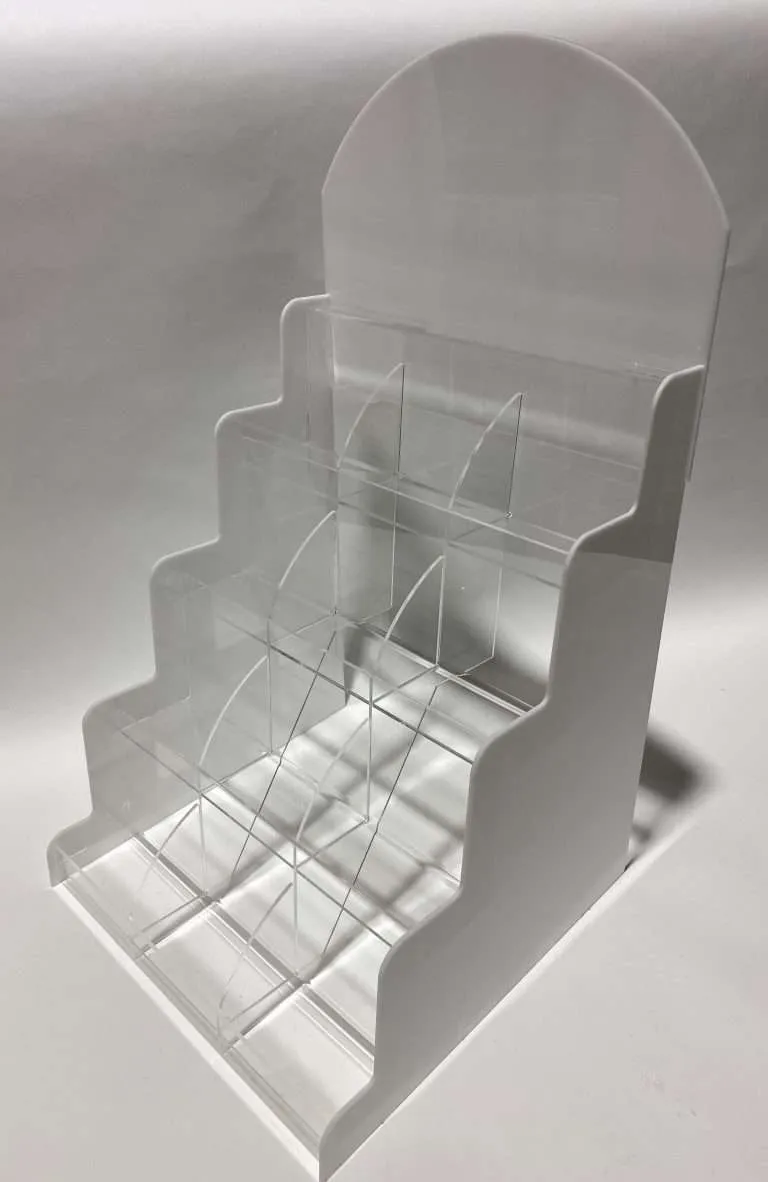
Sign plus literature pocket. Sign plus product riser. Menu plus QR plaque plus pick-up tray. Catalogs sell each function separately because warehouses stock parts, not solutions; a fabricated unit integrates them into one footprint — and countertop real estate is usually the scarcest resource in the whole program (the spec thinking is the same as in the countertop display spec guide).
4. The fleet has to match
A program that needs the same presentation at the register, on the shelf edge, at the service counter and in a window will not find one catalog family covering every placement — so the “stock” program ends up visibly assembled from three vendors’ aesthetics. A fabricated family is designed once and sized per placement: same radii, same thickness logic, same finish grade (the vocabulary for pinning that down is in finish grades for brand fixtures).
5. The quantity changes the arithmetic
Catalog pricing is built for small drops; production fabrication is built for runs. At program quantities, a production run of a holder designed for efficient sheet yield competes seriously with catalog pricing structures — and the real comparison is run-specific, which is exactly what a quote settles. How quantity reshapes fabricated-unit economics is the subject of designing POP for volume runs.
What forcing stock actually costs
The savings on a forced-fit stock holder are visible on the purchase order; the cost is visible at the shelf. A taped-in insert, a planogram compromised around a footprint that was never designed for it, a brand presentation delivered in a frame identical to the competitor’s two feet away — the display does its job all day, every day, in front of the only audience that matters, and it reads as exactly what it is. Presentation is what the fixture was for; paying procurement’s savings out of presentation is a bad trade in any program that expects the fixture to sell something.
The hybrid that often wins
The quietly effective middle path: keep the stock format, own the execution. A slant-back is a slant-back because the geometry works — so a fabricated slant-back at the brand’s insert size, in a heavier thickness, with the logo printed on it, delivers the familiar format and an owned look, without inventing a new object. Stock-inspired dimensions are a feature, not a concession: the format is proven, and the upgrade budget goes where it shows — thickness, finish, branding.
Where does that leave the decision? Honest and short. Standard insert, generic placement, no branding on the holder: catalog, genuinely. Any of the five triggers live: get the custom unit quoted before assuming it is out of reach — send the insert’s real dimensions, the placements, the quantity and the branding intent to the quote desk, and the comparison becomes two real numbers instead of an assumption. The wider map of what retail fixtures can be — well beyond holders — is in what is a POP display and the full retail and POP displays guide, with the brand-side version of this same decision in custom vs stock displays for brands; the program context lives at retail & POP displays.