Lab enclosures look like simple boxes and almost never are. They fit around instruments that cost more than cars, they live under cleaning regimes designed for benches rather than polymers, and they get ordered by people whose procurement reflexes were trained on metal parts or catalog goods. The same six mistakes account for most of the friction in first-time lab orders — and every one of them is fixable in the RFQ, before anything is built.
1. Measuring the instrument, not its life
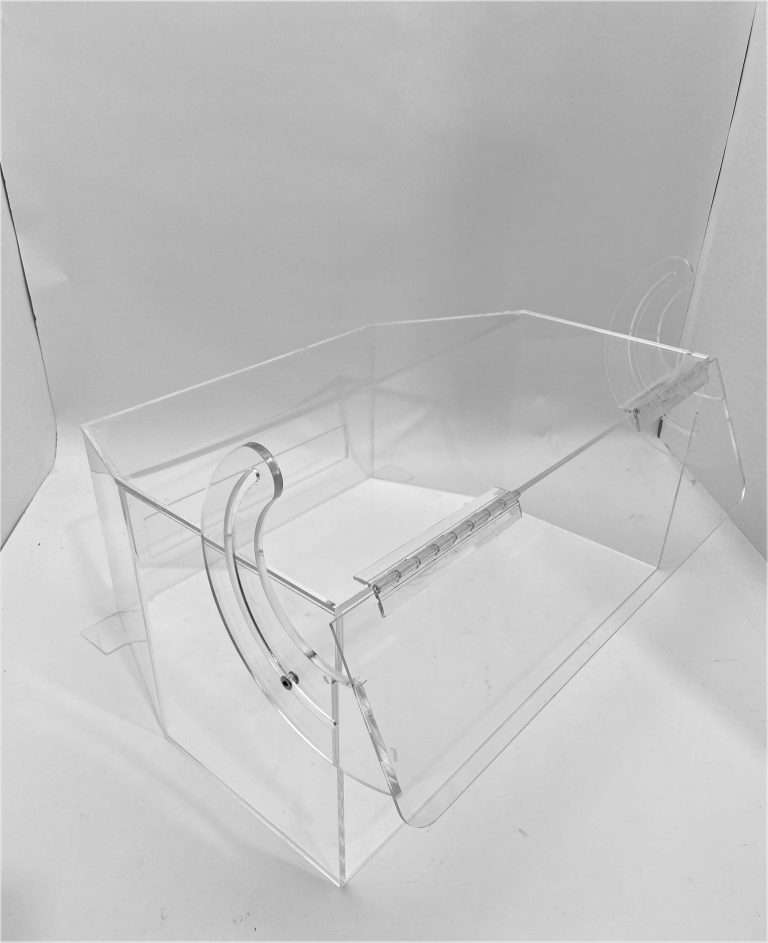
The enclosure drawn to the instrument’s chassis dimensions fits the instrument beautifully and fails the Tuesday after install: the power cable needs a bend radius the back panel doesn’t allow, the heat the unit sheds has nowhere to go, and the one knob the postdoc adjusts daily is sealed behind clear acrylic like an exhibit. The fix: dimension the working envelope, not the chassis — the instrument plus its cables at their real bend radii, its clearance for airflow, the reach path to every control someone touches, and the swing of anything that opens. Ports, cutouts, and access doors are routine fabrication; they are only cheap when they’re on the drawing. The access-geometry thinking is the same one in instrument enclosures and equipment covers.
2. No thought for how it gets cleaned
Labs clean aggressively, and the standard wipe-down chemistry of many benches will attack acrylic’s surface — the damage appears as crazing, a web of fine surface cracks, rather than dramatic failure, and by the time it’s visible it’s permanent (the mechanism: crazing, causes and prevention). The fix costs one line in the RFQ: state the lab’s actual wipe-down chemistry, so the material conversation can respond to it — sometimes the answer is acrylic plus a cleaning-protocol note for the bench staff (the safe protocol is published in cleaning and maintaining acrylic), and sometimes the honest answer is a different plastic for that bench, a decision tree covered in acrylic in universities and research labs.
3. Over-tolerancing everything
The metal-shop reflex: put a tight tolerance on every dimension, because that’s what rigor looks like. On a bonded plastic enclosure it buys nothing — most dimensions on an enclosure have no mating partner, and blanket tight callouts slow the quote while adding cost precisely nowhere it matters. The fix: general tolerances per the published Fabrication Tolerances standard, with explicit callouts only on the features that actually mate — the port that fits a flange, the track a door rides in, the holes that match an instrument’s bolt pattern. Where a drawing needs this discipline spelled out, tolerance callouts on drawings is the template.
4. Ordering one when the lab needs five
Custom work re-incurs its setup every time it’s ordered cold: the file review, the process planning, the production setup. When the same enclosure is ordered one at a time over a year — because each bench waited for budget, or nobody asked the other groups — the lab pays that setup repeatedly for identical parts. The fix: if other benches or sister labs will plausibly want the same unit, say so up front. The quote can reflect the batch, the drawings stay on file so later units are built from the same record (how reorders work), and the lab gets consistency across benches as a side effect.
5. Leaving performance requirements implicit
Anything safety- or containment-adjacent — shields, guards, enclosures around energized or hazardous work — carries requirements that someone must own explicitly. The failure mode is the implicit version: “it’s a safety shield” appears in an email, nothing appears on the drawing, and two parties hold different assumptions about what was promised. The fix: the lab specifies the requirement in writing — the standard, the thickness, the geometry its safety review calls for — and verifies performance on its side; the fabricator’s scope is explicit: build exactly that specification, to the stated dimensions and tolerances. That division is how the responsibility actually works — the lab’s safety officer knows the hazard and the governing rules; no fabricator can. Put the requirement on the drawing and both sides can meet it cleanly.
6. Discovering the PO deadline at week three
University and institutional purchasing has its own clocks — grant end dates, fiscal-year closeouts, PO expirations — and they surface late because the person who owns the science and the person who owns the money are rarely the same person. The classic version: fabrication is scheduled, and then someone mentions the funds expire this month. The fix: name the real deadline in the first email, whatever it is, and have the scheduling conversation then. Work enters our schedule as projects are approved and paid, and a hard institutional date is exactly what the Production Scheduling tiers are for — a deadline named at RFQ time can be scheduled honestly; one named at week three leaves far fewer options. Universities buy from us through the ordinary process — a PO number can be referenced on the invoice for the lab’s records. Grant-funded work has its own calendar quirks, covered in grant deadlines and production scheduling.
The pattern across all six: nothing here is a fabrication problem, and everything here is an information problem — the working envelope, the chemistry, the mating features, the batch, the requirement, the date. Put those six answers in the RFQ and a lab enclosure becomes what it should be: a precise box, built once, that disappears into the work it protects.